Paper Harvest Report
Date range: April 07, 2026
3 top-tier papers selected out of 102 total publications
Today’s Highlights
A Nature Water study of Ecuador’s 2023–2024 energy crisis shows that building out solar and wind power — and exploiting an “extreme-year synergy” with hydropower — could largely compensate dry-year generation deficits and safeguard reservoir levels, with broad implications for hydro-dependent nations across Latin America. In Geophysical Research Letters, a global assessment finds that ~28.5% of the world population (~2.6 billion people) will face heightened compound hot-dry extremes under current ~2.7 °C policies, with tropical islands and low-income countries bearing disproportionate risk. A third GRL paper compares conventional and multiscale CESM2 configurations, showing that cloud-resolving (MMF) embedding fixes longstanding biases in light-precipitation frequency and aerosol wet-removal rates — a meaningful improvement for Earth-system climate forcing estimates.
Table of Contents
- Today’s Highlights
- Top-Tier Journal Papers
- Variable renewables fortify Ecuador’s power system against recurrences of drought-driven energy crises
- Compound Hot‐Dry Extremes Amplify Disproportionate Climate Risks for Low‐Income Nations
- Assessing Aerosol Wet Removal Efficiency in Conventional and Multiscale Modeling Framework Configurations of the Community Earth System Model
- Statistics
- Filtering Criteria
Top-Tier Journal Papers
Variable renewables fortify Ecuador’s power system against recurrences of drought-driven energy crises
Authors: Sebastian Sterl, Luis E. Pineda, Tinne Mast, Yuliana Rodríguez, Paul Muñoz, Wim Thiery
Journal: Nature Water · DOI: 10.1038/s44221-026-00617-w
Matched topics: river, reservoir, drought, hydropower
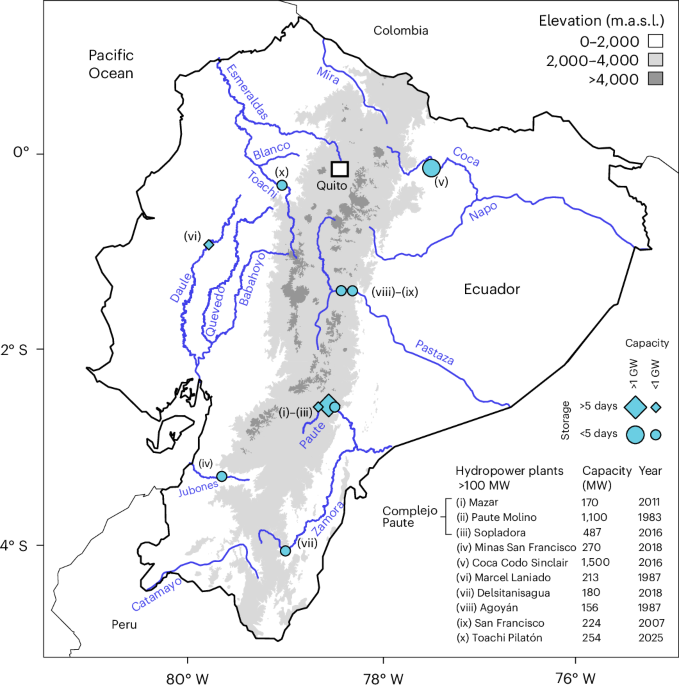
In 2023–2024, two successive failed rainy seasons plunged hydropower-dependent Ecuador into an unprecedented energy crisis. As rivers ran dry and hydropower generation dwindled, the Ecuadorian government had to implement daily nationwide electricity cuts throughout 2024 to keep reservoirs from emptying completely. In this Article, we show that opting for a strong build-out of solar and wind power—often criticized for their variability and purported lack of dependability—could become an important element in the fortification of Ecuador’s power system against similar future droughts. Exploiting a newly identified resource complementarity, dubbed extreme-year synergy, a coupling of hydropower operation with solar and wind energy generation would safeguard reservoir levels in critical periods, largely compensate the dry-year hydropower deficit, and substantially reduce the need for thermal backup capacity and generation, quantified through a new concept, the ‘indirect’ capacity credit of variable renewables. The identified opportunities have ramifications for hydro-dependent nations across Latin America and elsewhere.
Compound Hot‐Dry Extremes Amplify Disproportionate Climate Risks for Low‐Income Nations
Authors: Di Cai, Gerrit Lohmann, Xianyao Chen, Monica Ionita
Journal: Geophysical Research Letters · DOI: 10.1029/2025gl118822
Matched topics: drought, climate change
Droughts and hot extremes, individually and in combination, are intensifying, driven by anthropogenic greenhouse gas emissions. However, a globally comparable and cross‐national assessment of the future risks posed by these events remains a critical gap. Our analysis shows that under current policies, leading to ∼2.7°C warming by 2100, 28.5% ± 9.3% of the global population (roughly 2.6 ± 0.9 billion people) may face heightened compound hot‐dry extremes. Based on present‐day per capita emissions, the cumulative lifetime emissions of ∼3.4 average global citizens (or ∼1.2 average US citizens) could expose one individual to these conditions by the end of century. Tropical island nations are expected to experience the most severe increases in compound hot‐dry extremes. More critically, low‐income countries, despite contributing minimally to global emissions, are projected to suffer more frequently than high‐income countries. These findings underscore the urgent need for equity‐focused, immediate policy action to address the socio‐economic disparities exacerbated by climate change.
Assessing Aerosol Wet Removal Efficiency in Conventional and Multiscale Modeling Framework Configurations of the Community Earth System Model
Authors: Alison Banks, Gabriel J. Kooperman, Yangyang Xu, Wei‐Ching Hsu
Journal: Geophysical Research Letters · DOI: 10.1029/2025gl117102
Matched topics: earth system model
Aerosol particles play a crucial role in the global climate by absorbing and scattering radiation and influencing cloud properties. This study explores the role of resolved convection on precipitation and subsequent removal by wet deposition of aerosol in the Community Earth System Model (CESM2.1.0) by comparing two configurations with distinct representations of precipitation characteristics. We contrast the conventionally parameterized configuration (CAM5‐ZM) with the multiscale modeling framework (CAM5‐MMF), which uses embedded 4 km cloud‐resolving models to explicitly simulate convection. We compare the results against observations from Integrated Multi‐satellite Retrievals for Global Precipitation Measurement, MODIS, MERRA2 Reanalysis, and simulations from GEOS‐Chem and Aerocom. The CAM5‐MMF configuration better captures the frequency and intensity of rainfall by reducing the overestimation of light precipitation frequency in CAM5‐ZM. Improved precipitation frequency is associated with aerosol lifetimes and removal rates that better match observations, leading to higher black carbon and primary organic matter burdens, with implications for future climate forcing and air quality changes.
Statistics
| Metric | Count |
|---|---|
| Journals searched | 11 |
| Total papers fetched | 102 |
| Passed deterministic filter | 11 |
| After LLM relevance filtering | 3 |
| Rejected (not relevant) | 8 |
Papers by journal
| Journal | Papers |
|---|---|
| Nature Water | 1 |
| Geophysical Research Letters | 2 |
Filtering Criteria
Topics: hydrology, hydrologic model, river, runoff, streamflow, reservoir, water management, flood, drought, seasonal, land surface model, climate change, hydropower, surface water, irrigation, earth system model, estuary, coastal, freshwater discharge, river plume, ocean biogeochemistry, marine heatwave, paleohydrology, paleoclimate, Quaternary, Holocene, Pleistocene, fluvial geomorphology, river terrace, loess, drainage network, river capture, landscape evolution, luminescence dating
Fields: engineering, environmental science, computer science, geology, geography