Paper Harvest Report
Date range: March 25, 2026
7 top-tier papers selected out of 125 total publications
Today’s Highlights
A major Nature study reveals that extreme climate outcomes—including severe droughts and precipitation extremes—can occur even under moderate 2 °C warming, challenging the assumption that worst-case impacts require high warming levels. A companion Nature paper demonstrates critical gaps in the global precipitation observing network, with only 13.4% of land meeting WMO monitoring standards, directly limiting climate change impact assessments. On the groundwater front, a GRL study applies machine learning to characterize fine-scale groundwater recharge dynamics under ecological water replenishment in Beijing’s Yongding River basin.
Table of Contents
- Today’s Highlights
- Top-Tier Journal Papers
- Moderate global warming does not rule out extreme global climate outcomes
- Decadal-scale droughts disrupted the African Humid Period in the Sahara
- Precipitation observing network gaps limit climate change impact assessment
- Fine-Scale Characterization of Groundwater Recharge Efficacy Under Ecological Water Replenishment: An AI-Enhanced Learning Framework Benchmarked Against Traditional Geostatistics
- Climate-Driven Tree Mortality Alters the Timing and Magnitude of Forest Carbon Uptake in the Conterminous United States
- Projected Earlier Australian Summer Monsoon Onset Associated With Faster Eastward MJO Propagation
- ENSO phase transition enables prediction of winter North Atlantic Oscillation one year ahead
- Statistics
- Filtering Criteria
Top-Tier Journal Papers
Moderate global warming does not rule out extreme global climate outcomes
Authors: Emanuele Bevacqua, Erich Fischer, Jana Sillmann, Jakob Zscheischler
Journal: Nature · DOI: 10.1038/s41586-026-10237-9
Matched topics: drought, river
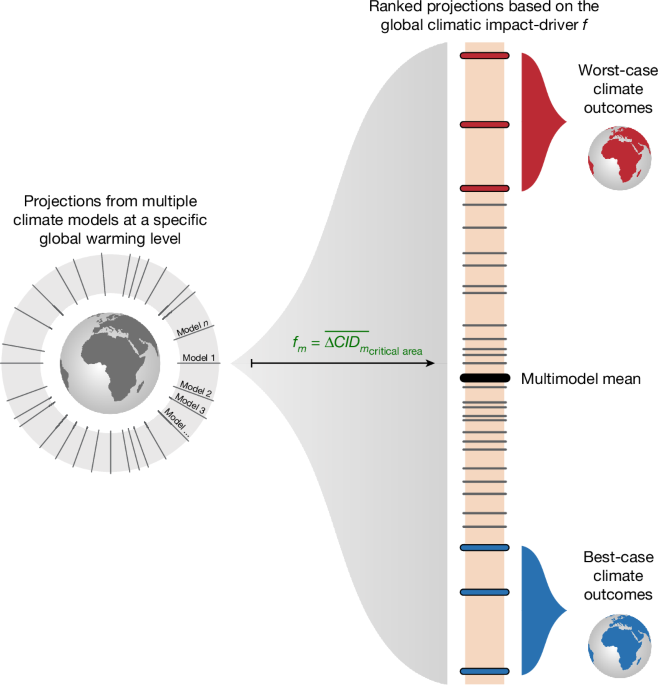
Effectively communicating worst-case projections of global future climate—hereinafter referred to as worst-case climate outcomes—is essential for risk assessment and developing robust adaptation strategies to global warming. Yet, current approaches for identifying spatially consistent climate outcomes are limited, with worst-case global climates typically communicated via the average of climate model projections at high global warming levels, such as 3 °C or 4 °C above the preindustrial era. Here we show that extreme global climate outcomes may occur even under moderate 2 °C warming for several sectors. For droughts in global key breadbasket regions, precipitation extremes over highly populated areas and fire weather extremes across forests, global climatic impact-drivers at 2 °C of global warming may turn out to be much more extreme than model-averaged projections at 3 °C or 4 °C warming. We derive these results by identifying sector-specific, spatially consistent potential high- and low-impact global climate outcomes through spatially averaging projected sector-relevant climatic impact-drivers across key global regions. Our approach can easily be adapted to a wide range of sectors to support the improvement of sector-specific climate risk assessment and to inform climate policy. As global warming approaches 1.5 °C, these findings underscore the urgency of rapid mitigation to limit warming well below 2 °C, as even a 2 °C world may entail severe impacts.
Decadal-scale droughts disrupted the African Humid Period in the Sahara
Authors: Florence Sylvestre, Martin Melles, Volker Wennrich, Michèle Dinies, Françoise Chalié, Didier Swingedouw et al.
Journal: Nature · DOI: 10.1038/s41586-026-10336-7
Matched topics: drought
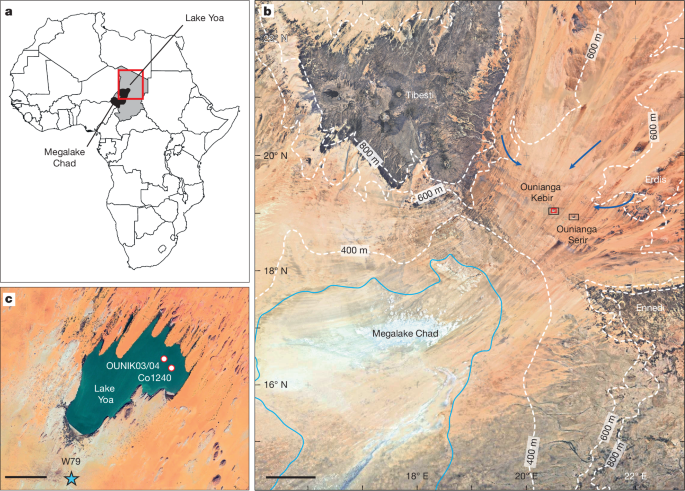
During the early and mid-Holocene, the Sahara and Sahel experienced a humid phase, the so-called African Humid Period (AHP)1. The AHP started around 14.8 thousand years before present (kyr bp), peaked between 9.0 kyr bp and 6.0 kyr bp and experienced short-lived droughts of as yet poorly constrained age and duration2,3. Here we show that the AHP was punctuated by two droughts of decadal-scale duration, at about 9.3 kyr bp and 8.2 kyr bp, and another more tentatively identified drought at 6.3 kyr bp. Our findings arise from a multiproxy time series from the annually layered (varved) sedimentary archive of Lake Yoa in Chad, which covers the past 10.25 kyr continuously. During the more prominent drought at 8.2 kyr bp, pollen and diatom data, along with leaf-wax isotopes and geochemical source area indicators, imply that a reduction in local precipitation and fluvial supply to Lake Yoa caused a lake-level drop accompanied by an expansion of reed belts along the shore. The proxy data, together with our climate simulations, suggest that the 8.2 kyr bp drought event was a direct and rapid response to a potential weakening of the Atlantic Meridional Overturning Circulation (AMOC) owing to sudden freshwater input into the North Atlantic. The results underline the need for improved decadal predictions4 to better anticipate such drought risks in the future. Sedimentary time-series data of Lake Yoa in Chad covering the past 10.25 thousand years (kyr) show that the mid-Holocene African Humid Period experienced several decadal-scale droughts, caused by sudden inputs of freshwater into the North Atlantic.
Precipitation observing network gaps limit climate change impact assessment
Authors: Jiajia Su, Chiyuan Miao, Francis Zwiers, Hylke Beck, Phil Jones, Qiaohong Sun et al.
Journal: Nature · DOI: 10.1038/s41586-026-10300-5
Matched topics: climate change
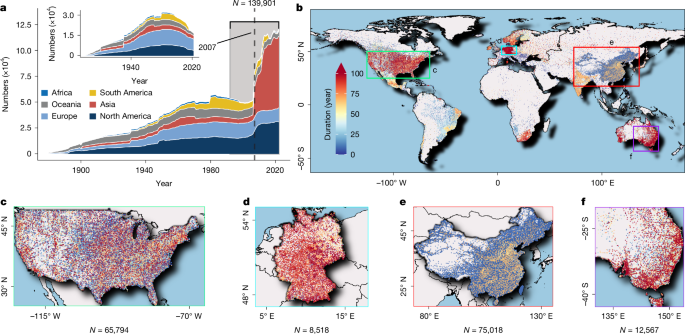
Reliable future climate projections and water deficiency assessments require precipitation observations that are both spatially comprehensive and temporally complete, yet many global regions still suffer from observation sparsity. Here we evaluate the distribution of 221,483 internationally exchanged precipitation gauges worldwide, with records across 1900-2022, and further explore where new gauges are most needed under different scenarios. We find that at present only 13.4% of the global land surface meets the World Meteorological Organization requirements for annual precipitation monitoring, indicating widespread scarcity that has serious socioeconomic implications. Europe has the highest continental gauge density (2.4 gauges per 1,000 km²), with Germany leading among countries over 50,000 km² (22.4 gauges per 1,000 km²). Globally, 25% of land surface already requires urgent expansion of gauge networks because of climate variability, including northern South America, northern North America, Central Africa and southern Asia. Considering projected precipitation changes and socioeconomic conditions under a high-emission scenario further identifies high-need regions in India, Greenland, Bolivia and China because of climate sensitivity and socioeconomic vulnerabilities, increasing this share to 32.1% of global land. Our findings highlight important gaps in global precipitation monitoring that require strategic investments in new gauges and underscore the need for open data access.
Fine-Scale Characterization of Groundwater Recharge Efficacy Under Ecological Water Replenishment: An AI-Enhanced Learning Framework Benchmarked Against Traditional Geostatistics
Authors: Weican Li, Chengpeng Lu, Jingsi Zhu, Yu Liu, Chengcheng Wu, Shuangyu Liu et al.
Journal: Geophysical Research Letters · DOI: 10.1029/2025gl121538
Matched topics: river
Ecological Water Replenishment (EWR) is critical for restoring depleted aquifers, yet quantifying its spatiotemporal impacts remains challenging. Leveraging multi-source data sets and Light Gradient Boosting Machine (LightGBM), this study reconstructs high-resolution (250 m) groundwater level dynamics in the Yongding River basin, Beijing, and quantifies feature importance. We find that the LightGBM simulations significantly outperforms traditional Kriging interpolation. While dynamic hydrological variables dominate model construction, static geographic factors are crucial for maintaining spatial consistency, effectively mitigating the limitations of purely data-driven approaches. Results show that while EWR drives groundwater recovery, its efficiency exhibits distinct diminishing marginal returns. This study elucidates the spatiotemporal impacts of EWR, offering scientific insights to optimize water allocation strategies in water-scarce regions.
Climate-Driven Tree Mortality Alters the Timing and Magnitude of Forest Carbon Uptake in the Conterminous United States
Authors: Linqing Yang, William R. L. Anderegg
Journal: Geophysical Research Letters · DOI: 10.1029/2025gl120746
Matched topics: climate change, river
Earth’s forests are major carbon sinks that slow human-driven climate change, yet climate-sensitive disturbances are increasing tree mortality and altering carbon cycling. We assessed how forest mortality influences the magnitude, phenology, and drivers of carbon fluxes across the conterminous United States. Using changes in normalized difference vegetation index (NDVI) and terrestrial gross primary production (GPP) before and after mortality events across spatial scales, we found mortality consistently advanced the midpoints of Greenup and Greendown. At fine (30 m) to moderate (500 m) resolutions, 60%–80% of sites showed declines in NDVI or GPP, whereas only ~15% did so at coarse (8 km) resolution, revealing strong scale dependence. Temperature or vapor pressure deficit (VPD) was the dominant factor modulating these responses. Overall, tree mortality affects both the timing and magnitude of forest carbon fluxes and underscores the critical importance of spatial resolution for detecting and modeling mortality effects.
Projected Earlier Australian Summer Monsoon Onset Associated With Faster Eastward MJO Propagation
Authors: Lu Wang, Xiya Yang
Journal: Geophysical Research Letters · DOI: 10.1029/2025gl119329
Matched topics: seasonal, climate change
The response of the Australian Summer Monsoon (AUSM) onset to global warming remains a critical and unresolved question. Here, using Coupled Model Intercomparison Project Phase 6 (CMIP6) multi-model simulations under the SSP5-8.5 scenario, we project a robust earlier onset by about 5 days by the late 21st century. Unlike traditional explanations that invoke mean-state sea surface temperature changes, our results highlight the important role of the Madden–Julian Oscillation (MJO). Because the AUSM onset is typically preceded by the first austral-spring MJO event entering the Australian sector, an earlier monsoon onset under warming is closely linked to the earlier arrival of this event. This shift is likely associated with a projected acceleration of the MJO’s eastward propagation. These findings underscore the influence of intraseasonal variability on future regional climate changes and provide new insight into monsoon predictability under global warming.
ENSO phase transition enables prediction of winter North Atlantic Oscillation one year ahead
Authors: Kiwook Kim, Myong-In Lee, Adam A. Scaife, Doug M. Smith
Journal: Nature Communications · DOI: 10.1038/s41467-026-70646-2
Matched topics: seasonal
The winter North Atlantic Oscillation (NAO) is a dominant mode of climate variability affecting temperature and precipitation across the Northern Hemisphere, yet its prediction at seasonal-to-decadal (S2D) lead times remains challenging. Here, using multi-year hindcasts from a multi-model ensemble initialized on 1 November for 1962–2019, we show that NAO skill one year ahead improves significantly when the El Niño–Southern Oscillation (ENSO) undergoes a phase transition next year. This improvement is linked to the northward propagation of anomalous atmospheric angular momentum, which dynamically organizes the NAO and is captured in reanalysis and models. During ENSO transition years, prediction skill increases with ensemble size, and when more than 10 members are used, the forecasts display the signal-to-noise paradox. These findings highlight the potential for enhanced one-year NAO predictability when ENSO transitions are present and large ensemble sizes are used in S2D prediction systems, given the skillful prediction of ENSO phase transitions at one-year lead times by multi-model ensembles.

Statistics
| Metric | Count |
|---|---|
| Journals searched | 11 |
| Total papers fetched | 125 |
| Passed deterministic filter | 11 |
| After LLM relevance filtering | 7 |
| Rejected (not relevant) | 4 |
Papers by journal
| Journal | Papers |
|---|---|
| Nature | 3 |
| Geophysical Research Letters | 3 |
| Nature Communications | 1 |
Filtering Criteria
Topics: flood, drought, river, reservoir, streamflow, runoff, precipitation, rainfall, groundwater, watershed, catchment, hydrology, hydrologic, hydraulic, water resources, water management, water quality, dam, levee, irrigation, hydropower, snow, glacier, ice sheet, permafrost, evapotranspiration, soil moisture, land surface, climate change, sea level, seasonal, El Nino, ENSO
Fields: Hydrology, Environmental Science, Geography, Geology