Paper Harvest Report
Date range: April 17, 2026
2 top-tier papers selected out of 87 total publications
Today’s Highlights
SWOT satellite provided the first direct high-resolution 2D measurements of a large outburst flood during the 2023 Kakhovka Dam failure, revealing that current 2D flood models significantly underestimate flood stage even with improved bathymetry. Meanwhile, a study in Nature Climate Change shows that ocean warming is weakening sea–land breeze circulation in coastal megacities, reducing their natural cooling and ventilation capacity.
Table of Contents
Top-Tier Journal Papers
SWOT Satellite Observations of the Kakhovka Dam Break Flood Highlight Limitations of Outburst Flood Models
Authors: K. E. Lehnigk, T. M. Pavelsky, K. A. Lang
Journal: Geophysical Research Letters · DOI: 10.1029/2025gl120832
Matched topics: reservoir, flood
The 6 June 2023 failure of the Kakhovka Dam generated a catastrophic outburst flood, leading to loss of life and infrastructure damage. During the flood, daily measurements of water surface elevation were collected by the SWOT satellite, providing the first direct, high‐resolution 2D measurements of a large outburst flood. We compared SWOT measurements with 2D numerical hydraulic simulations to evaluate the ability of flood models to reproduce outburst flood stage. Simulations reliant on minimally constrained, globally available reservoir bathymetry significantly underestimate flood stage. Modifying reservoir and channel bathymetry to reflect geomorphology produces better agreement with SWOT, and is closer to in situ reservoir bed elevations, yet still fails to reproduce both flood stage and timing. SWOT’s unprecedented direct measurements suggest that 2D flood models may not capture outburst flood dynamics at a level useful for geohazard decision making and demonstrate the need for more observational validation of this destructive and costly geohazard.
Ocean warming weakens the sea–land breeze in coastal megacities
Authors: Yunting Xiao, Yaxin Liu, Yu Nie, Yongjie Fang, Hao Liu et al.
Journal: Nature Climate Change · DOI: 10.1038/s41558-026-02618-9
Matched topics: coastal
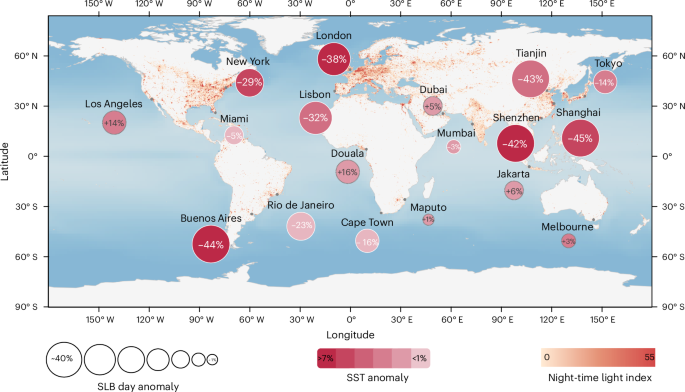
The sea–land breeze (SLB), driven by thermal contrasts between sea and land, forms a key circulation system in coastal cities which mitigates urban heat islands, improves air quality and supports urban habitability. However, the influence of climate change on these dynamics remains poorly understood. Here we reveal a widespread weakening of the SLB across global coastal megacities from 1979 to 2023, linked to ocean warming outpacing land warming during all seasons. Accelerated ocean warming reduces the sea–land thermal contrast, weakening the SLB. We find that weakened SLBs are associated with amplified daytime heat stress and degraded air quality, especially in tropical and subtropical megacities. As ocean warming accelerates, continued SLB weakening may threaten the liveability of coastal urban areas. These findings call for urgently integrating coastal atmospheric dynamics into urban climate adaptation strategies.
Statistics
| Metric | Count |
|---|---|
| Journals searched | 11 |
| Total papers fetched | 87 |
| Passed deterministic filter | 7 |
| After LLM relevance filtering | 2 |
| Rejected (not relevant) | 5 |
Papers by journal
| Journal | Papers |
|---|---|
| Geophysical Research Letters | 1 |
| Nature Climate Change | 1 |
Filtering Criteria
Topics: hydrology, hydrologic model, river, runoff, streamflow, reservoir, water management, flood, drought, seasonal, land surface model, climate change, hydropower, surface water, irrigation, earth system model, estuary, coastal, freshwater discharge, river plume, ocean biogeochemistry, marine heatwave, paleohydrology, paleoclimate, Quaternary, Holocene, Pleistocene, fluvial geomorphology, river terrace, loess, drainage network, river capture, landscape evolution, luminescence dating
Fields: engineering, environmental science, computer science, geology, geography