Paper Harvest Report
Date range: May 13, 2026
3 top-tier papers selected out of 143 total publications
Today’s Highlights
A landmark Nature study reveals that concentrated precipitation — fewer, heavier rainfall events — dries the land surface as strongly as increased total precipitation wets it, projecting abnormally dry conditions for 27% of the global population at ~2°C warming. Meanwhile, new research shows seasonal sea-level variability is set to reshape coastal ecosystems, and a multi-model analysis unpacks regionally divergent drivers behind freshwater planetary boundary transgressions across streamflow and soil moisture.
Table of Contents
Top-Tier Journal Papers
More concentrated precipitation decreases terrestrial water storage
Authors: Corey S. Lesk, Justin S. Mankin
Journal: Nature · DOI: 10.1038/s41586-026-10487-7
Matched topics: irrigation
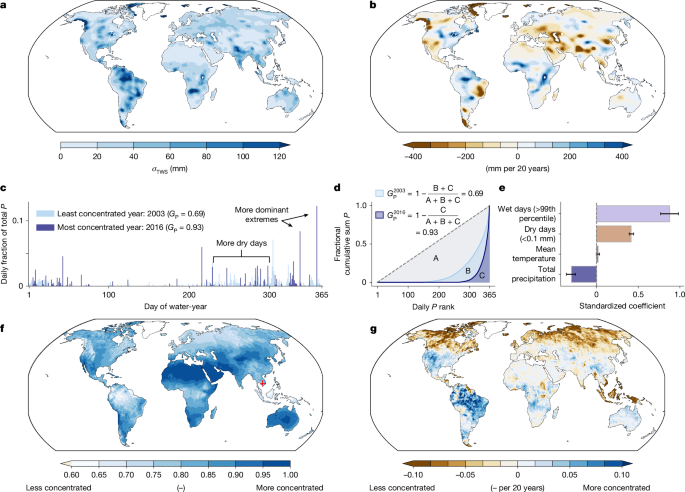
Terrestrial water availability is a key determinant of human and ecosystem well-being1,2. Apart from mean precipitation and evaporation changes3,4, it is unknown how daily-scale precipitation concentration into fewer, heavier events affects hydrologic partitioning and the land water balance5–9. Here we show observationally that more concentrated precipitation decreases land water availability across all climates globally, a drying effect as strong in magnitude as the wetting effect of increased total precipitation. Simple and complex land-surface models recover the observed effect, whereas idealized simulations show that it arises from enhanced evaporation caused by hydrologic partitioning changes at the land surface. Projected terrestrial water storage impacts of warming-driven precipitation concentration at about 2 °C of warming shift the land surface to abnormally dry conditions (≥0.5 standard deviation10) for 27% of the global population, independent of any total precipitation or irrigation changes. Our results show new key determinants of the land water balance, highlighting its sensitivity to the temporal distribution of precipitation, with broad implications for future water availability.
Future changes in seasonal sea-level variability could reshape coastal ecosystems
Authors: Tim H. J. Hermans, Gregory S. Fivash, Jim van Belzen
Journal: Nature Climate Change · DOI: 10.1038/s41558-026-02631-y
Matched topics: seasonal, coastal

Abstract not available.
Regionally divergent drivers behind transgressions of the freshwater change planetary boundary
Authors: Vili Virkki, Lauren Seaby Andersen, Sofie te Wierik et al.
Journal: Nature Communications · DOI: 10.1038/s41467-026-73051-x
Matched topics: river, streamflow
Human-driven freshwater change relates to elevated Earth system risks, which motivates analysis to better understand its global characteristics. Here, we analyse global and regional patterns of anomalous conditions and their drivers in streamflow (blue water) and soil moisture (green water), building on the recently updated planetary boundary for freshwater change (PB-FW). Our data consist of updated scenario simulations from a large ensemble of global hydrological models covering years 1901–2019. During the early twenty-first century, PB-FW transgression has increased across its blue and green water components. Climate has increasingly become the dominant global influence on dry and wet streamflow and soil moisture deviations from pre-industrial-like baseline conditions. Amongst the regionally variable change in blue and green water, direct human forcings (encompassing land and water use changes) intensify particularly dry deviations, whereas wet deviations are mainly climate-driven. Regional unpacking of the global PB-FW transgression improves understanding of the extent, degree and drivers of global freshwater change, guiding mitigation and adaptation strategies in response to it, and is a notable advancement for analysing PBs across scales.
Statistics
| Metric | Count |
|---|---|
| Journals searched | 11 |
| Total papers fetched | 143 |
| Passed deterministic filter | 3 |
| After LLM relevance filtering | 3 |
| Rejected (not relevant) | 0 |
Papers by journal
| Journal | Papers |
|---|---|
| Nature | 1 |
| Nature Climate Change | 1 |
| Nature Communications | 1 |
Filtering Criteria
Topics: hydrology, hydrologic model, river, runoff, streamflow, reservoir, water management, flood, drought, seasonal, land surface model, climate change, hydropower, surface water, irrigation, earth system model, estuary, coastal, freshwater discharge, river plume, ocean biogeochemistry, marine heatwave, paleohydrology, paleoclimate, Quaternary, Holocene, Pleistocene, fluvial geomorphology, river terrace, loess, drainage network, river capture, landscape evolution, luminescence dating
Fields: engineering, environmental science, computer science, geology, geography