Paper Harvest Report
Date range: April 28, 2026
3 top-tier papers selected out of 104 total publications
Today’s Highlights
Desert dust exerts nearly twice the longwave radiative heating estimated by current climate models, with omissions of longwave scattering and super-coarse dust biasing modeled surface energy fluxes and precipitation (Nature Communications). A global hackathon brought nearly 700 participants together to analyze km-scale Earth System Models, trialing new technologies to democratize access to high-resolution climate information (BAMS). AI is increasingly positioned to bridge disciplinary gaps in climate change research (Nature Climate Change).
Table of Contents
Top-Tier Journal Papers
Desert dust exerts twice the longwave radiative heating estimated by climate models
Authors: Jasper F. Kok, Ashok K. Gupta, Amato T. Evan, Carlos Pérez García-Pando, Longlei Li, Adeyemi A. Adebiyi et al.
Journal: Nature Communications · DOI: 10.1038/s41467-026-70952-9
Matched topics: climate change
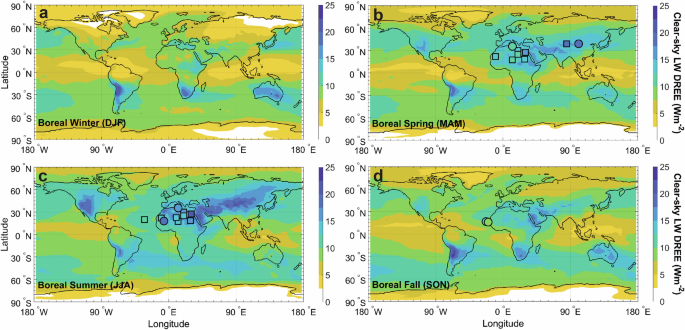
Although desert dust is the most abundant atmospheric aerosol by mass, its longwave radiative effects remain unclear, obscuring the impacts of dust on weather and climate. Here, using a data-driven analytical model constrained by observations, we show that scattering and absorption of longwave radiation by dust heats the planet by +0.25 ± 0.06 W m⁻² (90% confidence). This is nearly twice the value simulated by current climate models, which omit longwave scattering and underrepresent super coarse dust (diameter > 10 μm). These omissions bias modeled surface energy fluxes, cloud responses, precipitation, and atmospheric circulation. At the global scale, the sign and magnitude of the net dust direct radiative effect remain uncertain, with additional work needed to constrain shortwave cooling effects. These findings show that improving the representation of dust interactions with longwave radiation can improve weather forecasting and is essential to resolve the role of dust in climate change.
Hacking Km-Scale Models: A Participative Model for Climate Information
Authors: Andrew Gettelman, Pier Luigi Vidale, Bjorn Stevens, Florian Ziemen, Zhe Feng, Heike Konow et al.
Journal: Bulletin of the American Meteorological Society · DOI: 10.1175/bams-d-25-0183.1
Matched topics: earth system model

In May 2025 nearly 700 participants from all around the world coalesced at 10 regional nodes, and a few satellite nodes, to take part in a global hackathon of km-scale (horizontal grid spacing < 10 km) regional and global Earth System Models. Exciting science is emerging from these efforts, ranging across novel model analysis, new ways of integrating with satellite data, and emulation with machine learning. New technologies were trialed that enable the community to work in new and complementary ways to democratize access to global information at a local scale from a set of the world’s highest-resolution climate models. The hackathon demonstrated how exascale data can be organized to be accessible to anyone. Fundamentally, the community could apply these techniques and technologies to move towards more participative models for co-production and delivery of diverse sources of climate information for climate scientists and citizens alike.
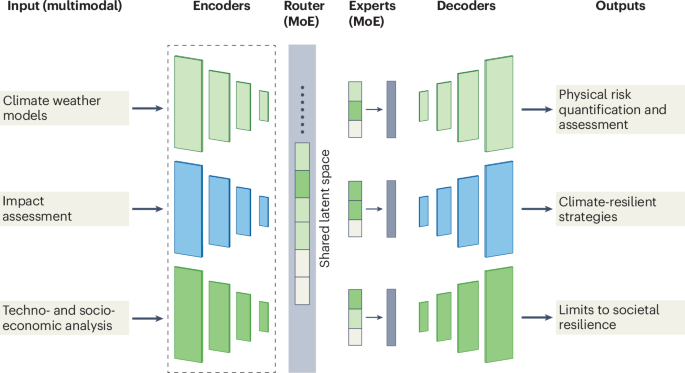
Artificial intelligence to support cross-disciplinary climate change research
Authors: Yang Ou, Carlos Rodriguez-Pardo, Alaa Al Khourdajie, Joeri Rogelj, Peijie Zhou, S. Karthik Mukkavilli et al.
Journal: Nature Climate Change · DOI: 10.1038/s41558-026-02624-x
Matched topics: climate change
Abstract not available.
Statistics
| Metric | Count |
|---|---|
| Journals searched | 11 |
| Total papers fetched | 104 |
| Passed deterministic filter | 8 |
| After LLM relevance filtering | 3 |
| Rejected (not relevant) | 5 |
Papers by journal
| Journal | Papers |
|---|---|
| Nature Communications | 1 |
| Bulletin of the American Meteorological Society | 1 |
| Nature Climate Change | 1 |
Filtering Criteria
Topics: hydrology, hydrologic model, river, runoff, streamflow, reservoir, water management, flood, drought, seasonal, land surface model, climate change, hydropower, surface water, irrigation, earth system model, estuary, coastal, freshwater discharge, river plume, ocean biogeochemistry, marine heatwave, paleohydrology, paleoclimate, Quaternary, Holocene, Pleistocene, fluvial geomorphology, river terrace, loess, drainage network, river capture, landscape evolution, luminescence dating
Fields: engineering, environmental science, computer science, geology, geography