Paper Harvest Report
Date range: May 18, 2026
2 top-tier papers selected out of 101 total publications
Today’s Highlights
Machine learning models trained on 470 field observations reveal that small water bodies contribute a disproportionate share of inland greenhouse gas emissions, amplified by agricultural nutrient loading. Meanwhile, a global analysis of riverine fish across 108 hydrological basins shows that biodiversity and habitat complexity provide critical insurance against anthropogenic destabilization.
Table of Contents
Top-Tier Journal Papers
Human amplification of climate-induced greenhouse gas emissions from global small water bodies
Authors: Xuliang Zhuang, Xiaoxuan Liu, Shengjun Xu, Xu Wang, Aamer Ali Shah et al.
Journal: Proceedings of the National Academy of Sciences · DOI: 10.1073/pnas.2537678123
Matched topics: climate change
Human activities amplify climate-induced greenhouse gas emissions from small water bodies (SWBs), creating critical but unquantified feedback in the global carbon cycle. Here, by training machine learning models on 470 field observations and upscaling to a global database of 3.28 million water bodies, we quantify this human amplification, which drives SWBs to emit 84.5 Tg CO 2 y −1 and 11.0 Tg CH 4 y −1 , a disproportionate share of total inland water emissions (15% of CO 2 and 28% of CH 4 ) from only 6% of Earth’s surface area. This amplification is primarily fueled by agricultural nutrient loading and land use intensity, which elevate CH 4 fluxes in agricultural catchments five times higher than those in forested systems. Future projections show this synergy will increase emissions by up to 30% (CO 2 ) and 14% (CH 4 ) by 2100 under SSP5-8.5, whereas sustainable pathways (SSP1-2.6) could mitigate this emission acceleration through nutrient mitigation efforts, a largely neglected feedback process in current climate change assessments.
Biodiversity and habitat complexity buffer the destabilizing effects of anthropogenic activities on riverine fish communities
Authors: Fei Ma, Hong Huang, Qi Yang, Florian Altermatt, Pubin Hong et al.
Journal: Nature Communications · DOI: 10.1038/s41467-026-73311-w
Matched topics: river
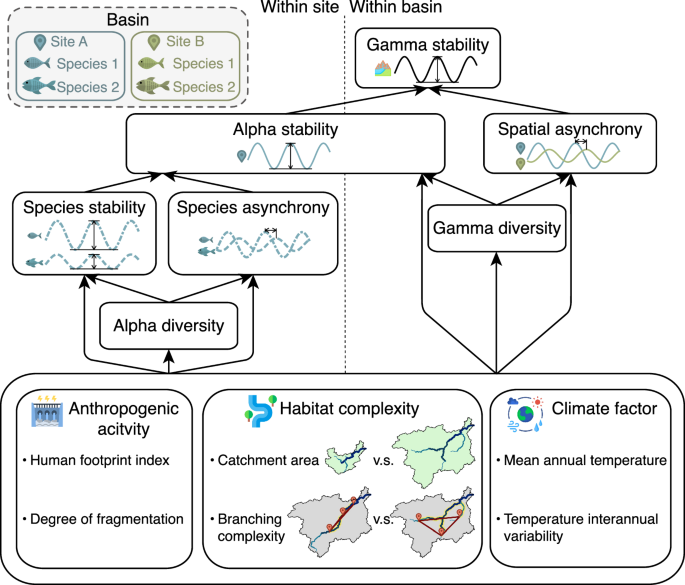
Riverine fish communities are essential for the functioning of aquatic ecosystems and provide important ecosystem services for fisheries. Yet, anthropogenic environmental changes pose threats to fish communities and result in population collapses and reduced yields, underscoring the need to understand their stability from local to regional scales. In this study, we leverage long-term observational data of riverine fish communities in 108 hydrological basins across the globe to determine how anthropogenic activity, biodiversity, and habitat complexity jointly influence riverine fish community stability (i.e., temporal invariability of total fish abundance) at the site and basin scales. Our analyses show that anthropogenic activities represented by human footprint index decrease fish community stability across spatial scales; however, biodiversity and habitat complexity buffer these destabilizing effects by providing insurance effects at both site and basin scales. Specifically, biodiversity has consistently stabilizing effects across scales through enhancing the asynchrony within and/or among fish communities. At the basin scale, greater habitat area increases gamma stability by enhancing spatial community asynchrony. Our findings underscore the importance of conserving both fish biodiversity and habitat complexity to sustain the stability of riverine fish communities in the Anthropocene.
Statistics
| Metric | Count |
|---|---|
| Journals searched | 11 |
| Total papers fetched | 101 |
| Passed deterministic filter | 8 |
| After LLM relevance filtering | 2 |
| Rejected (not relevant) | 6 |
| AI for Science items picked | 0 |
Papers by journal
| Journal | Papers |
|---|---|
| Proceedings of the National Academy of Sciences | 1 |
| Nature Communications | 1 |
Filtering Criteria
Topics: hydrology, hydrologic model, river, runoff, streamflow, reservoir, water management, flood, drought, seasonal, land surface model, climate change, hydropower, surface water, irrigation, earth system model, estuary, coastal, freshwater discharge, river plume, ocean biogeochemistry, marine heatwave, paleohydrology, paleoclimate, Quaternary, Holocene, Pleistocene, fluvial geomorphology, river terrace, loess, drainage network, river capture, landscape evolution, luminescence dating
Fields: engineering, environmental science, computer science, geology, geography