Paper Harvest Report
Date range: July 14, 2026
3 top-tier papers selected out of 89 total publications
Today’s Highlights
Three papers today. A Geophysical Research Letters study finds that the unprecedented spring wetting over western Central Asia during 1988–2007 was dominated by internal climate variability—North Atlantic sea-surface temperature variability drove 44.8% of the wetting trend by exciting a Eurasian Rossby wave train, far exceeding the externally forced contribution (21.7%), and removing this signal reduces near-term hydroclimate projection uncertainty by 28%. Two Nature Geoscience papers examine precipitation seasonality: one uses high-resolution sediment core imaging to reconstruct past monsoon variability, while another reveals reduced tropical rain-band north-south asymmetry through the seasonal cycle with implications for the global precipitation distribution.
Table of Contents
Top-Tier Journal Papers
Unprecedented Wetting Over Western Central Asia Dominated by Internal Climate Variability
Authors: Yu Ren, Jianping Huang, Haipeng Yu, Xiaolu Fan, Kangjie Ma, Xin Wang et al.
Journal: Geophysical Research Letters · DOI: 10.1029/2026gl122792
Matched topics: river, climate change, seasonal
Spring precipitation over western Central Asia (SCAP) experienced an abrupt and unprecedented wetting during 1988–2007, yet the relative contributions of external forcing and internal variability to this change and the underlying drivers remain unclear. Using observation data sets and large ensemble simulations, our study demonstrates that this wetting is dominated by internal climate variability. Specifically, mid‐high‐latitude North Atlantic sea‐surface temperature (NAS) variability drives interdecadal SCAP changes by exciting a Eurasian Rossby wave train, which enhances ascent motion over western Central Asia and promotes moisture transport into the region. A negative‐to‐positive NAS phase transition explains 44.82% of the 1988–2007 wetting, far exceeding the externally forced contribution (21.72%). Under mid‐intensity emission scenario, removing NAS‐related rainfall variability reduces near‐term SCAP projection uncertainty by 28.39%, highlighting NAS as a key source of predictability for hydroclimate risk on western Central Asia.
High-resolution imaging of a sediment core reconstructs past monsoon seasonality
Authors: Authors not available
Journal: Nature Geoscience · DOI: 10.1038/s41561-026-02025-x
Matched topics: seasonal, paleohydrology
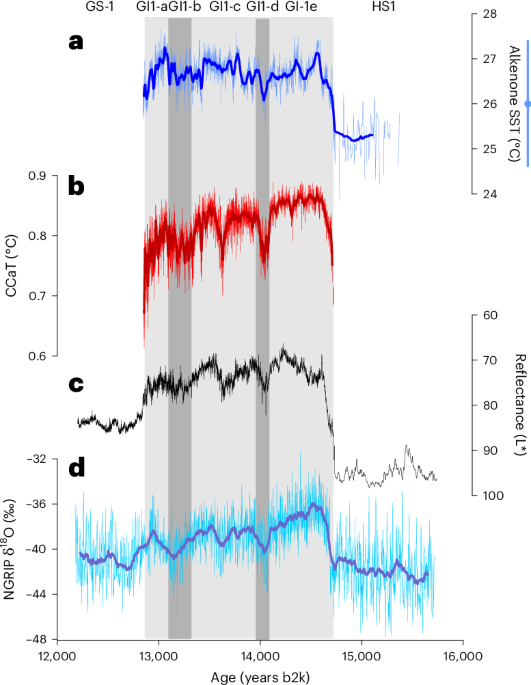
Abstract not available.
Reduced tropical rain-band asymmetry through the seasonal cycle
Authors: Pengcheng Zhang, Shang-Ping Xie, Nicholas J. Lutsko, Yuko M. Okumura, Da Yang, Tiffany A. Shaw
Journal: Nature Geoscience · DOI: 10.1038/s41561-026-02046-6
Matched topics: seasonal
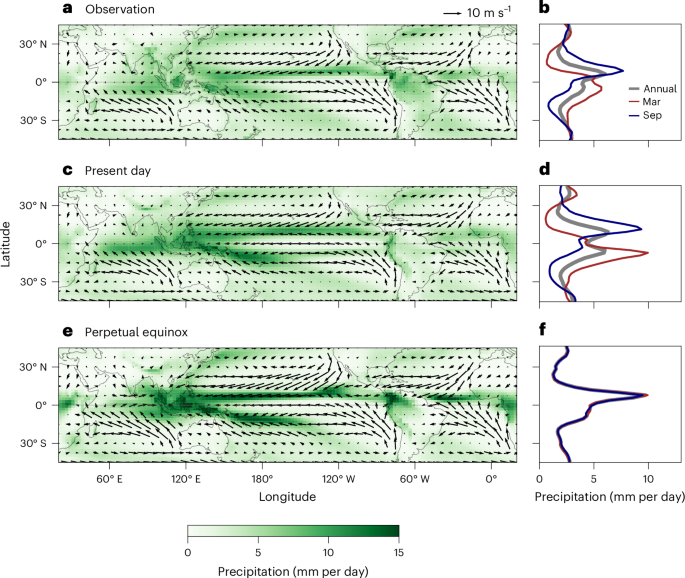
Abstract not available.
Statistics
| Metric | Count |
|---|---|
| Journals searched | 11 |
| Total papers fetched | 89 |
| Passed deterministic filter | 5 |
| After LLM relevance filtering | 3 |
| Rejected (not relevant) | 86 |
| AI for Science items picked | 0 |
Papers by journal
| Journal | Papers |
|---|---|
| Geophysical Research Letters | 1 |
| Nature Geoscience | 2 |
Filtering Criteria
Topics: hydrology, hydrologic model, river, runoff, streamflow, reservoir, water management, flood, drought, seasonal, land surface model, climate change, hydropower, surface water, irrigation, earth system model, estuary, coastal, freshwater discharge, river plume, ocean biogeochemistry, marine heatwave, paleohydrology, paleoclimate, Quaternary, Holocene, Pleistocene, fluvial geomorphology, river terrace, loess, drainage network, river capture, landscape evolution, luminescence dating
Fields: engineering, environmental science, computer science, geology, geography