Paper Harvest Report
Date range: June 22, 2026
3 top-tier papers selected out of 90 total publications
Today’s Highlights
Today’s three papers span river biogeochemistry, drought predictability, and deep-time monsoon dynamics. A PNAS study using a national-scale machine-learning framework finds that hydrologic connectivity strongly regulates riverine N2O hot spots and hot moments across the contiguous US, with the Midwest Corn Belt emerging as a major emission hotspot during high-flow periods. A Geophysical Research Letters paper links the prolonged 2020-2023 droughts across Central-West Asia, East Africa, and North America to consecutive La Niña events, identifying the tropical Pacific as a source of multi-year drought predictability. A Nature Geoscience study reconstructs contrasting summer and winter South Asian monsoon drivers across the last deglaciation from an Arabian Sea sediment core, separating high-latitude and global-temperature controls on monsoon wind strength.
Table of Contents
Top-Tier Journal Papers
Hydrologic connectivity amplifies riverine N2O emission hot spots and hot moments across the contiguous United States
Authors: Minpeng Hu, Zhongjie Yu, Timothy J. Griffis, Kelly Aho, Yucang Wang, Jie Yang et al.
Journal: Proceedings of the National Academy of Sciences · DOI: 10.1073/pnas.2524113123
Matched topics: river, seasonal
Riverine nitrous oxide (N2O) emissions constitute a significant yet uncertain component of global greenhouse gas budgets. Integrating approximately 3,600 observations across the contiguous United States (CONUS), we present a monthly resolved, national-scale estimate of riverine N2O emissions (60.7 Gg N2O-N y-1; 95% CI: 41.9 to 71.2) using a machine-learning framework. Our analysis reveals that enhanced hydrologic connectivity strongly regulates nitrogen and N2O delivery to streams, driving emission hot moments during high-flow periods, especially in nutrient-rich low-order streams. The Midwest Corn Belt is identified as a major emission hot spot, where seasonal increases in connectivity (e.g., late-winter thaws and postharvest rainfall) amplify riverine emissions relative to direct soil emissions. Our watershed-specific EF5r (0.0005 to 0.029) exceeds the IPCC default (0.0026) by more than twofold on average and up to 10-fold in intensively managed watersheds. These findings highlight the importance of incorporating hydrologic connectivity and nitrogen transport into climate models and watershed nitrogen management strategies.
Pan-Regional Prolonged Droughts Linked to Consecutive La Niña Events
Authors: Teng Zhang, Wenjun Zhang, Feng Jiang, Suqiong Hu, Shanlei Sun, Fei-Fei Jin, Haishan Chen
Journal: Geophysical Research Letters · DOI: 10.1029/2026gl122176
Matched topics: drought
From 2020 to 2023, prolonged droughts affected Central-West Asia, East Africa, and North America, causing widespread disruptions to regional hydroclimate and ecosystems. These droughts coincided with an unusually persistent cold state of the tropical Pacific associated with consecutive La Niña events. Here we demonstrate a robust historical linkage between consecutive La Niña events and pan-regional prolonged droughts across these regions. We show that the sustained cooling of tropical Pacific sea surface temperatures maintains large-scale atmospheric circulation anomalies that suppress moisture transport and precipitation, leading to persistent regional water deficits. Land-atmosphere feedbacks further amplify drought persistence in East Africa, while suppressing drought conditions in the other regions. In addition, observations indicate that the increasing frequency of consecutive La Niña events in recent decades coincides with a rise in prolonged drought occurrence across these regions. These results highlight the tropical Pacific as a key oceanic source of predictability for pan-regional drought variability.
Contrasting drivers of South Asian summer and winter monsoon evolution during the last deglaciation
Authors: Igor Obreht, Andreas Lückge, Mahyar Mohtadi, Petra Zahajská, Enno Schefuß, Denis Scholz et al.
Journal: Nature Geoscience · DOI: 10.1038/s41561-026-02023-z
Matched topics: river, seasonal
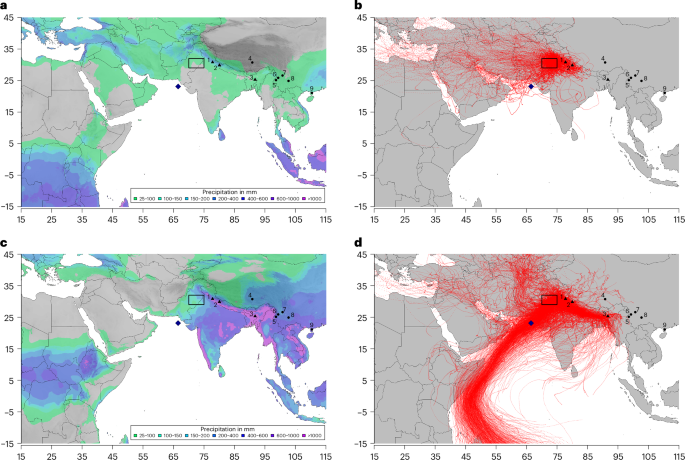
Reconstructing past South Asian monsoon dynamics, which governs wind and rainfall patterns across the Indian subcontinent, is crucial for understanding low-latitude climate. Constraining monsoon drivers requires separating summer and winter components in palaeoclimate archives, but this remains challenging because proxy signals usually integrate seasonal signals. The northeastern Arabian Sea provides a unique setting in which sedimentary and geochemical proxies are driven by the summer monsoon, while sea surface temperature is primarily controlled by winter monsoon winds. Here we employed mass spectrometry and hyperspectral imaging on a sediment core off Pakistan to reconstruct subdecadal changes in sea surface temperature and marine primary production during the last deglaciation (~16,000-12,000 years ago). Atmospheric humidity and vegetation changes were additionally assessed by plant-wax isotope analyses on a subset of samples. We show that summer monsoon winds were driven by the Northern Hemisphere high-latitude climate on centennial-to-millennial timescales. Winter monsoon was primarily characterized by a millennial-scale decline in wind strength driven by increasing global temperatures, with superimposed centennial-scale variability. We identified an inverse relationship between winter monsoon wind strength and the amount of winter non-monsoonal precipitation. Mechanistic insights of seasonal monsoon dynamics improved interpretation of regional palaeoprecipitation records and may enhance climate model performances in low latitudes.
AI for Science
How AI is changing research
- AI systems devise hypotheses and ways to test them (Nature, 2026-06-30) — AI agents are now collaborating to generate biomedical hypotheses and design the experiments to test them, edging toward a discovery cycle where AI participates at every step from idea to analysis — a template that’s just as applicable to hypothesis-driven hydrology (e.g. automated generation and screening of candidate drivers for streamflow anomalies) as it is to biomedicine.
Cross-discipline sparks
- RNAbpFlow: base pair-augmented SE(3) flow matching for conditional RNA 3D structure generation (Nature, 2026-06-30) — The method conditions a flow-matching generative model on known base-pairing constraints to produce physically valid 3D RNA structures. The same recipe — conditional generation under hard physical constraints — is the core ingredient behind emerging precipitation/snowpack downscaling and ensemble weather generators (e.g. diffusion- and flow-matching-based super-resolution of climate fields); a small earth-science team could now plausibly build a constrained flow-matching generator for, say, river-channel geometry or catchment DEM super-resolution that respects mass-conservation and flow-direction constraints the way RNAbpFlow respects base-pairing, without needing to hand-design a bespoke physics-informed architecture from scratch.
Statistics
| Metric | Count |
|---|---|
| Journals searched | 11 |
| Total papers fetched | 90 |
| Passed deterministic filter | 9 |
| After LLM relevance filtering | 3 |
| Rejected (not relevant) | 6 |
| AI for Science items picked | 2 |
Papers by journal
| Journal | Papers |
|---|---|
| Proceedings of the National Academy of Sciences | 1 |
| Geophysical Research Letters | 1 |
| Nature Geoscience | 1 |
Filtering Criteria
Topics: hydrology, hydrologic model, river, runoff, streamflow, reservoir, water management, flood, drought, seasonal, land surface model, climate change, hydropower, surface water, irrigation, earth system model, estuary, coastal, freshwater discharge, river plume, ocean biogeochemistry, marine heatwave, paleohydrology, paleoclimate, Quaternary, Holocene, Pleistocene, fluvial geomorphology, river terrace, loess, drainage network, river capture, landscape evolution, luminescence dating
Fields: engineering, environmental science, computer science, geology, geography