Paper Harvest Report
Date range: June 20, 2026
1 top-tier papers selected out of 52 total publications
Today’s Highlights
Today’s pick is a paleoclimate reconstruction from a stalagmite in central-eastern South America, using nucleation-assisted microthermometry to track cave temperatures across the last deglaciation. The record shows a 5.8 ± 0.3°C warming from the Last Glacial Maximum to the early Holocene, broadly tracking atmospheric CO2 and Antarctic temperatures, with an abrupt regional warming pulse across the Antarctic Cold Reversal-Younger Dryas transition linked to weakening of the Atlantic Meridional Overturning Circulation. Even the most rapid warming captured in the record was slower than projected future long-term warming — a useful benchmark for how unusual today’s greenhouse forcing is.
Table of Contents
Top-Tier Journal Papers
Rapid warming in South America during the last deglaciation
Authors: A. Ampuero, N. M. Stríkis, A. N. Meckler, Y. Krüger, M. Vuille, H. Vonhof et al.
Journal: Nature Communications · DOI: 10.1038/s41467-026-74093-x
Matched topics: paleoclimate, Holocene
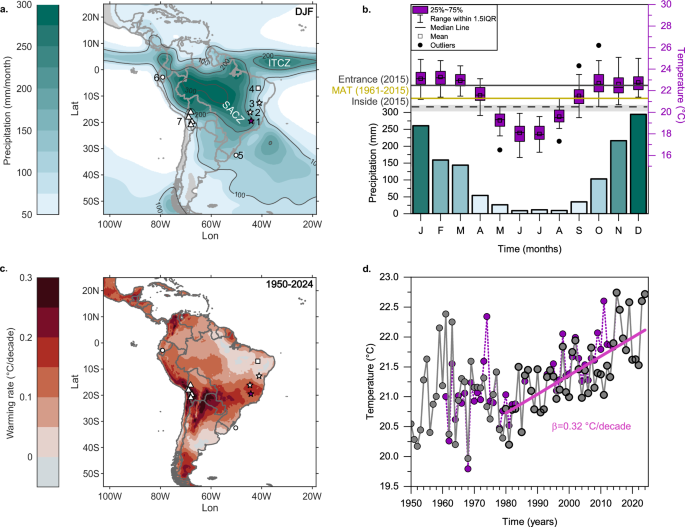
Understanding tropical land temperature response to rising atmospheric CO2 in the past is crucial for better constraining future climate projections. However, the evolution of regional land temperatures on paleoclimate timescales remains uncertain due to the paucity of precise records. Here we reconstructed temperatures across the last deglaciation using nucleation-assisted microthermometry in a stalagmite from central-eastern South America. We show that cave temperatures increased by 5.8 ± 0.3 °C (2 standard errors of the mean, SEM) from the Last Glacial Maximum to the early Holocene, broadly tracking global atmospheric CO2 and Antarctic temperatures. Our results reveal an abrupt regional warming across the Antarctic Cold Reversal-Younger Dryas (ACR-YD) transition, linked to the weakening of the Atlantic Meridional overturning circulation (AMOC). Notably, the most rapid warming at our cave was still slower than projections of future long-term warming, highlighting the unprecedented nature of the current greenhouse gas forcing.
Statistics
| Metric | Count |
|---|---|
| Journals searched | 11 |
| Total papers fetched | 52 |
| Passed deterministic filter | 2 |
| After LLM relevance filtering | 1 |
| Rejected (not relevant) | 1 |
| AI for Science items picked | 0 |
Papers by journal
| Journal | Papers |
|---|---|
| Nature Communications | 1 |
Filtering Criteria
Topics: hydrology, hydrologic model, river, runoff, streamflow, reservoir, water management, flood, drought, seasonal, land surface model, climate change, hydropower, surface water, irrigation, earth system model, estuary, coastal, freshwater discharge, river plume, ocean biogeochemistry, marine heatwave, paleohydrology, paleoclimate, Quaternary, Holocene, Pleistocene, fluvial geomorphology, river terrace, loess, drainage network, river capture, landscape evolution, luminescence dating
Fields: engineering, environmental science, computer science, geology, geography