Paper Harvest Report
Date range: June 16, 2026
5 top-tier papers selected out of 103 total publications
Today’s Highlights
A passive seismic network in a snowmelt-driven mountain watershed shows that ambient seismic velocity changes can track groundwater and ecohydrological dynamics in near real time, and a new generative emulator slashes the cost of testing untested CO2-emission pathways in Earth System Model climate projections. In the Arctic, warming-driven shifts in ocean circulation are turning the Beaufort Gyre into a basin-wide collection point for river-borne freshwater and contaminants from Siberia, while a companion paleoclimate study links orbital-scale Rossby wave dynamics over the Indo-Pacific Warm Pool to precipitation anomalies across the Asia-Pacific region. A global hydrokinetic-energy assessment also identifies hundreds of Arctic river communities that could swap diesel generators for dam-free in-stream turbines.
Table of Contents
- Today’s Highlights
- Top-Tier Journal Papers
- Seismic Velocity Variations Illustrate Hydrological and Ecohydrological Processes in a Mountain Watershed
- Interactive Climate Projection via Conditional Generative AI
- Warming transforms the western Arctic Ocean into a hub of drifting matter
- Rossby wave-modulated orbital precipitation anomalies in the Asia-Pacific region
- The in-stream renewable energy potential of rivers for remote communities in the global Arctic
- AI for Science
- Statistics
- Filtering Criteria
Top-Tier Journal Papers
Seismic Velocity Variations Illustrate Hydrological and Ecohydrological Processes in a Mountain Watershed
Authors: Kuan‐Fu Feng, Fan‐Chi Lin, Sara Warix, Paul D. Brooks, Qicheng Zeng, Tonie van Dam
Journal: Geophysical Research Letters · DOI: 10.1029/2025gl121378
Matched topics: water management, seasonal
We employ passive seismic interferometry to study seismic hydrological responses in a snowmelt‐driven, semi‐arid catchment. Seismic velocity changes (dv/v) at 2–4 Hz and 4–8 Hz are analyzed from six stations along a hillslope transect between May and November 2023 and compared to precipitation, soil moisture, and groundwater level timeseries. Variation in dv/v correlates with groundwater level and mirrors seasonal catchment wetting and evapotranspiration. Correlations between dv/v and groundwater are stronger at stations on the cooler, wetter, north‐facing hillslope than on the warmer, drier, south‐facing hillslope, consistent with expected recharge and evapotranspiration patterns. Different dv/v behaviors across two bands suggest depth‐dependent pore‐pressure changes, outlining different hydrologic zones. These findings highlight the utility of dv/v measurements in detecting laterally supplied water inputs, providing insight into local vertical water losses, effectively tracking groundwater–vegetation interactions, and supporting ecohydrological research and water management in semi‐arid snowmelt systems.
Interactive Climate Projection via Conditional Generative AI
Authors: Chengjie Sun, Zijie Guo, Pumeng Lyu, Fenghua Ling, Jing‐Jia Luo
Journal: Geophysical Research Letters · DOI: 10.1029/2026gl123578
Matched topics: earth system model
Dynamical Earth System Models are extremely expensive, requiring ∼10^6 core‐hours for century‐scale simulations. This limits climate projections to only a few Shared Socioeconomic Pathways (SSPs) and leaves numerous policy trajectories unexplored. Here, we develop an external forcing boundary‐constrained generative emulator trained on CMIP6 model outputs, enabling rapid projection of temperature, precipitation and sea‐surface height under arbitrary CO2 forcing pathways. The model learns the continuous manifold of future climate states by conditioning on the physical boundary defined by two extreme scenarios (SSP1‐1.9 and SSP5‐8.5). It can reconstruct climate responses under pathways held out during training (e.g., SSP2‐4.5). We further apply it to four newly constructed CO2 pathways (higher‐emission, lower‐emission, overshoot, and step‐change) to demonstrate its generalization capability across distinct forcings. This allows us to capture regional shifts in extreme events and threshold timings. The emulator substantially reduces computational demand and provides a high‐throughput, user‐driven platform for evaluating flexible mitigation strategies.
Warming transforms the western Arctic Ocean into a hub of drifting matter
Authors: Kou Wang, Caili Liu, Qi Shu, Claudia Wekerle, Caixia Wang, Qiang Wang
Journal: Nature Communications · DOI: 10.1038/s41467-026-74439-5
Matched topics: river, reservoir, coastal
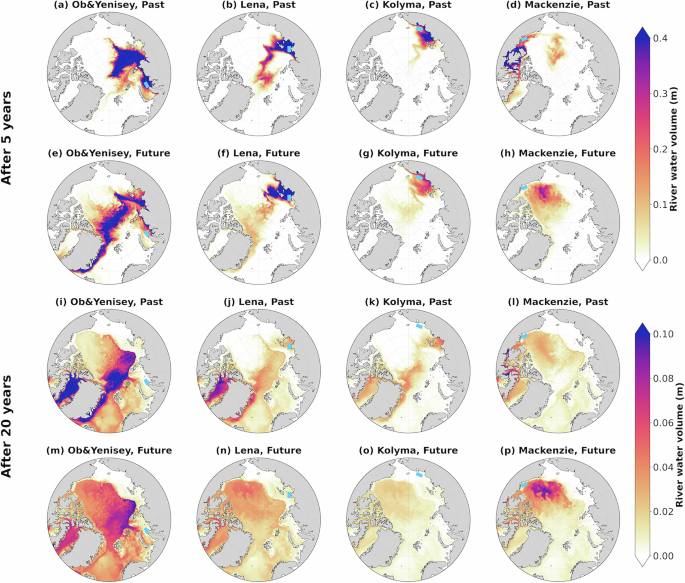
The Arctic Ocean is increasingly stressed by anthropogenic pollution and rapid environmental change. River discharge plays a crucial role in this transition by delivering freshwater, nutrients, carbon, and contaminants to the ocean. Yet how river-borne materials will spread through the Arctic under future climate warming remains unclear. Here we show that climate warming accelerates and expands the dispersal of Arctic river waters and drifting materials through multi-scale changes in ocean circulation linked to sea-ice decline and reduced upper-ocean density. Stronger ocean eddy activity and altered wind-driven circulation transform the Beaufort Gyre from a predominantly regional reservoir into a pan-Arctic convergence zone that efficiently accumulates river-derived materials from Siberia. Meanwhile, intensified boundary currents and Transpolar Drift accelerate the export of Siberian discharge toward the North Atlantic. Together, these circulation changes greatly increase cross-basin connectivity, with broad implications for marine ecosystems in the northern high-latitude oceans and for Arctic coastal communities. Climate warming is transforming the western Arctic Ocean into a major accumulation zone of drifting materials from across the Arctic while accelerating connections between Siberian shelves and the North Atlantic.
Rossby wave-modulated orbital precipitation anomalies in the Asia-Pacific region
Authors: Zhaojie Yu, Lina Song, Zhimin Jian, Mahyar Mohtadi, Yair Rosenthal, Kyung-Sook Yun et al.
Journal: Nature Communications · DOI: 10.1038/s41467-026-74368-3
Matched topics: seasonal

Orbital-scale dynamics of Indo-Pacific Warm Pool (IPWP), Earth’s dominant heat and moisture source, exert far-reaching yet incompletely understood influences on global hydroclimate. Here, by synthesizing sedimentary proxies with transient simulations, we identify a coherent, banded precipitation anomaly across the Asia-Pacific region that cannot be explained by regional dynamics alone. We show that seasonal deep convection over the IPWP excites planetary Rossby waves. On orbital timescales, their integrated effects are consistent with precessional forcing, while precession simultaneously modulates the large-scale atmospheric background state that influences their spatial organization. Guided by summer circulation, the Rossby-wave-related responses extend poleward and reorganize large-scale moisture transport and precipitation across the mid- and high-latitudes. The cumulative wave response and background-state modulation provide a robust dynamical linkage between tropical convection and extratropical hydroclimate on orbital timescales. This mechanism offers a physically consistent interpretation for how low-latitude orbital forcing imprints hydroclimate variability across Pan-Asia via planetary-wave dynamics.
The in-stream renewable energy potential of rivers for remote communities in the global Arctic
Authors: Katelyn Kirby, Colin D. Rennie, Ioan Nistor, Cameron Johnstone, Stephanie Ordoñez-Sánchez, Song Fu et al.
Journal: Nature Communications · DOI: 10.1038/s41467-026-74292-6
Matched topics: river, hydropower

Many Arctic communities rely on diesel-generated electricity, resulting in high costs, environmental impacts, and limited development opportunities. Hydrokinetic energy (HKE), which generates power from flowing water without dams, offers a lower-impact renewable energy alternative to conventional hydropower. Here we identify feasible Arctic communities with suitable river conditions for HKE development and highlight regions with the greatest potential. Using a detailed case study of the Iqaluit Kuunga River in Nunavut, Canada, alongside a global assessment, we identify 325 Arctic communities suitable for HKE deployment. These sites represent a theoretical energy potential of 4,626 megawatt-hours per square metre of turbine area annually under open water conditions. Feasibility varies with the local resource availability, proximity to river sites, and projected diesel offset. Together, these results highlight the potential for HKE to support cleaner, community-based energy systems, and the datasets provide a foundation for targeted renewable energy transitions in Arctic communities.
AI for Science
How AI is changing research
- How GPT-5 helped immunologist Derya Unutmaz solve a 3-year-old mystery (OpenAI, 2026-06-23) — A working immunologist used GPT-5 Pro as a hypothesis-generation partner to crack a multi-year stall on T-cell behavior, the kind of “AI as research collaborator” workflow that’s increasingly viable for any lab without a dedicated computational team.
Statistics
| Metric | Count |
|---|---|
| Journals searched | 11 |
| Total papers fetched | 103 |
| Passed deterministic filter | 10 |
| After LLM relevance filtering | 5 |
| Rejected (not relevant) | 5 |
| AI for Science items picked | 1 |
Papers by journal
| Journal | Papers |
|---|---|
| Nature Communications | 3 |
| Geophysical Research Letters | 2 |
Filtering Criteria
Topics: hydrology, hydrologic model, river, runoff, streamflow, reservoir, water management, flood, drought, seasonal, land surface model, climate change, hydropower, surface water, irrigation, earth system model, estuary, coastal, freshwater discharge, river plume, ocean biogeochemistry, marine heatwave, paleohydrology, paleoclimate, Quaternary, Holocene, Pleistocene, fluvial geomorphology, river terrace, loess, drainage network, river capture, landscape evolution, luminescence dating
Fields: engineering, environmental science, computer science, geology, geography