Paper Harvest Report
Date range: June 19, 2026
1 top-tier papers selected out of 64 total publications
Today’s Highlights
Today’s lone pick reconstructs the chain of events around the end-Permian mass extinction, the most severe biotic crisis in Earth’s history. Using biogeochemical modeling, Bayesian inversion, and multiple proxies, the authors show that vegetation die-off triggered a pulse of continental erosion that buffered early carbon release — resolving the puzzling ~50,000-year lag between the carbon isotope excursion and peak warming — while also flushing riverine phosphorus into the oceans, fueling the marine anoxia that helped precondition the extinction. It’s a striking case of land-surface erosion and river-borne nutrient export directly pacing a global biogeochemical catastrophe.
Table of Contents
Top-Tier Journal Papers
Erosion-driven delayed warming and marine stress prior to the end-Permian mass extinction
Authors: Shihan Li, Jiaheng Shen, Ethan L. Grossman, Shuang Zhang
Journal: Nature Communications · DOI: 10.1038/s41467-026-74636-2
Matched topics: river
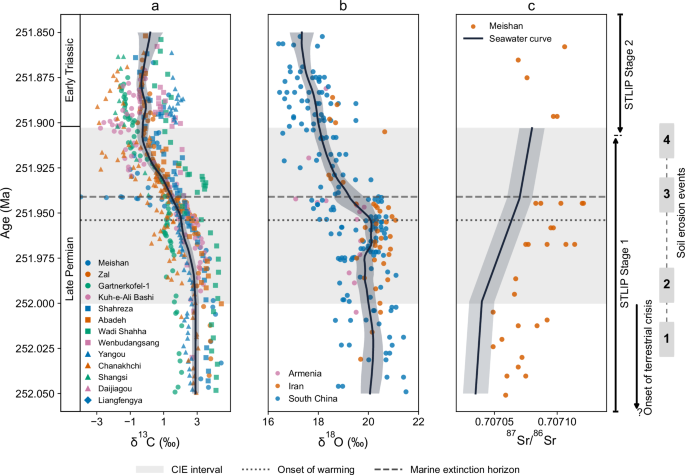
The end-Permian mass extinction (EPME) presents an anomaly: intense global warming lags the onset of the carbon isotope excursion (CIE) by ~50,000 years, challenging the presumed link between carbon cycle perturbations and climate warming. Using biogeochemical modeling, Bayesian inversion, and multiple proxies, here we show that incorporating continental erosion as a forcing term into the hyperthermal models can resolve this decoupling. Enhanced erosion, likely resulting from the terrestrial die-off of vegetation, accelerates continental weathering, which buffers early carbon release and delays global warming. This process also increases riverine phosphorus export to the oceans, fostering gradual marine anoxia and preconditioning the oceans for the extinction event. With these findings, we present a coherent unifying scenario for the EPME environmental dynamics. Furthermore, our study refines the hyperthermal paradigm, offering implications for future climate scenarios. Increased continental erosion during the end-Permian mass extinction buffered carbon emissions, delaying global warming by ~50 kyr and promoting marine anoxia, revealing a key link between ecosystem collapse and climate response.
Statistics
| Metric | Count |
|---|---|
| Journals searched | 11 |
| Total papers fetched | 64 |
| Passed deterministic filter | 5 |
| After LLM relevance filtering | 1 |
| Rejected (not relevant) | 4 |
| AI for Science items picked | 0 |
Papers by journal
| Journal | Papers |
|---|---|
| Nature Communications | 1 |
Filtering Criteria
Topics: hydrology, hydrologic model, river, runoff, streamflow, reservoir, water management, flood, drought, seasonal, land surface model, climate change, hydropower, surface water, irrigation, earth system model, estuary, coastal, freshwater discharge, river plume, ocean biogeochemistry, marine heatwave, paleohydrology, paleoclimate, Quaternary, Holocene, Pleistocene, fluvial geomorphology, river terrace, loess, drainage network, river capture, landscape evolution, luminescence dating
Fields: engineering, environmental science, computer science, geology, geography