Paper Harvest Report
Date range: June 17, 2026
2 top-tier papers selected out of 104 total publications
Today’s Highlights
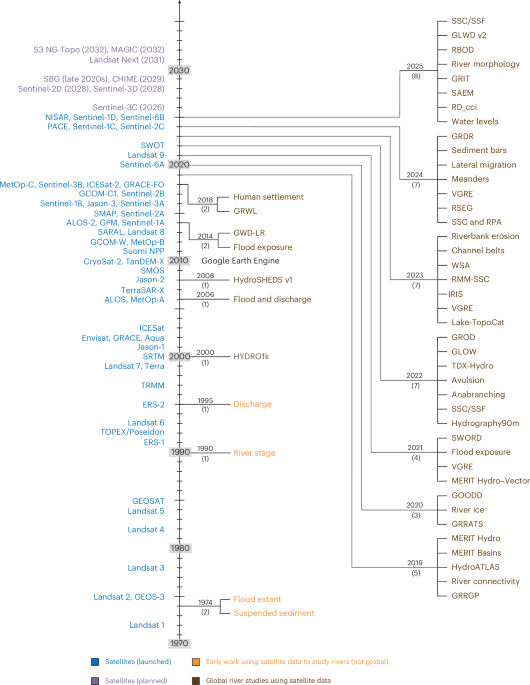
A Nature Water perspective from a large international author group lays out the state of remote sensing for global river science, surveying how satellite observation is reshaping how we measure rivers worldwide. In a complementary finding from the Qinghai-Tibet Plateau, permafrost thaw is shown to simultaneously increase river CO2 emissions and accelerate rock-weathering carbon drawdown — with weathering fluxes already offsetting roughly a third of emissions and potentially overtaking them as thaw continues.
Table of Contents
Top-Tier Journal Papers
Rock weathering can counteract river CO2 emissions induced by permafrost thaw
Authors: Liwei Zhang, Aaron Bufe, Joshua F. Dean, Gerard Rocher-Ros, Ryan A. Sponseller, Emily H. Stanley et al.
Journal: Nature · DOI: 10.1038/s41586-026-10664-8
Matched topics: river
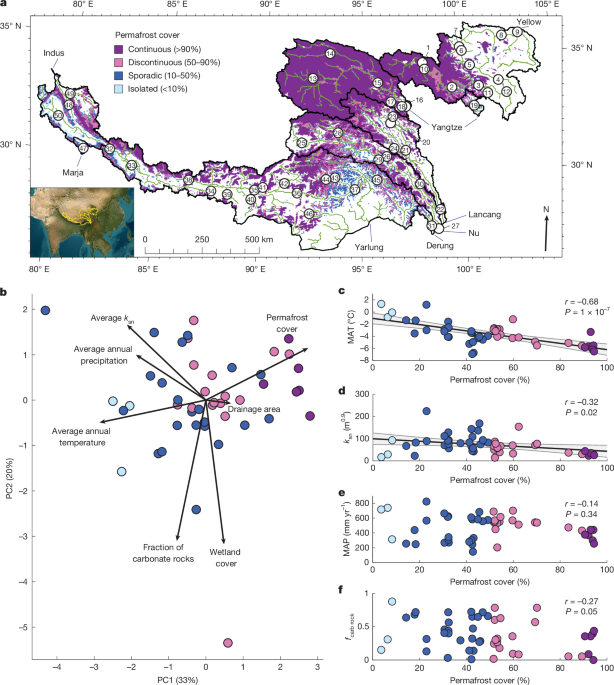
Climate-induced permafrost thaw unlocks large stores of organic carbon that are mineralized and emitted as carbon dioxide (CO2) from rivers to the atmosphere1. Concurrently, warming and permafrost thaw can increase mineral weathering rates, thus affecting the release and sequestration of inorganic carbon2–4. Yet how these biological and geological carbon cycles interact and jointly affect CO2 dynamics (emission compared with drawdown) in permafrost rivers remains unknown5. Here we combine CO2 emissions, organic and inorganic solute concentrations, dual carbon isotopes (δ13C–Δ14C) and geochemical modelling to infer how permafrost thaw may affect river biogeochemistry over decades to centuries across the Qinghai–Tibet Plateau. Leveraging a gradient of thermal permafrost degradation, we find that river CO2 emissions decline, whereas solute fluxes from rock weathering increase with decreasing permafrost cover. Across this region, net CO2 drawdown fluxes from rock weathering are about 35% of river CO2 emissions, varying from around 15% in catchments with continuous permafrost to more than 100% in catchments with discontinuous or isolated permafrost. Thus, carbon fluxes from chemical weathering may become increasingly important with ongoing permafrost thaw, potentially even outpacing river CO2 emissions. Our findings disentangle the interplay between biological and geological carbon fluxes that are important for the cryosphere and the global carbon cycle. Permafrost thaw on the Qinghai–Tibet Plateau increases rock-weathering rates while reducing river CO2 emissions, suggesting geological carbon fluxes may eventually outpace thaw-driven emissions.
Remote sensing and the new global river science
Authors: Dongmei Feng, Xiao Yang, Tamlin M. Pavelsky, George H. Allen, Paul Bates, Colin J. Gleason et al.
Journal: Nature Water · DOI: 10.1038/s44221-026-00665-2
Matched topics: river
Abstract not available.
AI for Science
How AI is changing research
- A global map of seagrass ecosystems (Nature, 2026-06-24) — Combining satellite imagery with machine learning produced the first comprehensive global map of seagrass meadows, revealing widespread loss and degradation since 2019. The same recipe — multispectral imagery plus deep-learning classifiers at planetary scale — is the same one increasingly used for global river-width and surface-water-extent mapping in hydrology.
- AI tool spots antibiotics that fight drug-resistant gonorrhoea (Nature, 2026-06-24) — A machine-learning screen identified candidate therapies against multidrug-resistant Neisseria gonorrhoeae, another case of virtual screening displacing brute-force wet-lab campaigns in early-stage discovery.
- How agents are transforming work (OpenAI, 2026-06-25) — New research on AI agents handling longer, more complex multi-step tasks — useful context for how far autonomous research and data-pipeline agents (including automated literature-harvesting workflows like this one) can be pushed before needing human oversight.
Statistics
| Metric | Count |
|---|---|
| Journals searched | 11 |
| Total papers fetched | 104 |
| Passed deterministic filter | 7 |
| After LLM relevance filtering | 2 |
| Rejected (not relevant) | 5 |
| AI for Science items picked | 3 |
Papers by journal
| Journal | Papers |
|---|---|
| Nature | 1 |
| Nature Water | 1 |
Filtering Criteria
Topics: hydrology, hydrologic model, river, runoff, streamflow, reservoir, water management, flood, drought, seasonal, land surface model, climate change, hydropower, surface water, irrigation, earth system model, estuary, coastal, freshwater discharge, river plume, ocean biogeochemistry, marine heatwave, paleohydrology, paleoclimate, Quaternary, Holocene, Pleistocene, fluvial geomorphology, river terrace, loess, drainage network, river capture, landscape evolution, luminescence dating
Fields: engineering, environmental science, computer science, geology, geography