Paper Harvest Report
Date range: July 07, 2026
1 top-tier paper selected out of 96 total publications
Today’s Highlights
A global synthesis across 281 woody species and 102 forest communities reveals a counterintuitive pattern: soils with more organic carbon are dominated by younger, faster-cycling carbon, not older stabilized pools. The persistence of soil organic matter — measured by radiocarbon signatures — declines as soil carbon content increases, driven primarily by plant carbon inputs rather than by microbial carbon use efficiency. These findings call for Earth system models to explicitly represent plant carbon inputs and microbially mediated stabilization pathways to improve climate-feedback projections.
Table of Contents
Top-Tier Journal Papers
Declines in organic matter persistence with increased soil carbon
Authors: Guang Zhao, Chao Liang, Zhihua Liu, Nan Cong, Zhoutao Zheng, Edith Bai et al.
Journal: Nature Communications · DOI: 10.1038/s41467-026-75185-4
Matched topics: earth system model
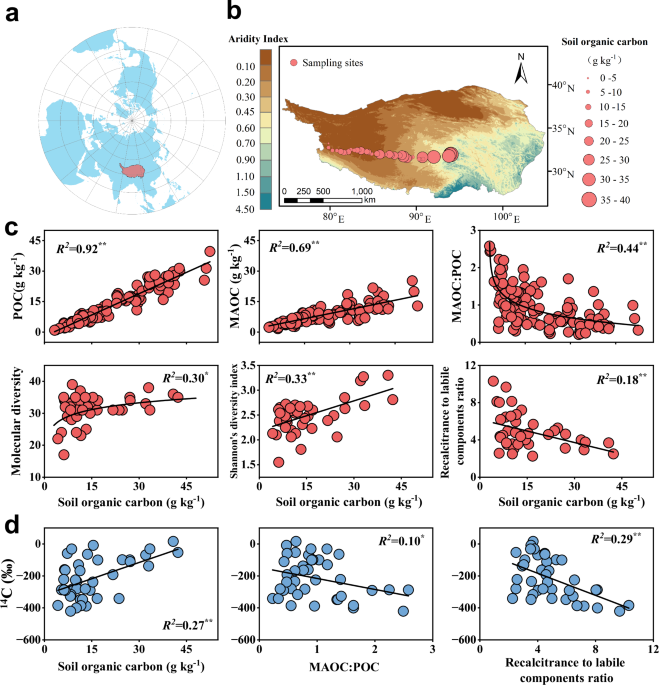
The persistence of soil organic matter (SOM) is critical for predicting carbon-climate feedbacks, yet how increasing soil organic carbon (SOC) relates to long-term SOM persistence across environmental gradients remains unclear. Soil radiocarbon, SOM physicochemical composition, and microbial carbon use efficiency (CUE) are analyzed along a precipitation-driven gradient integrated with global datasets. Here we show, as SOC content increases, its persistence as reflected by radiocarbon signatures declines at both the transect and global scales. This pattern indicates that higher SOC soils are increasingly dominated by younger, faster-cycling carbon rather than older, stabilized pools. Plant carbon inputs strongly predict SOM persistence and are associated with younger, less persistent SOC. While microbial CUE increases with SOC, higher CUE does not necessarily enhance long-term stabilization. Our findings suggest that SOC content alone provides limited insight into long-term soil carbon persistence and highlight the importance of explicitly representing plant carbon inputs and microbially mediated persistence in Earth system models.
Statistics
| Metric | Count |
|---|---|
| Journals searched | 11 |
| Total papers fetched | 96 |
| Passed deterministic filter | 9 |
| After LLM relevance filtering | 1 |
| Rejected (not relevant) | 8 |
| AI for Science items picked | 0 |
Papers by journal
| Journal | Papers |
|---|---|
| Nature Communications | 1 |
Filtering Criteria
Topics: hydrology, hydrologic model, river, runoff, streamflow, reservoir, water management, flood, drought, seasonal, land surface model, climate change, hydropower, surface water, irrigation, earth system model, estuary, coastal, freshwater discharge, river plume, ocean biogeochemistry, marine heatwave, paleohydrology, paleoclimate, Quaternary, Holocene, Pleistocene, fluvial geomorphology, river terrace, loess, drainage network, river capture, landscape evolution, luminescence dating
Fields: engineering, environmental science, computer science, geology, geography