Paper Harvest Report
Date range: July 10, 2026
3 top-tier papers selected out of 77 total publications
Today’s Highlights
Today’s harvest brings three papers spanning urban ecohydrology, coastal marine science, and Holocene paleoclimate. A land-atmosphere modeling study demonstrates that explicitly representing urban ecohydrology processes—tree canopy interactions and impervious-to-pervious runoff routing—cools and moistens pre-storm conditions, shifting simulated Milwaukee rainfall closer to observations. A Nature Geoscience study of Congo Basin peat reveals that hydroclimate-driven dry phases caused abrupt ~80% collapses in net oxygen surplus within centuries over the Holocene, reframing terrestrial peatlands as a dynamic, fast-responding component of Earth’s carbon–oxygen balance comparable in magnitude to marine burial.
Table of Contents
Top-Tier Journal Papers
Ecohydrologic Processes Modify Urban Rainfall Intensification in Land‐Atmosphere Simulations
Authors: G. Aaron Alexander, Daniel B. Wright, Carolyn B. Voter, Steven P. Loheide
Journal: Geophysical Research Letters · DOI: 10.1029/2026gl121642
Matched topics: hydrology, runoff
Ecohydrologic processes influence urban water and energy cycles including convective rainfall. Coupled land‐atmosphere models, however, lack fine‐scale representation of urban ecohydrology processes. This study integrates these processes into ensemble land‐atmosphere simulations to assess changes in convective rainfall in Milwaukee, Wisconsin. We compare simulations using existing urban land surface representations to ones that resolve processes like tree canopy overhanging pavement and runoff routing from impervious to pervious surfaces. We find that ecohydrologic processes produce cooler and wetter conditions ahead of rainfall due to higher evapotranspiration, especially under weak atmospheric forcing. Simulated rainfall aligns more closely with observed rainfall when ecohydrologic processes are considered, especially in an area of known urban rainfall intensification; more of this rainfall infiltrates. Our findings highlight the importance of model representation of urban ecohydrology to better understand rainfall holistically and the importance of representing these processes for precipitation forecasts and for exploring future city‐scale climate adaptation strategies.
Low Cross‐Product Agreement in Global Coastal Marine Heatwaves (1982–2023) and Implications for Trend Attribution
Authors: Wenjin Sun, Jiaxiang Li, Tianxiao Cui, Jingsong Yang, Changming Dong
Journal: Geophysical Research Letters · DOI: 10.1029/2026gl124134
Matched topics: river, coastal, marine heatwave
Coastal marine heatwaves (MHWs) derived from satellite and blended sea surface temperature (SST) products often disagree, but the magnitude and drivers of this uncertainty remain poorly quantified. Using four daily SST products from 1982 to 2023, we quantify agreement at 9,946 global coastal points using two inter‐product intersection‐over‐union metrics, a daily‐scale co‐identification rate and an event‐scale rate based on overlapping event intervals. We find low global agreement, with daily‐ and event‐scale rates averaging 12.34% ± 7.84% and 16.33% ± 8.35%, respectively, and interquartile ranges of 6.34%–17.19% and 10.17%–21.55%. Both rates increase systematically with event duration and annual cumulative intensity. MHW trends are generally consistent across products, whereas trend attribution ratios show substantial inter‐product divergence. These results indicate comparatively consistent estimates of long‐term change but highlight the need to explicitly report multi‐product uncertainty in coastal attribution.
Hydroclimate controls Congo peatland net oxygen release over the past 10,600 years
Authors: M. E. Galvez, S. Wu, Y. Garcin, E. Schefuß, G. Gassier, J. Lebamba et al.
Journal: Nature Geoscience · DOI: 10.1038/s41561-026-02031-z
Matched topics: Holocene
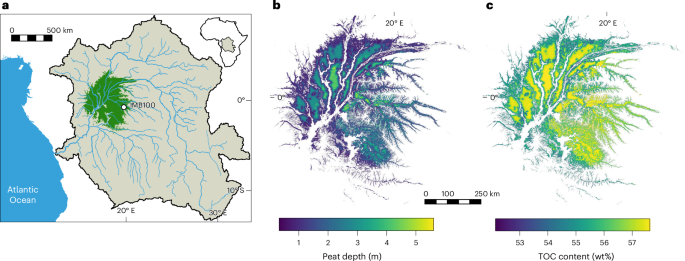
The burial of organic matter in marine environments is considered the dominant long-term source of atmospheric oxygen, yet the contribution of terrestrial burial remains poorly constrained. Quantifying any oxygen surplus associated with organic matter burial conventionally assumes a 1:1 oxygen-to-carbon stoichiometry. Here we aim to test this assumption and quantify net oxygen release from a terrestrial setting over time. We applied direct redox titration to a 10,600-year Congo Basin peat core, a hotspot of carbon accumulation. We find systematic deviation from the 1:1 ratio, enabling precise, time-resolved quantification of the net redox imbalance. Fluxes were strikingly nonlinear: drier phases triggered abrupt ~80% declines in net oxygen surplus within centuries, followed by rapid recovery when wetter conditions returned, revealing a hydroclimate-sensitive carbon–oxygen valve. Cumulative Holocene oxygen surplus reached 83 [68–100] petagrams of oxygen equivalents. Using the Congo oxygen-to-carbon ratio, we estimate that global peatland net oxygen production is commensurate with continental weathering oxygen sinks in the Holocene—a flux comparable in magnitude to marine burial but responding on orders-of-magnitude-shorter timescales. This finding provides qualitative insight into the contribution of terrestrial environments to Earth’s redox balance. It also offers a direct stoichiometric framework—applicable to coal archives—for quantifying that contribution across the Phanerozoic, independent of isotopic proxies, complementing existing marine-based models.
Statistics
| Metric | Count |
|---|---|
| Journals searched | 11 |
| Total papers fetched | 77 |
| Passed deterministic filter | 9 |
| After LLM relevance filtering | 3 |
| Rejected (not relevant) | 6 |
| AI for Science items picked | 0 |
Papers by journal
| Journal | Papers |
|---|---|
| Geophysical Research Letters | 2 |
| Nature Geoscience | 1 |
Filtering Criteria
Topics: hydrology, hydrologic model, river, runoff, streamflow, reservoir, water management, flood, drought, seasonal, land surface model, climate change, hydropower, surface water, irrigation, earth system model, estuary, coastal, freshwater discharge, river plume, ocean biogeochemistry, marine heatwave, paleohydrology, paleoclimate, Quaternary, Holocene, Pleistocene, fluvial geomorphology, river terrace, loess, drainage network, river capture, landscape evolution, luminescence dating
Fields: engineering, environmental science, computer science, geology, geography