Paper Harvest Report
Date range: June 24, 2026
4 top-tier papers selected out of 112 total publications
Today’s Highlights
Today’s four papers span climate-water feedbacks, transboundary hydropower equity, Quaternary glaciology, and coastal carbon cycling. A PNAS study using fully coupled earth system model simulations finds that atmospheric vapor pressure deficit (VPD) feedbacks triggered by vegetation-mediated energy changes could offset up to 68% of the evapotranspiration reduction expected from CO₂-driven stomatal closure at 4×CO₂, substantially limiting the physiological benefits of rising CO₂ for surface water availability and intensifying surface aridification. A Nature Water paper demonstrates that equity can be directly embedded into transboundary water optimization using Atkinson’s welfare function, achieving 3–25 percentage-point reductions in inequality among Zambezi riparian states at less than 5% sacrifice in total hydropower generation. A GRL study constrains West Antarctic Ice Sheet fluctuations over the past 850,000 years using iceberg-rafted debris provenance in Amundsen Sea sediment cores, and a Nature Communications paper documents divergent soil carbon responses to land use during coastal reclamation of tidal flats.
Table of Contents
- Today’s Highlights
- Top-Tier Journal Papers
- Balancing equity and efficiency in transboundary water systems with Atkinson’s welfare function
- A potential overestimation of CO₂ physiological effects on evapotranspiration
- Reduced West Antarctic Ice Sheet Size During Prominent Quaternary Interglacials Constrained by Iceberg‐Rafted Debris Provenance in the Amundsen Sea
- Divergent responses of soil organic and inorganic carbon driven by land use during coastal reclamation
- AI for Science
- Statistics
- Filtering Criteria
Top-Tier Journal Papers
Balancing equity and efficiency in transboundary water systems with Atkinson’s welfare function
Authors: Wyatt Arnold, Matteo Giuliani, Andrea Castelletti
Journal: Nature Water · DOI: 10.1038/s44221-026-00671-4
Matched topics: drought, hydropower
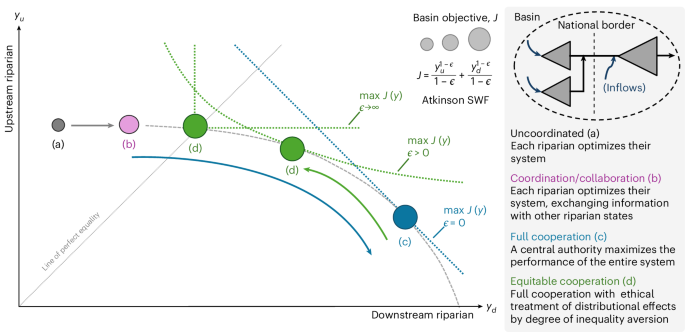
Water resources optimization conventionally maximizes system-wide efficiency, treating distributional equity as secondary. Here we present a framework that directly incorporates equity into optimization using Atkinson’s inequality measure. This approach makes distributional value judgements transparent through a single, interpretable inequality aversion parameter that spans principles from utilitarian efficiency to Rawlsian justice, enabling stakeholders to negotiate between efficiency and fairness. Applied to hydropower operations and floating photovoltaic expansion in the Zambezi Watercourse, we demonstrate that substantial equity improvements (3–25 percentage point reduction in the Atkinson index) can be achieved with minimal efficiency sacrifices (1.0–4.2% of total hydropower generation). These gains arise through increases in reliable (‘firm’) power generation, enhancing drought resilience for the most vulnerable riparian states. The framework adapts to changing objectives, prioritizing investments towards disadvantaged actors without requiring predetermined weights or hierarchies. The methodology generalizes to any multi-actor resource allocation problem in which monotonically increasing, concave objectives create scope for welfare-improving redistribution.
A potential overestimation of CO₂ physiological effects on evapotranspiration
Authors: Yi Hao, Xing Yuan, Xiazhen Xi, Zhenzhong Zeng, Giovanni Forzieri, Peili Wu
Journal: Proceedings of the National Academy of Sciences · DOI: 10.1073/pnas.2534643123
Matched topics: earth system model
It is generally believed that CO2 physiological forcing can partially mitigate land surface drying under global warming by reducing stomatal conductance and evapotranspiration. Most of this type of study focuses on the direct regulation by vegetation physiology, overlooking interactive feedback from the atmosphere. Using fully coupled earth system model simulations, we find that the physiological benefit may have been optimistically overestimated. Vegetation-induced energy change may in turn further affect atmospheric vapor pressure deficit (VPD), exerting extra evapotranspiration demand indirectly. Indirect VPD feedback over northern mid-high latitudes could offset 54% (±26%) of evapotranspiration reduction driven by stomatal closure under current CO2 condition, and that proportion increases to 68% (±18%) at 4 × CO2. The enhanced VPD feedback is largely driven by vegetation-mediated albedo decline and temperature rise in northern mid-high latitudes, which intensifies evapotranspiration loss as stomatal constraints are minimal. These are important findings, substantially limiting the physiological benefits of CO2 with extra pressure on surface aridification and water resources.
Reduced West Antarctic Ice Sheet Size During Prominent Quaternary Interglacials Constrained by Iceberg‐Rafted Debris Provenance in the Amundsen Sea
Authors: Patric Simões Pereira, Claus‐Dieter Hillenbrand, Sidney R. Hemming, James W. Marschalek, Rob Larter, James A. Smith, Gerhard Kuhn, Tina van de Flierdt
Journal: Geophysical Research Letters · DOI: 10.1029/2026gl121909
Matched topics: coastal, Quaternary
The stability of the West Antarctic Ice Sheet (WAIS) remains a major uncertainty in sea‐level projections, and geologic records provide important constraints on its past behavior. We present ⁴⁰Ar/³⁹Ar ages of biotite and hornblende grains from iceberg‐rafted debris (IRD) in two Amundsen Sea sediment cores (PC493 and PS58/254), located south and north of the southern boundary of the Antarctic Circumpolar Current (sbACC), respectively. Over the past 850,000 years, PC493 records a stable IRD provenance dominated by eastern Amundsen Sea sources, consistent with transport by the westward‐flowing Antarctic Coastal Current. In contrast, PS58/254 shows temporally variable sources, with southeastern Amundsen Sea inputs during glacials and increased Marie Byrd Land contributions during interglacials, indicating latitudinal sbACC shifts. The absence of East Antarctic IRD is consistent with no open‐marine connection between the Weddell and Amundsen Seas, while abundant <10 Ma grains during Marine Isotope Stages 5, 11, and 15 imply reduced WAIS elevation.
Divergent responses of soil organic and inorganic carbon driven by land use during coastal reclamation
Authors: Jiahao Zhai, Lijie Pu, Sihua Huang, Jiawei Tao, Chaosheng Zhang
Journal: Nature Communications · DOI: 10.1038/s41467-026-74876-2
Matched topics: coastal

Coastal reclamation fundamentally transforms natural tidal flat ecosystems into managed terrestrial landscapes, initiating profound shifts in soil physicochemical properties and carbon dynamics; understanding how reclamation history and land use jointly regulate soil carbon fraction dynamics is essential for evaluating carbon sequestration potential in rapidly expanding reclaimed coastlines. Here, we show that reclamation induces progressive desalination, surface dealkalization, nutrient enrichment, and texture refinement; soil organic carbon increases markedly across reclamation stages, exhibiting strong surface accumulation under woodland and cropland, with mineral-associated organic carbon as the dominant fraction and organic carbon increasingly stable; soil inorganic carbon remains stable during early reclamation but declines markedly in surface layers of long-term reclaimed terrestrial soils while remaining high in aquaculture systems; and organic carbon fractions are primarily associated with nutrient availability and clay content whereas inorganic carbon dynamics are closely linked to soil pH and salinity.
AI for Science
How AI is changing research
- Claude Science is Anthropic’s newest flagship product (MIT Tech Review, 2026-06-30) — Anthropic launched Claude Science, a flagship product aimed specifically at supporting scientific research workflows — from literature synthesis and hypothesis generation to code-assisted data analysis — signaling a shift from general-purpose assistants toward AI systems tailored to the research lifecycle.
Cross-discipline sparks
- Agriculture is ready for AI, but its data isn’t (MIT Tech Review, 2026-06-30) — A candid assessment of why AI adoption in agriculture is stalled not by algorithms but by heterogeneous, inconsistent data infrastructure. Earth-science teams will recognize the same bottleneck: multi-decade streamflow records with shifting gauge networks, satellite precipitation products with temporal seams, and reanalysis data at incompatible resolutions. The lesson is actionable — before chasing better models, audit your data pipelines and standardize your schema. Small hydrology groups could adapt the agricultural data-readiness frameworks being developed now (interoperable APIs, tiered quality flags, sensor metadata standards) before AI tools that depend on them become commodity.
Statistics
| Metric | Count |
|---|---|
| Journals searched | 11 |
| Total papers fetched | 112 |
| Passed deterministic filter | 11 |
| After LLM relevance filtering | 4 |
| Rejected (not relevant) | 7 |
| AI for Science items picked | 2 |
Papers by journal
| Journal | Papers |
|---|---|
| Proceedings of the National Academy of Sciences | 1 |
| Geophysical Research Letters | 1 |
| Nature Water | 1 |
| Nature Communications | 1 |
Filtering Criteria
Topics: hydrology, hydrologic model, river, runoff, streamflow, reservoir, water management, flood, drought, seasonal, land surface model, climate change, hydropower, surface water, irrigation, earth system model, estuary, coastal, freshwater discharge, river plume, ocean biogeochemistry, marine heatwave, paleohydrology, paleoclimate, Quaternary, Holocene, Pleistocene, fluvial geomorphology, river terrace, loess, drainage network, river capture, landscape evolution, luminescence dating
Fields: engineering, environmental science, computer science, geology, geography