Paper Harvest Report
Date range: June 08, 2026
2 top-tier papers selected out of 85 total publications
Today’s Highlights
Today’s harvest surfaces two papers connecting land-surface processes to large-scale hydrological and climate outcomes. A PNAS study using Lagrangian moisture tracking finds that Amazon deforestation has reduced growing-season precipitation by 6–30% across Brazilian soybean states since 1982, costing roughly 700 kton in cumulative soybean production—and hints at a self-reinforcing feedback where yield losses encourage further forest clearing. Complementing this, a Nature Communications analysis of CMIP6 models reveals that future soil moisture–temperature coupling is strongly scenario-dependent: under aggressive warming (SSP5-8.5), coupling weakens at low-to-mid latitudes while intensifying poleward, with implications for regional drought and heatwave risk.
Table of Contents
Top-Tier Journal Papers
Amazon deforestation reduces precipitation and soybean yields across Southern Brazil
Authors: Hao Li, Corey S. Lesk, Lei Zhu, Thomas W. Crowther, Min Chen, Deepak K. Ray et al.
Journal: Proceedings of the National Academy of Sciences · DOI: 10.1073/pnas.2525378123
Matched topics: seasonal, climate change
Rapid agricultural expansion has driven forest loss worldwide. Deforestation reduces evaporation, potentially decreasing precipitation and crop yields far beyond agricultural frontiers. Here, we quantified the teleconnection impacts of Amazon deforestation on precipitation and soybean yields across Brazil during 1982-2018, using a Lagrangian moisture tracking model. Our analysis indicates that tree evaporation contributes one-third of growing-season precipitation, yet recent deforestation decreased seasonal precipitation by 6 to 30% across Brazilian soybean states, with replacement land covers providing limited compensation for the losses. Although precipitation declines were most pronounced near Amazonian deforestation, the largest yield reductions (227 kton, or ~6% loss) occurred in the southern state of Rio Grande do Sul. Cumulatively, deforestation-driven precipitation declines resulted in a total soybean production loss of ~700 kton. These findings reveal that expanding agriculture into forests undermines yields in established croplands, potentially creating a feedback where yield losses drive demand for additional forest clearing. Under continued deforestation and climate change, this feedback is likely to intensify, threatening Brazilian rainfed agriculture into the future.
Divergent regional responses of soil moisture-air temperature coupling under future climate scenarios
Authors: Daniel F. T. Hagan, Guojie Wang, Alan T. Kennedy-Asser, João L. Geirinhas, Kirsten L. Findell, Mingxing Li et al.
Journal: Nature Communications · DOI: 10.1038/s41467-026-74040-w
Matched topics: drought
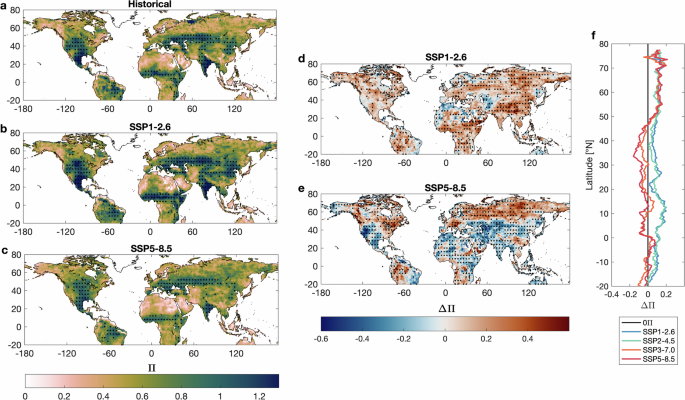
Climate models project that hotspot regions where soil moisture (SM) influences air temperature (T) will shift and strengthen, affecting droughts and heatwaves, yet the mechanisms driving these changes remain uncertain. Here, we use Coupled Model Intercomparison Project Phase 6 output and find divergent regional responses in SM–T coupling to different future emission scenarios during boreal summer. Under the low-end SSP1-2.6 scenario, SM–T coupling expands across all historical hotspots, while under the high-end SSP5-8.5 scenario, warming produces a latitudinal contrast, where SM–T coupling weakens and contracts at low-to-mid latitudes of the Northern Hemisphere but strengthens at higher latitudes. Coupling also strengthens in the humid tropics south of the equator, where disproportionate evaporation increases offset precipitation gains and depletes soil moisture. These shifts are driven by dynamic and thermodynamic changes modulating the atmospheric and land segments of SM–T coupling. Additionally, the influence of the poleward expansion of the Hadley cells, more pronounced under SSP5-8.5, further pushes SM control on surface energy partitioning northward. Together, these divergent responses reveal a nuanced, scenario-dependent future for SM–T coupling.
Statistics
| Metric | Count |
|---|---|
| Journals searched | 11 |
| Total papers fetched | 85 |
| Passed deterministic filter | 10 |
| After LLM relevance filtering | 2 |
| Rejected (not relevant) | 8 |
| AI for Science items picked | 0 |
Papers by journal
| Journal | Papers |
|---|---|
| Proceedings of the National Academy of Sciences | 1 |
| Nature Communications | 1 |
Filtering Criteria
Topics: hydrology, hydrological, streamflow, runoff, river, flood, drought, reservoir, dam, irrigation, water resources, precipitation, rainfall, evapotranspiration, groundwater, aquifer, watershed, basin, catchment, water cycle, water balance, soil moisture, snowmelt, glacier, ice sheet, sea level, storm surge, coastal flooding, climate change, land surface, earth system, seasonal, discharge, flow routing, hydraulic, water management
Fields: Environmental Science, Earth and Planetary Sciences, Geography, Agricultural and Biological Sciences, Atmospheric Science, Oceanography, Civil Engineering, Water Resources Management