Paper Harvest Report
Date range: June 10, 2026
4 top-tier papers selected out of 133 total publications
Today’s Highlights
Four papers today span cryosphere–ocean coupling, climate-driven hydrologic whiplash, coastal sea-level extremes, and deep-time paleomonsoon dynamics. A Nature study finds that accelerating Arctic glacier disintegration is amplifying iceberg-borne debris delivery to the deep seafloor, reshaping benthic habitats in a modern echo of Pleistocene Heinrich events. A Nature Climate Change paper shows human-driven sea-level rise has quadrupled the frequency of extreme coastal sea-level events since 1900, while a PNAS feature examines the growing frequency of abrupt wet-to-dry “hydrologic whiplash” under climate change. A Nature Communications study reconstructs 7-to-2.5-million-year-old rainfall seasonality on the Chinese Loess Plateau, linking subtropical jet shifts to the expansion of C4 grassland ecosystems.
Table of Contents
- Today’s Highlights
- Top-Tier Journal Papers
- Amplified Arctic iceberg traffic reshapes benthic biodiversity
- Driven by climate change, sudden swings between wet and dry create “hydrologic whiplash”
- Human-driven sea-level rise has quadrupled the frequency of coastal sea-level extremes since 1900
- Jet-induced rainfall seasonality and C4 migration over East Asia
- AI for Science
- Statistics
- Filtering Criteria
Top-Tier Journal Papers
Amplified Arctic iceberg traffic reshapes benthic biodiversity
Authors: Thomas Krumpen, Kirstin S. Meyer-Kaiser, Claudia Wekerle, Lars Ackermann, Deonie Castle, Melanie Bergmann et al.
Journal: Nature · DOI: 10.1038/s41586-026-10630-4
Matched topics: Pleistocene
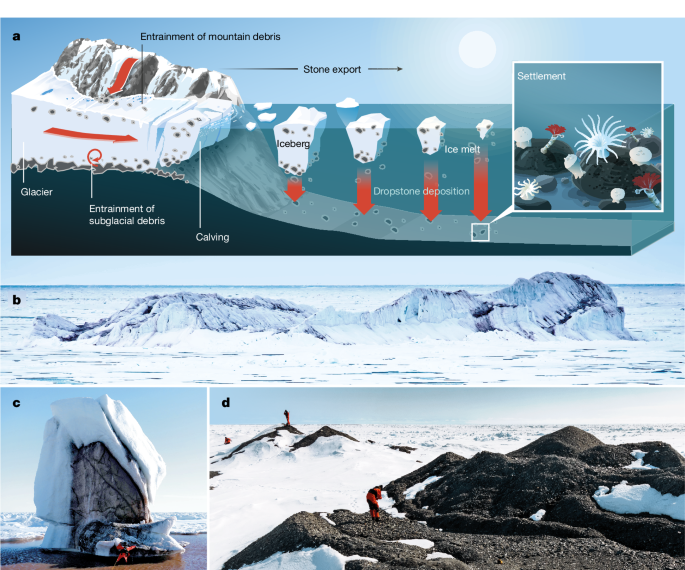
The Arctic is undergoing rapid warming, resulting in retreating sea ice and glaciers, yet how cryospheric changes propagate into the deep ocean remains poorly understood. Here we identify a climate-driven mechanism linking accelerating glacier disintegration to an increase in deep-sea hard-bottom habitats far beyond calving fronts. Seafloor observations in Fram Strait show a localized increase in the density and patchiness of dropstones delivered by debris-laden icebergs. At the same time, four decades of shipboard records show that the occurrence of icebergs increased abruptly in the early 2000s. Backtracking links these icebergs to the main outlet glaciers in northeast Greenland and the Russian High Arctic. In northeast Greenland, the timing of glacier destabilization coincides with this rise, whereas sparse satellite coverage in the Russian sector limits temporal attribution despite indications of enhanced glacier activity. A model sensitivity study shows that, apart from intensified calving, a more dynamic sea ice cover enhances downstream transport of glacial ice. Along these pathways, increased iceberg activity could reshape deep-sea habitats through enhanced melt and associated lithogenic input, and elevate navigational hazards as maritime traffic expands in the Arctic. Although modest compared with the iceberg discharges of Pleistocene Heinrich events, this mechanism provides a modern analogue of long-range cryospheric influence on the seafloor in a warming climate.
Driven by climate change, sudden swings between wet and dry create “hydrologic whiplash”
Authors: Amy McDermott
Journal: Proceedings of the National Academy of Sciences · DOI: 10.1073/pnas.2617960123
Matched topics: climate change
Abstract not available.
Human-driven sea-level rise has quadrupled the frequency of coastal sea-level extremes since 1900
Authors: Sönke Dangendorf, Qiang Sun, Pravin Maduwantha, Thomas Wahl, Marta Marcos, Ben Marzeion et al.
Journal: Nature Climate Change · DOI: 10.1038/s41558-026-02659-0
Matched topics: coastal
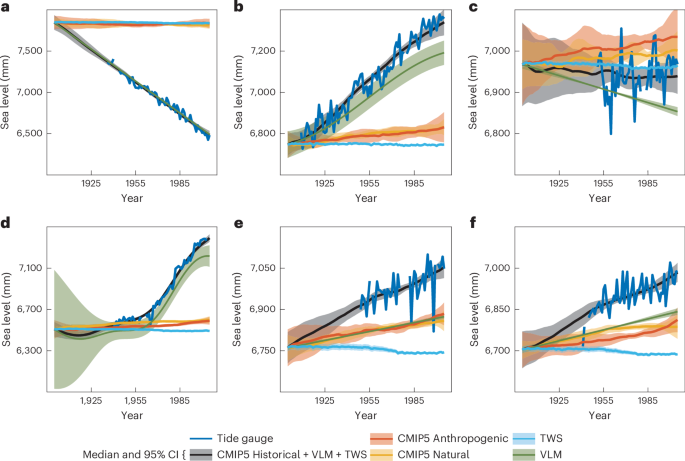
Abstract not available.
Jet-induced rainfall seasonality and C4 migration over East Asia
Authors: Jiawei Da, Chijun Sun, Lily Serach, Timothy Gallagher, Huayu Lu, Katharine Huntington et al.
Journal: Nature Communications · DOI: 10.1038/s41467-026-74312-5
Matched topics: river, seasonal, Pleistocene, loess
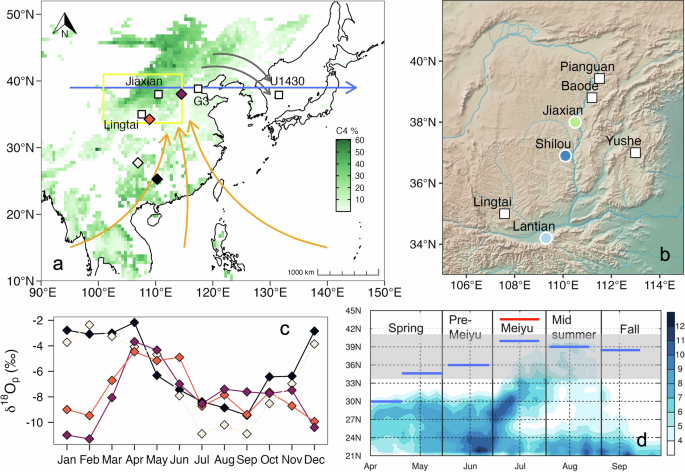
The Neogene expansion of C4 grasslands transformed terrestrial ecosystems with marked influence on mammalian evolution, including hominins. However, the asynchronous C4 expansion on different continents makes it difficult to identify the environmental drivers, especially for higher latitudes. Here we show that rainfall seasonality governed extratropical Plio-Pleistocene C4 distributions in East Asia. Rainfall oxygen isotope ratios and clumped isotope soil temperatures exhibit coupled variations on the Chinese Loess Plateau (CLP) from 7 to 2.5 million years ago, indicating more spring rain during warmer times when the subtropical westerly jet was further poleward, and more concentrated summer rain under cooler climates. We attribute these changes to meridional shifts of a summer rain band on orbital and longer timescales. The most C4-rich ecosystems, as identified by organic carbon δ13C records, tracked this summer rain band, eventually eclipsing the southern CLP margin during the late Pleistocene cooling. Our model refines the East Asian paleomonsoon concept and explains the equatorward migration of extratropical C4 ecosystems, highlighting the tight coupling between regional rainfall seasonality and vegetation.
AI for Science
How AI is changing research
- A near-autonomous AI chemist improves a challenging reaction in medicinal chemistry (OpenAI, 2026-06-17) — OpenAI and Molecule.one show an AI agent proposing and validating improvements to a real medicinal-chemistry reaction, a concrete sign that lab-automation agents are moving from literature synthesis into actual bench-level experimental design.
- Introducing LifeSciBench (OpenAI, 2026-06-17) — A new expert-authored benchmark for evaluating AI agents on real-world life-science research tasks. No comparable benchmark exists yet for hydrologic or earth-system reasoning tasks (e.g., diagnosing a streamflow anomaly or a land-surface model bias) — a gap a small team could plausibly fill.
Statistics
| Metric | Count |
|---|---|
| Journals searched | 11 |
| Total papers fetched | 133 |
| Passed deterministic filter | 10 |
| After LLM relevance filtering | 4 |
| Rejected (not relevant) | 6 |
| AI for Science items picked | 2 |
Papers by journal
| Journal | Papers |
|---|---|
| Nature | 1 |
| Proceedings of the National Academy of Sciences | 1 |
| Nature Climate Change | 1 |
| Nature Communications | 1 |
Filtering Criteria
Topics: hydrology, hydrologic model, river, runoff, streamflow, reservoir, water management, flood, drought, seasonal, land surface model, climate change, hydropower, surface water, irrigation, earth system model, estuary, coastal, freshwater discharge, river plume, ocean biogeochemistry, marine heatwave, paleohydrology, paleoclimate, Quaternary, Holocene, Pleistocene, fluvial geomorphology, river terrace, loess, drainage network, river capture, landscape evolution, luminescence dating
Fields: engineering, environmental science, computer science, geology, geography