Paper Harvest Report
Date range: June 11, 2026
6 top-tier papers selected out of 132 total publications
Today’s Highlights
Six papers today trace water from catchments to coasts. A Science study spanning 3,821 European catchments introduces “wetness boundaries” that determine whether nitrogen accumulates or leaches as landscape water velocities shift, and a companion Geophysical Research Letters paper finds flash droughts arriving earlier each decade as spring vegetation greens up sooner under warming. On the coasts, permafrost-thaw runoff is darkening Arctic shelf waters, Venice’s MoSE storm-surge gates are reshaping lagoon wetland resilience even as they cut flood risk, and atmospheric rivers emerge as an underappreciated driver of marine heatwaves — alongside a global synthesis of where drought-risk research, policy, and practice still fall short.
Table of Contents
- Today’s Highlights
- Top-Tier Journal Papers
- Divergent evolution of nitrogen cycling along gradients of landscape water velocities
- Earlier Flash Drought Onset Driven by Spring Vegetation Greening and Warming
- Enhanced Solar Radiation Attenuation in the Arctic Shelf Driven by Warming-Induced Terrestrial Inputs
- Ten key insights and gaps to inform drought risk research, policy and practice
- Reconciling flood-risk reduction and wetland resilience behind coastal floodgates
- Detected impacts of atmospheric rivers on marine heatwaves
- AI for Science
- Statistics
- Filtering Criteria
Top-Tier Journal Papers
Divergent evolution of nitrogen cycling along gradients of landscape water velocities
Authors: Songjun Wu, Chris Soulsby, Yi Zheng, Andreas Musolff, Doerthe Tetzlaff
Journal: Science · DOI: 10.1126/science.aed0399
Matched topics: climate change
Increasing fertilization has pushed the nitrogen cycle beyond planetary boundaries, yet its fate remains uncertain owing to long-standing neglect of landscape water velocities in nitrogen models. Leveraging isotope-aided modeling across 3821 European catchments, we demonstrate that evolution of nitrogen cycling is strongly linked to shifts in landscape water velocities since 1980. We propose the concept of “wetness boundaries,” where hydrological transitions beyond boundaries amplify nitrogen accumulation and leaching, whereas conditions remaining within boundaries mitigate these processes.
Earlier Flash Drought Onset Driven by Spring Vegetation Greening and Warming
Authors: Feng Ma, Xing Yuan
Journal: Geophysical Research Letters · DOI: 10.1029/2026gl122625
Matched topics: drought, climate change
The onset timing of the flash drought season critically determines whether these rapid-intensifying events coincide with sensitive stages of vegetation growth, as droughts occurring early in the growing season can severely undermine ecosystem productivity. However, how onset timing has evolved under climate change remains unclear. To address this gap, we analyze onset trends across global vegetated areas from 1982 to 2023 and reveal a widespread but regionally heterogeneous advance, averaging approximately one day earlier per decade. This shift is particularly pronounced in northern mid- to high latitudes, where spring vegetation greening and warming jointly drive earlier depletion of soil moisture.
Enhanced Solar Radiation Attenuation in the Arctic Shelf Driven by Warming-Induced Terrestrial Inputs
Authors: Xingyuan Zhu, Tao Li, Lee W. Cooper
Journal: Geophysical Research Letters · DOI: 10.1029/2025gl121447
Matched topics: river, runoff, coastal
Arctic warming accelerates permafrost thaw and coastal erosion, increasing terrestrial material transport to the ocean. Using Moderate Resolution Imaging Spectroradiometer (MODIS) data (2002-2023), we report a widespread increase in the diffuse attenuation coefficient Kd(490) across Arctic shelves since 2018, notably in the Laptev and Kara Seas, which are subject to high runoff and coastal erosion. These regions exhibited Kd(490) increases of 25% and 22%, respectively, relative to the 2002-2017 baseline period. Spatiotemporal correlation analysis attributes these optical changes to warming-driven increases in terrestrial sediment and organic matter delivery to the shelf.
Ten key insights and gaps to inform drought risk research, policy and practice
Authors: Marthe Linda Kris Wens, Michael Hagenlocher, Anastasiya Shyrokaya, Micha Werner, Andrea Toreti, Pedro Henrique Lima Alencar et al.
Journal: Nature Water · DOI: 10.1038/s44221-026-00651-8
Matched topics: drought
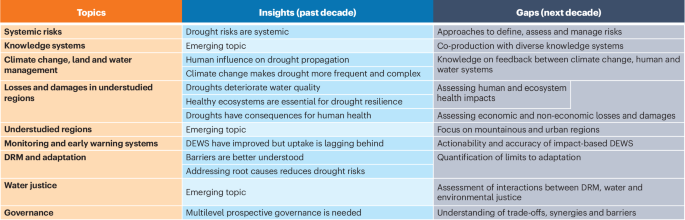
Abstract not available.
Reconciling flood-risk reduction and wetland resilience behind coastal floodgates
Authors: Alessandro Michielotto, Alvise Finotello, Riccardo A. Mel, Eli D. Lazarus, Luca Carniello, Davide Tognin et al.
Journal: Nature Water · DOI: 10.1038/s44221-026-00658-1
Matched topics: flood, coastal
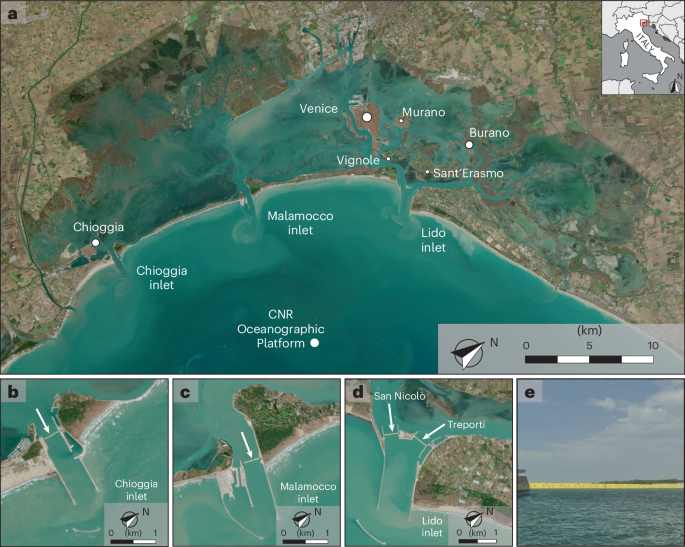
Coastal urban areas face increasing threats from sea-level rise and extreme weather events. Where population relocation is not feasible, hard-engineering defence measures are adopted to mitigate flooding. However, the implications of such interventions for surrounding coastal ecosystems remain poorly understood. Here we explored the effects of the recently inaugurated Mo.S.E. storm-surge barriers on hydrodynamics and wetland resilience within the Venice Lagoon — a highly anthropized environment that may foreshadow future adaptation in other coastal cities.
Detected impacts of atmospheric rivers on marine heatwaves
Authors: Suqiong Hu, Shineng Hu
Journal: Nature Communications · DOI: 10.1038/s41467-026-74249-9
Matched topics: river, seasonal, climate change, marine heatwave
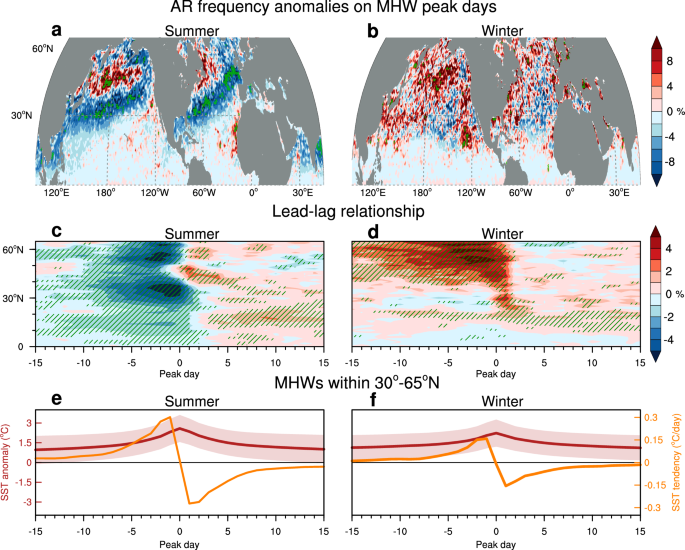
Marine heatwaves (MHWs) are periods of unusually high sea surface temperature that can persist for weeks to months and extend across thousands of kilometers. Their increasing frequency and intensity under climate change threaten marine ecosystems and fisheries, yet the physical processes that govern their occurrence and evolution remain poorly understood. Here we analyze satellite and reanalysis data to show that atmospheric rivers (ARs) — long, narrow corridors of concentrated atmospheric moisture, often described as “rivers in the sky” — play a previously overlooked role in modulating marine heatwave occurrence and intensity.
AI for Science
How AI is changing research
- Is AI ruining our skills? Early results are in — and they’re not good (Nature, 2026-06-18) — Early deskilling data is sobering: Polish endoscopists’ independent adenoma-detection rate fell from 28.4% to 22.4% once AI assistance was removed, and a separate Anthropic study found programmers using AI assistants showed measurable skill degradation on coding tasks — worth keeping in mind as more of the research pipeline itself leans on AI assistance.
Cross-discipline sparks
- SAMJ: fast image annotation on ImageJ/Fiji via segment anything model (Nature Communications, 2026-06-18) — SAMJ wraps SAM-2/EfficientSAM into a no-code ImageJ/Fiji plugin so biologists can click-to-segment microscopy images without a CV engineer. The same recipe is directly portable to remote sensing: a small hydrology team could build an equivalent QGIS plugin to rapidly hand-annotate flood extents, river channels, or reservoir boundaries in satellite/aerial imagery, skipping months of custom segmentation-model engineering.
- Why the Human Genome’s Tangled Physicality May Confound AI (Quanta Magazine, 2026-06-18) — The piece’s core point — sequence-based AI models miss genome function because regulation depends on 3D chromatin folding, not linear sequence — has a hydrologic analogue: streamflow/runoff ML models that flatten a catchment into tabular features hit a similar ceiling, since channel-network topology, subsurface flow paths, and reservoir connectivity are inherently graph-structured and dynamic. A reminder to weigh graph-neural-network river-routing architectures before scaling up purely sequence-based emulators.
Statistics
| Metric | Count |
|---|---|
| Journals searched | 11 |
| Total papers fetched | 132 |
| Passed deterministic filter | 19 |
| After LLM relevance filtering | 6 |
| Rejected (not relevant) | 13 |
| AI for Science items picked | 3 |
Papers by journal
| Journal | Papers |
|---|---|
| Science | 1 |
| Geophysical Research Letters | 2 |
| Nature Water | 2 |
| Nature Communications | 1 |
Filtering Criteria
Topics: hydrology, hydrologic model, river, runoff, streamflow, reservoir, water management, flood, drought, seasonal, land surface model, climate change, hydropower, surface water, irrigation, earth system model, estuary, coastal, freshwater discharge, river plume, ocean biogeochemistry, marine heatwave, paleohydrology, paleoclimate, Quaternary, Holocene, Pleistocene, fluvial geomorphology, river terrace, loess, drainage network, river capture, landscape evolution, luminescence dating
Fields: engineering, environmental science, computer science, geology, geography