Paper Harvest Report
Date range: October 03, 2026
3 top-tier papers selected out of 27 total publications
Today’s Highlights
Earth-system model simulations published in Nature Communications reveal that the global mean temperature response to land-surface change scales approximately linearly (~0.4 K per W/m²) with the resulting shift in planetary albedo — a finding that simplifies how we interpret large-scale land-cover feedbacks on climate. A companion GRL study shows flash drought events increase global dust loading, with soil moisture depletion and vegetation stress emerging as stronger predictors than wind speed. A third GRL paper demonstrates that high-resolution sea-land breeze forcing significantly modifies coastal circulation and summer latent heat flux in Mississippi Sound, underscoring the importance of fine-scale atmospheric forcing for estuarine modeling.
Table of Contents
Top-Tier Journal Papers
Global climate impact of land-surface change driven by radiative effects
Authors: Philipp de Vrese, Victor Brovkin, Moritz Günther, Sarah M. Kang, Thomas Raddatz, Wim Thiery, Yi Yao
Journal: Nature Communications · DOI: 10.1038/s41467-026-77834-0
Matched topics: hydrology, river
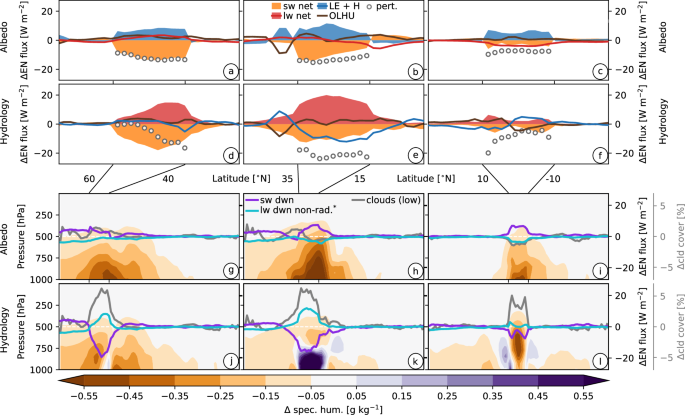
A robust proportionality between radiative forcing and global-mean temperature has been established for most climate drivers. However, land-surface changes are considered an exception due to their potential to alter surface hydrology, introducing non-radiative effects that may rival those from surface albedo changes. Here, comparing Earth-system-model simulations with large-scale perturbations of surface albedo and water availability, we find that the spatially integrated biophysical climate impact is similarly dominated by radiative processes and scales approximately linearly with the resulting shifts in planetary albedo, implying a ~ 0.4 K surface temperature response per W m−2 change in top-of-atmosphere net short-wave radiation. Thus, while non-radiative effects strongly influence local temperatures, their net contribution to the global-mean signal is negligible. The planetary-albedo response is primarily governed by regional cloud-cover characteristics, resulting in a substantially stronger temperature response to land-surface change in mid- and high-latitude regions than in the tropics and subtropics. This study shows that the integrated temperature response to land-surface change scales linearly with the resultant shift in planetary albedo, demonstrating that non-radiative effects — which determine local temperatures — cancel out at the global scale.
Dust Loading Increases During Topsoil Flash Droughts Under Rapid Surface Drying and Vegetation Stress
Authors: Xuesong Wang, Chunlai Zhang, Xi Chen
Journal: Geophysical Research Letters · DOI: 10.1029/2026gl124553
Matched topics: drought
Using satellite‐derived dust optical depth (DOD), reanalysis meteorology, and a global topsoil flash drought (TSFD) inventory for 2003–2022, we find that TSFD events are associated with increased dust loading at the global scale. During TSFD events, 44.7% of land pixels exhibited positive DOD anomalies. The net global DOD anomaly increased significantly over the study period; however, this trend cannot be attributed solely to TSFD‐related effects, as changes in background environmental conditions may also have contributed. Compound TSFD–strong dust (TSFD_SD) events occurred most frequently under sparse vegetation and moderately elevated wind conditions. SHapley Additive exPlanation (SHAP) analysis showed that DOD variability during TSFD events was more strongly associated with soil moisture, background aridity, and vegetation state than with wind speed. These relationships are consistent with a mechanism in which rapid topsoil drying and vegetation stress increase surface erodibility and may enhance dust loading, although the observational analyses do not establish causality.
The Influence of Sea‐Land Breeze on the Circulation and Air‐Sea Thermodynamics of the Mississippi Sound and Bight
Authors: D. N. Bernstein, B. N. Armstrong, A. Razavi Arab, M. K. Cambazoglu, J. D. Wiggert
Journal: Geophysical Research Letters · DOI: 10.1029/2026gl123988
Matched topics: coastal
High spatial and temporal resolution wind forcing is essential to capture the highly variable atmospheric circulation driving ocean currents in shallow waters and across complex coastal features in the Mississippi Sound. In this study, we examine the sensitivity of modeled hydrodynamics to sea‐land breeze (SLB) circulation. Two versions of the CONCORDE Meteorological Analysis (CMA) wind fields were applied as forcing in the COAWST‐based model: an hourly 1‐km resolution data set and a 24‐hr low‐pass filtered version of this data set (CMA24). Inter‐comparison of the resulting solutions isolates the impact of diurnal SLB circulation. Our analysis demonstrates that removing diurnal, SLB‐dominated wind variability modifies circulation patterns and impacts the heat exchange between the atmosphere and estuarine‐shelf waters within the Mississippi Sound. This study estimates its contribution to summer latent heat flux to be 18 W/m². These results underscore the importance of high‐resolution atmospheric forcing for representing coastal ocean dynamics in modeling applications.
Statistics
| Metric | Count |
|---|---|
| Journals searched | 11 |
| Total papers fetched | 27 |
| Passed deterministic filter | 5 |
| After LLM relevance filtering | 3 |
| Rejected (not relevant) | 2 |
| AI for Science items picked | 0 |
Papers by journal
| Journal | Papers |
|---|---|
| Geophysical Research Letters | 2 |
| Nature Communications | 1 |
Filtering Criteria
Topics: hydrology, hydrologic model, river, runoff, streamflow, reservoir, water management, flood, drought, seasonal, land surface model, climate change, hydropower, surface water, irrigation, earth system model, estuary, coastal, freshwater discharge, river plume, ocean biogeochemistry, marine heatwave, paleohydrology, paleoclimate, Quaternary, Holocene, Pleistocene, fluvial geomorphology, river terrace, loess, drainage network, river capture, landscape evolution, luminescence dating
Fields: engineering, environmental science, computer science, geology, geography