Paper Harvest Report
Date range: September 17, 2026
1 top-tier paper selected out of 112 total publications
Today’s Highlights
A new study in Nature Communications reveals that Indian Ocean Dipole events drive basin-scale asymmetric changes in coastal phytoplankton biomass through Kelvin wave dynamics. During positive IOD events, equatorial easterly wind anomalies generate upwelling Kelvin waves that raise the thermocline, enhance nutrient availability, and increase phytoplankton biomass by 27%; the response during negative IOD is a comparatively modest 13% decline. Underwater topography amplifies these regional responses, and with projected increases in extreme positive IOD frequency under climate change, the study implies enhanced primary production and significant implications for Indian Ocean fisheries.
Table of Contents
Top-Tier Journal Papers
Asymmetric basin-wide responses of coastal phytoplankton biomass to the Indian Ocean dipole
Authors: Xinyang Wang, Hongliang Li, Jingjing Zhang, Shuh-Ji Kao, Feng Zhou, Diana Ruiz-Pino et al.
Journal: Nature Communications · DOI: 10.1038/s41467-026-77809-1
Matched topics: coastal
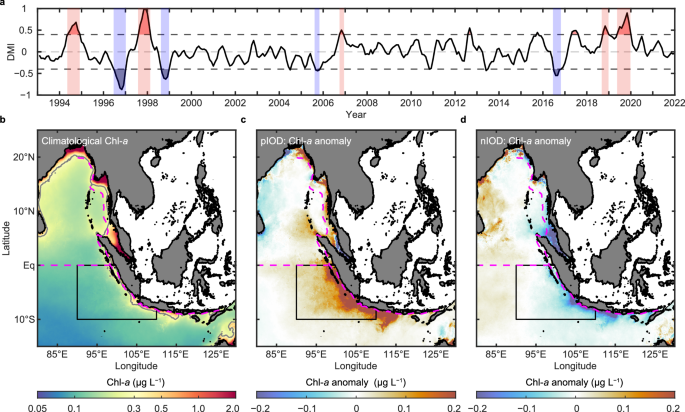
Frequent Indian Ocean Dipole (IOD) events exert substantial ecological pressure on marine ecosystems of the Indian Ocean. However, how coastal ecosystems respond to IOD events remains unknown. Here, combining field observations, remote sensing, and model-derived product, we reveal a basin-scale response of surface and subsurface phytoplankton along the vast eastern Indian Ocean coastline; further, the response is asymmetric between IOD phases, with a 27.0 ± 17.0% increase during positive IOD but only a 13.1 ± 5.2% decrease during negative IOD. Upwelling Kelvin waves (KWs) generated by equatorial easterly wind anomalies during positive IOD raise the thermocline and mixing intensity, increase nutrient availability, and phytoplankton biomass. In contrast, downwelling KWs generated by equatorial westerly wind anomalies during negative IOD further constrain the oligotrophy-limited phytoplankton baseline, resulting in a substantially weaker biological response. Within the KWs framework, underwater topography enhances regional sensitivity to KWs forcing, thereby amplifying the asymmetric phytoplankton biomass responses. Our findings imply that the projected increase in extreme positive IOD events will likely enhance primary production, with possible implications for regional fisheries. This study shows that Indian Ocean Dipole events drive asymmetric, basin-scale changes in coastal phytoplankton through Kelvin waves, while underwater topography amplifies regional biological responses.
AI for Science
How AI is changing research
- AI system helps lab devices ‘talk’ with each other — streamlining research (Nature, 2026-09-24) — An AI-orchestrated middleware now enables heterogeneous lab instruments to exchange data and trigger each other autonomously, collapsing multi-step manual protocols into single-run pipelines. Earth-science field labs running suites of water-quality analyzers, automated samplers, or multi-sensor weather stations face the same interoperability bottleneck; this recipe — instrument abstraction layer + LLM-driven protocol translation — is directly applicable to sensor-rich hydrology and climate monitoring networks.
Statistics
| Metric | Count |
|---|---|
| Journals searched | 11 |
| Total papers fetched | 112 |
| Passed deterministic filter | 6 |
| After LLM relevance filtering | 1 |
| Rejected (not relevant) | 5 |
| AI for Science items picked | 1 |
Papers by journal
| Journal | Papers |
|---|---|
| Nature Communications | 1 |
Filtering Criteria
Topics: hydrology, hydrologic model, river, runoff, streamflow, reservoir, water management, flood, drought, seasonal, land surface model, climate change, hydropower, surface water, irrigation, earth system model, estuary, coastal, freshwater discharge, river plume, ocean biogeochemistry, marine heatwave, paleohydrology, paleoclimate, Quaternary, Holocene, Pleistocene, fluvial geomorphology, river terrace, loess, drainage network, river capture, landscape evolution, luminescence dating
Fields: engineering, environmental science, computer science, geology, geography