Paper Harvest Report
Date range: September 30, 2026
3 top-tier papers selected out of 6 total publications
Today’s Highlights
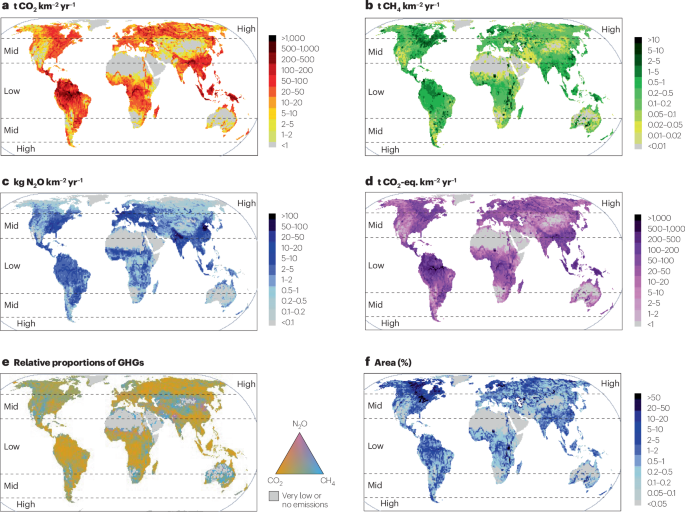
A machine-learning emulation framework calibrated against satellite observations shows the Antarctic Ice Sheet is very likely (≥0.92 probability) committed to mass loss through the end of this century even under aggressive emissions-reduction scenarios, with cascading mechanisms potentially contributing up to 25.4 cm of sea-level rise by 2100 (Nature Geoscience). A whole-watershed enhanced weathering experiment demonstrates that basalt application raises streamwater alkalinity within weeks, with hydrologic variability and seasonal temperature cycling critically governing both the rate and monitoring of carbon removal at the catchment scale (Nature Water). A Nature Reviews Earth & Environment synthesis examines the drivers and global trends of greenhouse gas emissions from inland waters, placing rivers, lakes, and reservoirs within the broader Earth-system carbon budget.
Table of Contents
Top-Tier Journal Papers
Committed Antarctic Ice Sheet mass loss by the end of the twenty-first century
Authors: Yucheng Lin, Xuebin Zhang, Nicholas R. Golledge, Robert E. Kopp, John A. Church, Yi Jin et al.
Journal: Nature Geoscience · DOI: 10.1038/s41561-026-02102-1
Matched topics: coastal
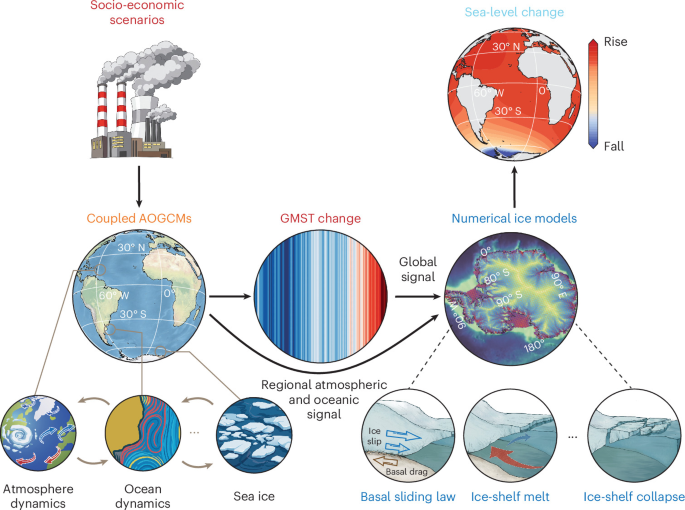
The Antarctic Ice Sheet is the largest source of uncertainty in sea-level rise projections, with uncertainties propagating through emissions scenarios, atmosphere–ocean general circulation models, ice-sheet dynamics and sea-level physics. In ice-sheet model intercomparison exercises, these uncertainties—typically attributed to intermodel differences—stem from modelling choices that may bias ensembles towards commonly adopted approaches regardless of observational consistency. Here we quantify how each individual physical assumption cascades into projection uncertainty using a machine-learning emulation framework, which also enables Bayesian calibration against satellite observations to reduce projection bias. Our results suggest it is very likely (≥0.92 probability) that the Antarctic Ice Sheet is committed to twenty-first-century mass loss, even under aggressive emissions-reduction scenarios. Higher emissions drive greater Antarctic mass loss by 2100 (≥0.89 probability), directly elevating near-term coastal risks. Under very high-emissions scenarios, we identify cascading mechanisms that could produce up to 25.4 cm of sea-level rise by 2100 (95th percentile; median = 15.7 cm) while remaining consistent with satellite observations. Effective management of these risks to densely populated coastal communities requires rapid emissions reductions and improved constraints on climate model selection, sliding laws and ice-shelf melt parameterizations.
Multiple lines of evidence reveal rapid, seasonal watershed responses to enhanced weathering
Authors: Fengchao Sun, Robert A. Rioux, Tim Jesper Suhrhoff, Wyatt Tatge, Boriana Kalderon-Asael, Quinn Zacharias et al.
Journal: Nature Water · DOI: 10.1038/s44221-026-00716-8
Matched topics: seasonal
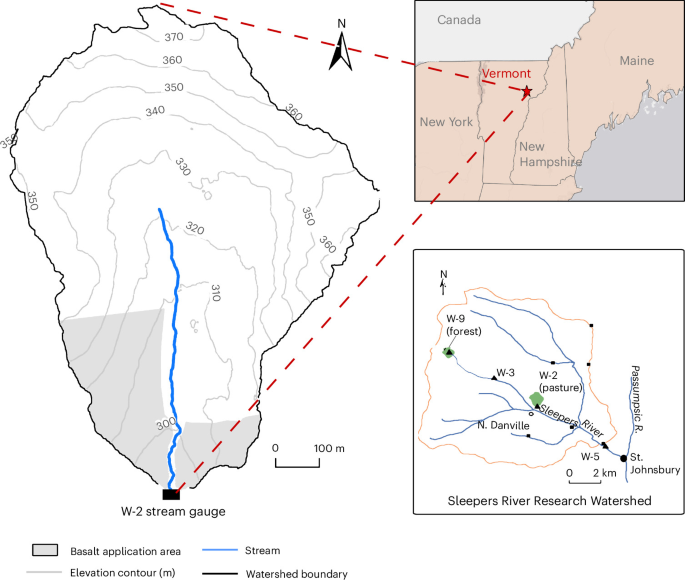
A whole-watershed experiment revealed rapid streamwater alkalinity increases within weeks of basalt application, with strong seasonal cycling and the export of ~10% of theoretical carbon removal as alkalinity over 2 years, underscoring that temperature and hydrologic variability critically govern enhanced weathering effectiveness and monitoring.
Importance, drivers and trends of inland water greenhouse gas emissions
Authors: Ronny Lauerwald, David Bastviken, Tom Battin, Philippe Ciais, Hanqin Tian, George H. Allen et al.
Journal: Nature Reviews Earth & Environment · DOI: 10.1038/s43017-026-00818-7
Matched topics: river
Abstract not available.
AI for Science
How AI is changing research
- Retrofitting language models to operate over bytes (Nature, 2026-10-08) — A new architecture retrofits LLMs to operate over raw byte sequences instead of tokenized text, eliminating the tokenization bottleneck. For earth scientists, this opens a path to training language models directly on binary scientific data (NetCDF, HDF5, sensor streams) and non-standard scientific notation without domain-specific preprocessing pipelines.
Cross-discipline sparks
- Australia’s current wildfire crisis linked to colonial land-use change (Nature, 2026-10-08) — Researchers tied modern wildfire intensification in Australia directly to post-1788 colonial land-use disruption using historical fire records and present-day remote sensing. The cross-discipline angle for earth scientists: the same approach—integrating colonial-era archival records, paleoecological proxies, and geospatial time series—is now tractable for a small team using AI to mine historical documents and link them to land-surface model inputs, enabling long-term baseline shifts in land cover and disturbance regimes to be embedded in ESM simulations.
Statistics
| Metric | Count |
|---|---|
| Journals searched | 11 |
| Total papers fetched | 81 |
| Passed deterministic filter | 6 |
| After LLM relevance filtering | 3 |
| Rejected (not relevant) | 3 |
| AI for Science items picked | 2 |
Papers by journal
| Journal | Papers |
|---|---|
| Nature Geoscience | 1 |
| Nature Water | 1 |
| Nature Reviews Earth & Environment | 1 |
Filtering Criteria
Topics: hydrology, hydrologic model, river, runoff, streamflow, reservoir, water management, flood, drought, seasonal, land surface model, climate change, hydropower, surface water, irrigation, earth system model, estuary, coastal, freshwater discharge, river plume, ocean biogeochemistry, marine heatwave, paleohydrology, paleoclimate, Quaternary, Holocene, Pleistocene, fluvial geomorphology, river terrace, loess, drainage network, river capture, landscape evolution, luminescence dating
Fields: engineering, environmental science, computer science, geology, geography