Paper Harvest Report
Date range: August 13, 2026
2 top-tier papers selected out of 119 total publications
Today’s Highlights
Two papers stand out today. A Nature Climate Change study overturns a key assumption about AMOC collapse, showing that the rate of CO₂ emissions—not an absolute warming threshold—is what determines whether the Atlantic overturning circulation tips: slow forcing keeps it stable past 5.5 °C, while fast ramps trigger collapse at just 2 °C. On the water management front, a Science report documents how record-low snowpack on the Colorado River forced federal authorities to cancel dam releases intended for ecosystem management, underscoring how supply volatility is straining river governance.
Table of Contents
Top-Tier Journal Papers
Fight over Colorado River water threatens ecosystems
Authors: Erik Stokstad
Journal: Science · DOI: 10.1126/science.ael4192
Matched topics: river
After a record-low snowpack, federal authorities canceled dam releases for managing fish and sandbars.
Failure to track a stable AMOC state under rapid climate change
Authors: René M. van Westen, Reyk Börner, Henk A. Dijkstra
Journal: Nature Climate Change · DOI: 10.1038/s41558-026-02730-w
Matched topics: climate change
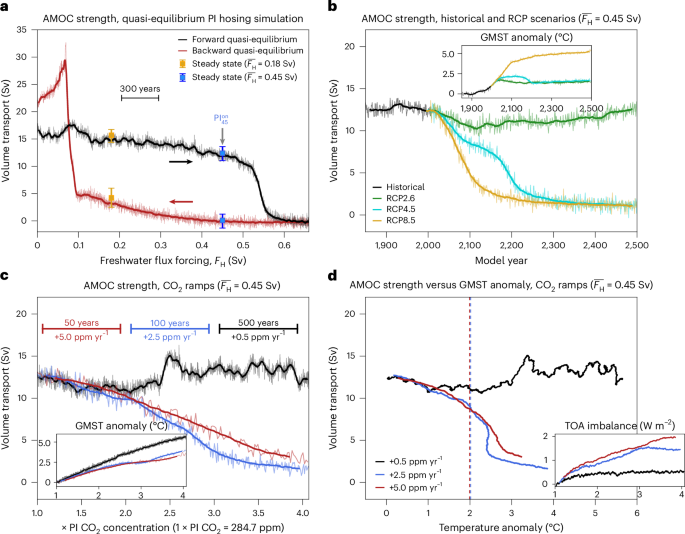
The Atlantic Meridional Overturning Circulation (AMOC), a tipping element of the climate system, currently has an estimated global warming threshold for collapse of +4.0 °C (uncertainty range 1.4–8 °C). However, such a threshold may not be meaningful because AMOC stability depends on the rate of radiative forcing change, not a set temperature. Here we identify an AMOC stabilizing mechanism that operates on timescales slower than present-day warming rates. Slow forcing permits coherent adjustment of surface and interior ocean properties, supported by enhanced evaporation and reduced sea-ice extent, counteracting destabilizing feedbacks. Using a slow CO₂ ramp (+0.5 ppm yr⁻¹) climate model simulation, we explicitly demonstrate the AMOC remains stable up to +5.5 °C of global warming. By contrast, under faster CO₂ ramps, the AMOC collapses at substantially lower warming levels (+2 °C). Our findings demonstrate rate-induced AMOC tipping and imply that limiting the rate of emissions is critical for reducing the risk of an AMOC collapse.
AI for Science
How AI is changing research
-
Staggering 90% of biomedical papers now show signs of AI help (Nature, 2026-08-20) — A landmark Nature analysis finds AI assistance now present in the overwhelming majority of biomedical publications, a pace of adoption suggesting earth-science fields face a similar normalization within one to two years. Researchers who have not yet built AI into their workflows are increasingly the outliers.
-
Provenance grounds trust in autonomous science (Nature Computational Science, 2026-08-20) — Proposes a provenance framework for autonomous research pipelines, ensuring every claim in an AI-generated scientific result can be traced to its inputs and methods. As agentic science systems—like automated literature harvesting and hypothesis generation—proliferate in earth science, reproducibility-by-design frameworks like this will become essential infrastructure for peer review.
Statistics
| Metric | Count |
|---|---|
| Journals searched | 11 |
| Total papers fetched | 119 |
| Passed deterministic filter | 8 |
| After LLM relevance filtering | 2 |
| Rejected (not relevant) | 6 |
| AI for Science items picked | 2 |
Papers by journal
| Journal | Papers |
|---|---|
| Science | 1 |
| Nature Climate Change | 1 |
Filtering Criteria
Topics: hydrology, hydrologic model, river, runoff, streamflow, reservoir, water management, flood, drought, seasonal, land surface model, climate change, hydropower, surface water, irrigation, earth system model, estuary, coastal, freshwater discharge, river plume, ocean biogeochemistry, marine heatwave, paleohydrology, paleoclimate, Quaternary, Holocene, Pleistocene, fluvial geomorphology, river terrace, loess, drainage network, river capture, landscape evolution, luminescence dating
Fields: engineering, environmental science, computer science, geology, geography