Paper Harvest Report
Date range: September 28, 2026
4 top-tier papers selected out of 90 total publications
Today’s Highlights
A global observational study spanning ~19,000 catchments finds that hydrological drought does not simply mirror atmospheric drying — nonlinear propagation through catchments can substantially weaken, delay, or amplify drought signals before they manifest in streamflow, underscoring the need for hydrologically explicit drought assessments. On the land surface side, forest fragmentation is shown to outpace forest cover loss as a driver of warming in nearly half of global forests, with implications for land surface model parameterization. In southern Africa, a synthesis of field research identifies six priority interventions to build early warning systems capable of handling unprecedented climate extremes.
Table of Contents
- Today’s Highlights
- Top-Tier Journal Papers
- Global hydrological drought diverges from atmospheric drying
- Fragmentation outweighs forest cover in shaping land surface temperature across half of global forests
- Opportunities for increasing resilience to changing severe weather in southern Africa: “Early Action and Enhanced Adaptive Capacity for All”
- Making river cooperation fairer
- Statistics
- Filtering Criteria
Top-Tier Journal Papers
Global hydrological drought diverges from atmospheric drying
Authors: Yuhan Guo, Jinghua Xiong, Yuting Yang, Shanbai Liang, Li Guo, Dawen Yang
Journal: Nature Water · DOI: 10.1038/s44221-026-00724-8
Matched topics: drought
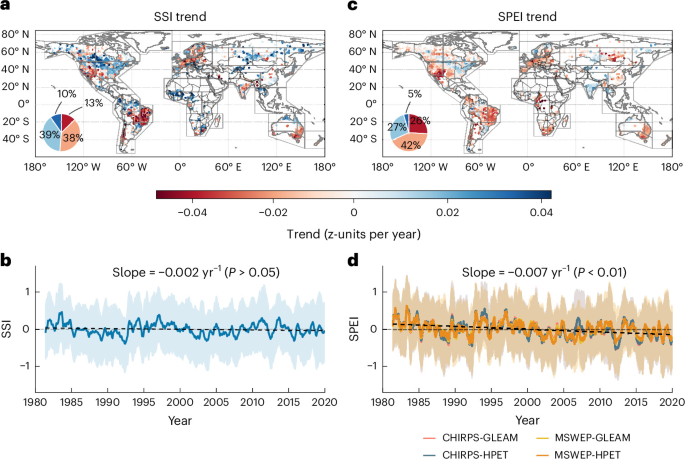
Atmospheric evaporative demand is increasing with climate warming and can intensify drought, yet how strongly long-term atmospheric drying propagates into realized river-flow deficits remains poorly quantified. Here using streamflow observations from approximately 19,000 catchments worldwide, we provide a global observational assessment of hydrological drought and compare its evolution with atmospheric drought diagnosed from precipitation and evaporative demand. We show that atmospheric drought trends exhibit a broad spatial predominance towards drying over the past four decades, whereas streamflow drought trends are substantially more heterogeneous and show highly spatially variable change at the global scale. This heterogeneity is consistent with nonlinear drought propagation that can attenuate, delay, reshape or amplify atmospheric drought signals before they emerge in streamflow. Our results provide global observational evidence that long-term atmospheric drying is not transmitted uniformly or proportionally into river flow but can be weakened in many catchments and reinforced in others, highlighting the need to account explicitly for hydrological propagation when assessing water-security risks under climate warming.
Fragmentation outweighs forest cover in shaping land surface temperature across half of global forests
Authors: Jiawei Li, Jiaxin Wu, Jun Ma
Journal: Proceedings of the National Academy of Sciences · DOI: 10.1073/pnas.2615021123
Matched topics: climate change
Forests are widely recognized for their significant role in climate change mitigation. Global landscape-scale assessments have focused mainly on how forest cover (FC) affects temperature. Yet, changes in forest area are generally accompanied by altered fragmentation, and both the independent effect of fragmentation on forest thermal environments and its contribution relative to FC remain insufficiently understood. We disentangled the respective relationships of fragmentation and FC with land surface temperature (LST) across the globe. Except in boreal zones with a mean annual air temperature below 0°C, LST was positively associated with forest fragmentation. In 48% of global forests, the influence of fragmentation on LST predominated over that of FC exerting an effect averaging 3.23 times as large. In particular, tropical forest loss typically coincided with increased fragmentation, jointly contributing to amplified warming. Our findings highlight that forest fragmentation should be considered alongside FC when assessing the climate benefits of global forests, and that optimizing landscape configurations could enhance the effectiveness of forestry policies in achieving climate goals.
Opportunities for increasing resilience to changing severe weather in southern Africa: “Early Action and Enhanced Adaptive Capacity for All”
Authors: Elizabeth J. Kendon, Luis Artur, Francois Engelbrecht, Dewald Van Niekerk, Carlos Ayala, Alexander J. Baker et al.
Journal: Bulletin of the American Meteorological Society · DOI: 10.1175/bams-d-25-0196.1
Matched topics: climate change

Our world is facing unprecedented extremes due to climate change. These are likely to be outside the coping range of indigenous methods and existing disaster risk reduction capabilities. For Early Warning Systems (EWS) to significantly reduce risks from weather hazards, they need to be effective and resilient to future extreme conditions. EWS across Africa, however, face tremendous challenges including a lack of comprehensive risk analysis, issues disseminating information and insufficient financing to set up systems especially in the most at-risk contexts. Despite progress, many people still do not access warnings, and an alarming number of people do not act. Experience from research projects across southern Africa has identified communication gaps, a lack of trust, involuntary immobility, the limited inclusion of vulnerable groups, a lack of integration of climate change considerations into EWS design and limited coordination of EWS across all governance levels as key barriers to EWS uptake. To overcome these barriers, and support effective early action and enhance adaptive capacity for all, we outline six priority intervention areas: (a) understanding risks of unprecedented events; (b) stress-testing of EWS; (c) equipping hydrometeorological services; (d) community participation toward vulnerability-focused EWS; (e) integrating local and scientific knowledge; and (f) strengthening coordination across agencies.
Making river cooperation fairer
Authors: Phoebe Koundouri
Journal: Nature Water · DOI: 10.1038/s44221-026-00718-6
Matched topics: river
Abstract not available.
Statistics
| Metric | Count |
|---|---|
| Journals searched | 11 |
| Total papers fetched | 90 |
| Passed deterministic filter | 5 |
| After LLM relevance filtering | 4 |
| Rejected (not relevant) | 1 |
| AI for Science items picked | 0 |
Papers by journal
| Journal | Papers |
|---|---|
| Nature Water | 2 |
| Proceedings of the National Academy of Sciences | 1 |
| Bulletin of the American Meteorological Society | 1 |
Filtering Criteria
Topics: hydrology, hydrologic model, river, runoff, streamflow, reservoir, water management, flood, drought, seasonal, land surface model, climate change, hydropower, surface water, irrigation, earth system model, estuary, coastal, freshwater discharge, river plume, ocean biogeochemistry, marine heatwave, paleohydrology, paleoclimate, Quaternary, Holocene, Pleistocene, fluvial geomorphology, river terrace, loess, drainage network, river capture, landscape evolution, luminescence dating
Fields: engineering, environmental science, computer science, geology, geography