Paper Harvest Report
Date range: July 31, 2026
3 top-tier papers selected out of 4 total publications
Today’s Highlights
Permafrost thaw in Arctic coastal zones is mobilizing ancient organic carbon into nearshore marine sediments, yet a new Nature Geoscience study finds that less than 10% of this Pleistocene-age carbon is respired back to the atmosphere—most is buried, though the reactive fraction may have already degraded in the water column, suggesting Earth system models need better representation of coastal permafrost carbon pathways. Meanwhile, a pair of complementary Nature Geoscience papers debate what drives asymmetric Himalayan river drainage: the original study argues rainfall gradients explain the patterns without invoking river piracy, while the reply defends evidence for tectonic-driven drainage reorganization—a dispute central to understanding how river networks evolve over geological timescales.
Table of Contents
Top-Tier Journal Papers
Limited remineralization of Arctic permafrost-derived organic carbon in nearshore marine sediments
Authors: Manuel Ruben, Bingbing Wei, Anabel von Jackowski, Jens Hefter, Torben Gentz, Florence Schubotz et al.
Journal: Nature Geoscience · DOI: 10.1038/s41561-026-02060-8
Matched topics: earth system model, coastal, Pleistocene
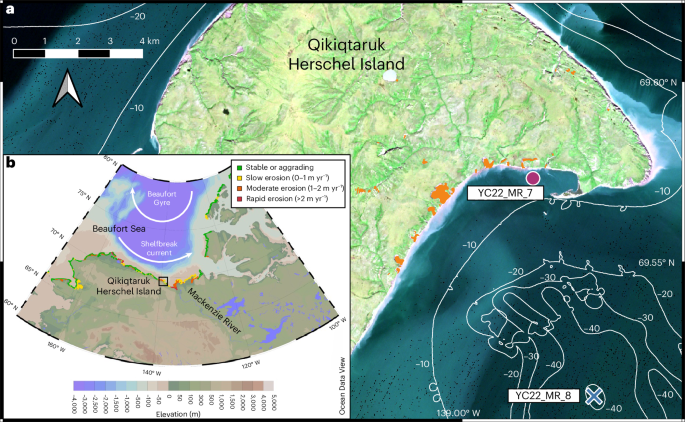
Rapid Arctic warming causes thawing and erosion of coastal permafrost, releasing organic carbon into the Arctic Ocean. Although much of this organic carbon is deposited in marine sediments, the extent to which it is remineralized and re-enters the active carbon cycle remains uncertain. Here we examine the fate of permafrost-derived organic carbon in the nearshore sediments of Qikiqtaruk, Canada. Analysis of dual carbon isotopes revealed that nearshore sedimentary organic carbon originated predominantly from eroded ancient permafrost deposits, but the remineralization end-product, dissolved inorganic carbon, diffusing back out of the sediment was younger and predominantly of marine origin. We estimate that <10% of land-derived Pleistocene permafrost organic carbon is respired after redeposition in marine sediments. Our findings indicate that despite substantial Pleistocene permafrost organic carbon accumulation in marine sediments due to permafrost thaw and coastal erosion, much of it remains buried, potentially limiting its immediate contribution to atmospheric carbon. However, given the high reactivity of permafrost organic carbon entering the ocean, a reactive subfraction may remain in the water column or was degraded prior to redeposition in the analysed sediments, highlighting the need for more comprehensive assessments of permafrost organic carbon degradation and its inclusion into Earth system models.
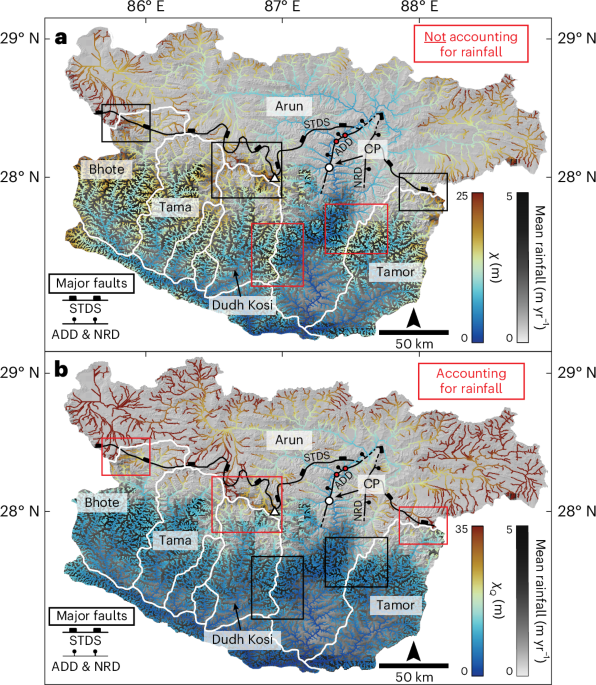
Himalayan rivers reflect rainfall patterns, not river piracy
Authors: Joel S. Leonard, Kelin X. Whipple
Journal: Nature Geoscience · DOI: 10.1038/s41561-026-02059-1
Matched topics: river
Abstract not available.
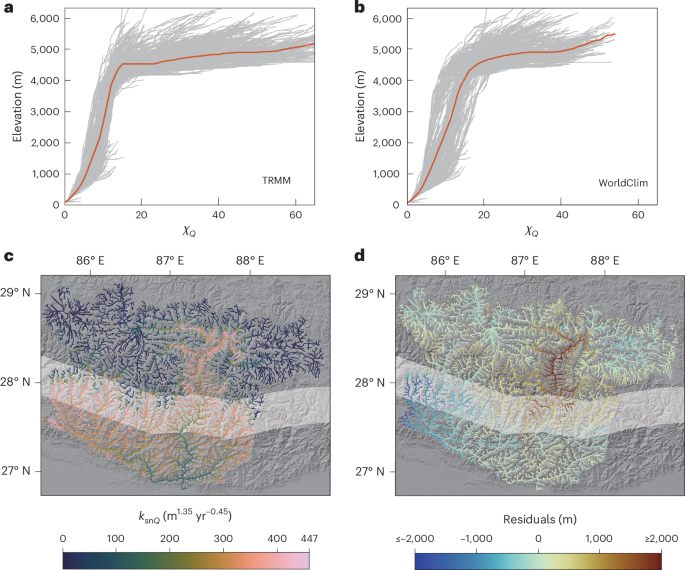
Reply to: Himalaya rivers reflect rainfall patterns, not river piracy
Authors: Xu Han, Adam G. G. Smith, Jin-Gen Dai, Matthew Fox
Journal: Nature Geoscience · DOI: 10.1038/s41561-026-02061-7
Matched topics: river
Abstract not available.
Statistics
| Metric | Count |
|---|---|
| Journals searched | 11 |
| Total papers fetched | 28 |
| Passed deterministic filter | 4 |
| After LLM relevance filtering | 3 |
| Rejected (not relevant) | 1 |
| AI for Science items picked | 0 |
Papers by journal
| Journal | Papers |
|---|---|
| Nature Geoscience | 3 |
Filtering Criteria
Topics: hydrology, streamflow, river, flood, drought, reservoir, dam, water resources, groundwater, precipitation, runoff, watershed, basin, irrigation, hydropower, water quality, evapotranspiration, soil moisture, snowmelt, glacier, climate change, land surface model, earth system model, remote sensing, machine learning, coastal, estuary, sea level, ocean, permafrost, Pleistocene, Holocene, paleohydrology, geomorphology, fluvial, sediment, erosion, seasonal, monsoon, ENSO, teleconnection
Fields: Hydrology, Environmental Science, Earth and Planetary Sciences, Geology, Oceanography, Geography, Water Resources, Civil Engineering, Atmospheric Science