Paper Harvest Report
Date range: August 04, 2026
2 top-tier papers selected out of 83 total publications
Today’s Highlights
A paleoclimate study from PNAS uses stable carbon isotope analysis to reconstruct Early Holocene moisture variability across the southern Levant, showing that grain size increases in pre-domestication cereals reflect plastic developmental responses to local water availability rather than genetic selection — reframing a long-standing narrative in archaeobotany. A mechanistic Lagrangian heat budget analysis of the 2013–2016 North Pacific marine heatwave (Nature Communications) demonstrates that ocean heat advection, not anomalous surface heat flux, was the dominant sustaining mechanism, with a persistent low-pressure anomaly driving a positive feedback loop that maintained the event across multiple years.
Table of Contents
Top-Tier Journal Papers
Developmental plasticity under human management shaped cereal evolution prior to domestication in the Early Holocene southern Levant
Authors: Jade Whitlam, Pascal Flohr, Amy Bogaard, Michael Charles, Bill Finlayson, Cheryl A. Makarewicz
Journal: Proceedings of the National Academy of Sciences · DOI: 10.1073/pnas.2535274123
Matched topics: Holocene
The domestication of plants in southwest Asia was an evolutionary process that took place over several millennia in the Early Holocene. During this time, domestic species developed distinct traits that distinguished them from their wild counterparts. Current models of plant domestication emphasize the role of genetic selection in the evolution of these traits, viewing these as heritable adaptations that arose in response to selective pressures associated with human cultivation. In cereals, domestication resulted in the evolution of nonshattering rachis and increased grain size, two traits that can be tracked directly in the archaeobotanical record. Analyses of Early Neolithic cereal remains demonstrate that grain size increase occurred prior to the evolution of nonshattering rachis, a sequence that is often interpreted as evidence of selection for larger grains under cultivation, specifically tillage. Here, we combine morphological and metrical analyses of cereal remains, stable carbon isotope analysis, and weed ecology to test this hypothesis, using three assemblages from the southern Levant: Pre-Pottery Neolithic A Sharara (c. 9250-9200 cal BCE), Pre-Pottery Neolithic A el-Hemmeh (c. 9400-8700 cal BCE), and Late Pre-Pottery Neolithic B el-Hemmeh (c. 7500-7000 cal BCE). Our findings indicate that increased grain size in the Early Holocene can be better understood as a plastic response to variation in growing conditions, specifically moisture, rather than as a result of genetic selection for increased grain size under cultivation. We propose that cereal evolution in southwest Asia was initially driven by developmental plasticity, followed by genetic selection.
Coupled air–sea interactions drove and sustained the 2013–2016 North Pacific marine heatwave
Authors: Wenrui Jiang, Gaël Forget, Yuanyuan Song, Thomas W. N. Haine
Journal: Nature Communications · DOI: 10.1038/s41467-026-76096-0
Matched topics: marine heatwave
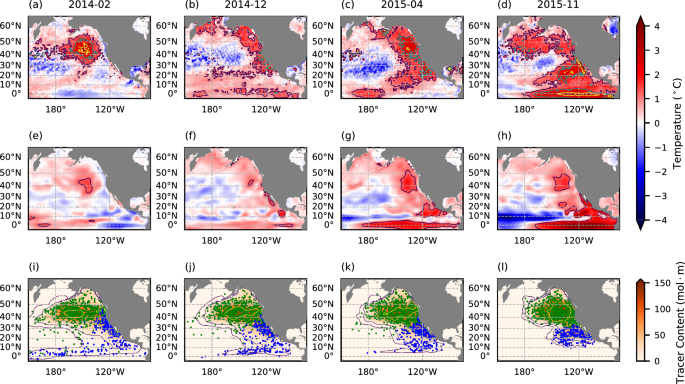
The 2013–2016 marine heatwave (MHW) in the Northeastern Pacific ranks among the most intense extratropical ocean warming events on record. Its intricate evolution has complicated efforts to understand the underlying dynamics crucial for predicting future MHWs. Here, we track the MHW using a closed, three-dimensional Lagrangian heat budget that quantifies the processes driving its evolution. Three-dimensional particle trajectories separate the MHW into northern and southern components and reveal that they are of distinct kinematic origin. We quantitatively demonstrate through a closed budget that advection, rather than surface forcing, plays the dominant role in sustaining the MHW’s heat content. The northern component was maintained by a weakening of Ekman heat transport across the North Pacific Current, combined with reduced wintertime surface heat loss. The southern component was driven by weakened Ekman upwelling caused by reduced alongshore winds over the California Current. We further identify a persistent low sea-level pressure anomaly over the central Pacific that altered wind patterns, redistributing heat and moisture poleward to ultimately force both parts of the MHW. Elevated surface temperatures, in turn, amplified this pressure anomaly, completing a positive feedback loop that sustained the event across multiple years.
Statistics
| Metric | Count |
|---|---|
| Journals searched | 11 |
| Total papers fetched | 83 |
| Passed deterministic filter | 6 |
| After LLM relevance filtering | 2 |
| Rejected (not relevant) | 4 |
| AI for Science items picked | 0 |
Papers by journal
| Journal | Papers |
|---|---|
| Proceedings of the National Academy of Sciences | 1 |
| Nature Communications | 1 |
Filtering Criteria
Topics: hydrology, hydrologic model, river, runoff, streamflow, reservoir, water management, flood, drought, seasonal, land surface model, climate change, hydropower, surface water, irrigation, earth system model, estuary, coastal, freshwater discharge, river plume, ocean biogeochemistry, marine heatwave, paleohydrology, paleoclimate, Quaternary, Holocene, Pleistocene, fluvial geomorphology, river terrace, loess, drainage network, river capture, landscape evolution, luminescence dating
Fields: engineering, environmental science, computer science, geology, geography