Paper Harvest Report
Date range: September 04, 2026
3 top-tier papers selected out of 74 total publications
Today’s Highlights
Two coupled biases in CESM2 suppress Northwest Indian Ocean warming and produce an erroneous moistening trend over Eastern Central India, highlighting critical targets for Earth system model improvement before monsoon projections can be trusted. Meanwhile, a pan-peatland analysis across 276 site-years reveals that hydrology controls the temperature sensitivity of carbon release — raising water tables above 20 cm is the key lever for climate mitigation in these ecosystems. Finally, a remote-sensing study of boreal forests shows that phenological leaf-loss events cause roughly twice the warming of equivalent leaf-gain events, a positive biophysical feedback with implications for land surface model parameterizations.
Table of Contents
Top-Tier Journal Papers
Diagnosing CESM2 Biases in Northwest Indian Ocean Warming and Its Implications for India Summer Monsoon Precipitation
Authors: Yunfan Chen, Julia Cole, Samantha Stevenson, Midhun Madhavan, Yan Du, Yingying Feng et al.
Journal: Geophysical Research Letters · DOI: 10.1029/2026gl123060
Matched topics: earth system model
Declining monsoon rainfall over agriculture‐dependent Eastern Central India (ECI) during 1901–2014 threatens regional food and water security. Observations link ECI drying to rapid Northwest Indian Ocean (NWIO) warming, which weakens monsoon circulation. However, the widely used Community Earth System Model version 2 (CESM2) Large Ensemble fails to reproduce this drying, instead simulating increasing ECI precipitation while underestimating NWIO warming. Using the fully coupled CESM2 Large Ensemble and Pacific pacemaker experiments where realistic tropical Pacific SST anomalies are specified, we identify ocean biases limiting NWIO warming: (a) a lack of El Niño intensification diminishes Pacific‐to‐Indian Ocean heat transmission; (b) an overly deep southwestern Indian Ocean thermocline weakens the thermocline–SST feedback, constraining NWIO warming. The drying effect of NWIO warming‐induced monsoon weakening could be masked by thermodynamic forcing from global warming in the CESM2 Large Ensemble, leading to ECI wetting. Addressing these model biases is critical for monsoon rainfall projections.
Phenological Fluctuations Induce Seasonal Asymmetric Warming in Boreal Forests
Authors: Kai Yan, Panpan Liu, Cheng Huang, Jing M. Chen, Yongxian Su, Si Gao et al.
Journal: Nature Communications · DOI: 10.1038/s41467-026-77464-6
Matched topics: seasonal
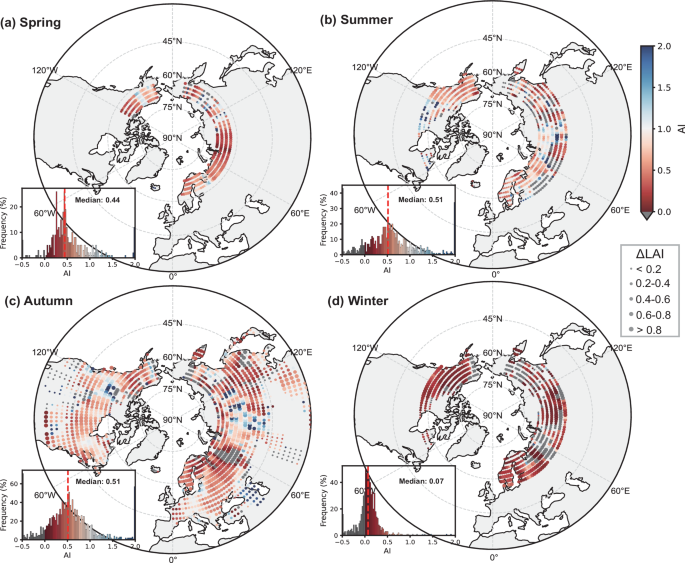
Phenological shifts in boreal forests alter land-atmosphere energy exchange, but annual averages mask pronounced seasonal contrasts in the magnitude and pathways of this feedback. Here we show that climate-driven phenological instability generates a systematic warming asymmetry: surface warming from leaf area loss exceeds the cooling from an equivalent gain. During the growing season, additional foliage yields diminishing cooling returns as transpiration approaches its physiological limits, constraining latent heat flux. During the dormant season, the canopy-snow albedo contrast makes shortwave radiation dominant; because this radiative perturbation is converted into surface temperature highly non-linearly, foliage loss still produces a net warming exceeding the cooling from an equivalent gain. Per unit leaf area change, the median asymmetry index indicates warming roughly 2.0-2.3 times stronger than cooling in spring and autumn, and about an order of magnitude stronger in winter, where a very small greening-side sensitivity inflates the ratio; in summer both responses approach the detection limit and the asymmetry is not directionally robust. Phenological instability therefore acts as a seasonally structured positive biophysical feedback in northern ecosystems.
Drivers of Northern Peatland CO2 Fluxes Revisited: Interacting Water Level-Temperature Dependency
Authors: Nicolas Behrens, Christian Brümmer, Kuno Kasak, June Skeeter, Ian B. Strachan, Ype van der Velde et al.
Journal: Nature Communications · DOI: 10.1038/s41467-026-77456-6
Matched topics: hydrology, river
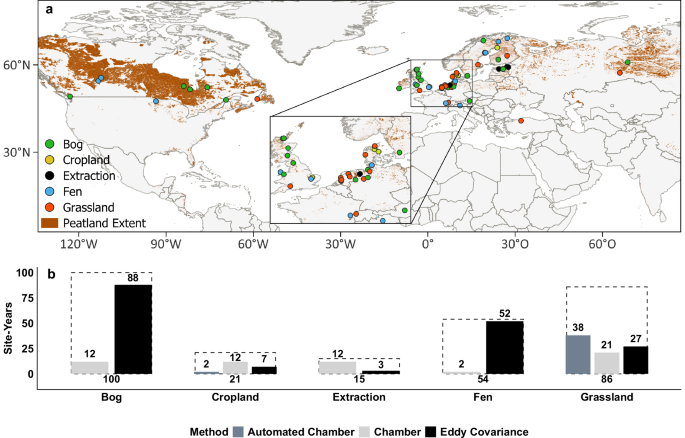
Peatlands are the largest terrestrial stores of organic carbon, but drainage has turned them into substantial sources of CO2. While water level is widely recognized as the primary control of CO2 emissions from peatlands, effective future management requires understanding its interaction with rising temperatures under a warming climate. Using 276 site-years of annual CO2 flux observations across temperate and boreal peatlands, we apply explainable machine-learning to disentangle the combined effects of water table depths and temperature on ecosystem CO2 exchange at annual scales. Across peatlands spanning diverse land-cover—including natural fens and bogs, croplands, grasslands, and extraction sites—CO2 emissions exhibit a non-linear response to water table depth. Emissions decline when water tables are raised above 60-75 cm depth. Optimal mitigation requires water tables of 20 cm or higher. We find that deep water tables interact with temperatures to increase emissions at temperate sites. On a subset of 113 site-years of daily CO2 flux data, we show that at warm temperatures, higher water tables suppress, whereas deeper water tables enhance temperature-driven CO2 emissions from peatlands. We demonstrate that hydrology regulates the temperature sensitivity of peatland carbon release, revealing a key control on carbon–climate feedbacks under future warming.
AI for Science
How AI is changing research
- Department of Energy bets on ‘open’ AI models for science (Science, 2026-09-11) — DOE is partnering with an AI startup on “Genesis Mission,” building open foundation models to automate large-scale scientific workflows at national labs. Directly relevant: DOE national labs run E3SM (Earth System Model) and other climate/hydrologic codes — an open scientific AI infrastructure could accelerate model calibration, parameterization, and ensemble workflows that currently require manual expert intervention.
Statistics
| Metric | Count |
|---|---|
| Journals searched | 11 |
| Total papers fetched | 74 |
| Passed deterministic filter | 7 |
| After LLM relevance filtering | 3 |
| Rejected (not relevant) | 4 |
| AI for Science items picked | 1 |
Papers by journal
| Journal | Papers |
|---|---|
| Nature Communications | 2 |
| Geophysical Research Letters | 1 |
Filtering Criteria
Topics: hydrology, hydrologic model, river, runoff, streamflow, reservoir, water management, flood, drought, seasonal, land surface model, climate change, hydropower, surface water, irrigation, earth system model, estuary, coastal, freshwater discharge, river plume, ocean biogeochemistry, marine heatwave, paleohydrology, paleoclimate, Quaternary, Holocene, Pleistocene, fluvial geomorphology, river terrace, loess, drainage network, river capture, landscape evolution, luminescence dating
Fields: engineering, environmental science, computer science, geology, geography