Paper Harvest Report
Date range: October 14, 2026
5 top-tier papers selected out of 111 total publications
Today’s Highlights
The day’s standout is a machine learning framework that doubles subseasonal (2–6 week) forecast skill and outperformed all operational centers at ECMWF’s 2025 real-time competition—a breakthrough with direct implications for reservoir operations and flood preparedness. Complementing the predictive advances, a 450,000-year speleothem record from the Andes reveals that Northern and Southern Hemisphere monsoons are usually anti-phased but synchronize during glacial terminations, refining paleo-ESM benchmarks. Rounding out a strong day: climate-warming simulations project a shift toward more extreme warm-season floods in the Midwest using WRF-Hydro, compound drought-heatwave events are expanding their global spatial footprint, and South Atlantic atmospheric river patterns can predict Amazon wildfire severity two months ahead.
Table of Contents
- Today’s Highlights
- Top-Tier Journal Papers
- Advancing subseasonal forecasting with machine learning
- Interhemispheric monsoon dynamics over the past 450,000 years
- Changes in Flood Frequency and Seasonality Across Midwestern U.S. Watersheds Under a Warming Climate: Insights From Convection-Permitting Climate Simulations and Physics-Based Hydrologic Models
- Global expansion of compound drought–heatwave risk
- A South Atlantic atmospheric river dipole as a key precursor of Amazon wildfires
- AI for Science
- Statistics
- Filtering Criteria
Top-Tier Journal Papers
Advancing subseasonal forecasting with machine learning
Authors: Hannah Guan, Soukayna Mouatadid, Paulo Orenstein, Judah Cohen, Haiyu Dong, Zekun Ni et al.
Journal: Nature · DOI: 10.1038/s41586-026-11126-x
Matched topics: seasonal

Decision-makers rely on weather forecasts to plant crops, manage wildfires, allocate water and energy and prepare for weather extremes. Today, such forecasts enjoy unprecedented accuracy as far as 2 weeks thanks to steady advances in physics-based dynamical models and data-driven artificial intelligence models. However, model skill drops precipitously at subseasonal timescales (2–6 weeks ahead) due to compounding errors, systemic model biases and the chaotic nature of the atmosphere. To counter this degradation, we introduce probabilistic bias correction, a machine learning framework that substantially reduces systematic error by learning to correct historical probabilistic forecasts. When applied to the leading dynamical and artificial intelligence models from the European Centre for Medium-Range Weather Forecasts (ECMWF), probabilistic bias correction doubles the modest subseasonal skill of the AI Forecasting System and improves the skill of the operationally debiased dynamical model for 91% of pressure, 92% of temperature and 98% of precipitation targets. We designed probabilistic bias correction for operational deployment, and, in the 2025 real-time forecasting competition of ECMWF, its global forecasts were the best for all weather variables and lead times, outperforming the dynamical models from six operational forecasting centres, an international dynamical multimodel ensemble, the AI Forecasting System of ECMWF and the forecasting systems of 34 teams worldwide.
Interhemispheric monsoon dynamics over the past 450,000 years
Authors: E. J. Olson, D. P. Gillikin, D. Parmenter, S. Burns, A. Verheyden, O. Miyawaki et al.
Journal: Nature · DOI: 10.1038/s41586-026-11166-3
Matched topics: climate change
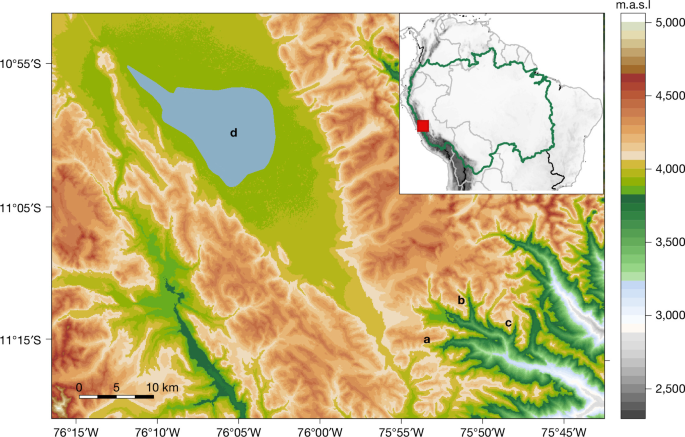
The global monsoon system provides freshwater to much of Earth’s biota, including its human population. The Milankovitch theory predicts changes in Earth’s solar insolation over geologic time, and these variations are expected to result in changes to the global monsoon. Internal climate forcings, such as ice cover and sea surface temperatures, may also affect the system. However, few records of monsoon variability in the Southern Hemisphere over glacial–interglacial cycles exist to test our understanding of the factors that drive variations in the global monsoon. Here we show that monsoons in both the Southern and Northern Hemispheres vary with Milankovitch forcing, and with internal boundary conditions over the past 450,000 years. We present a record of South American Summer Monsoon (SASM) variability, based on speleothem oxygen-isotope data from the Amazon Basin. South American Summer Monsoon variability and that of a major Northern Hemisphere monsoon—that is, the Asian monsoon—have been strikingly out of phase. However, we observe occasional synchronous behaviour in regions impacted by both monsoons. We identify a synchronicity threshold that is exceeded during ten events, including during glacial terminations. Comparison with palaeoclimatic forcing factors during these intervals indicates that greenhouse gas concentrations, cross-equatorial thermal gradients and sea surface temperatures in both the Atlantic and Pacific probably influence these events.
Changes in Flood Frequency and Seasonality Across Midwestern U.S. Watersheds Under a Warming Climate: Insights From Convection-Permitting Climate Simulations and Physics-Based Hydrologic Models
Authors: Mohammad Abbasian, Daniel B. Wright, Michael Notaro, Steve Vavrus, Daniel J. Vimont
Journal: Geophysical Research Letters · DOI: 10.1029/2026gl124622
Matched topics: hydrologic model, flood, seasonal
We combine CONUS404 convection-permitting climate simulations with the physics-based WRF-Hydro model to assess how climate warming may influence flood frequency and seasonality across the Midwestern United States. This framework captures interactions among precipitation, soil moisture, and snowpack that shape flood generation. Both simulated warming and historical records show a regional shift toward more extreme warm-season, rainfall-driven floods. This regional signal, however, does not translate uniformly to individual watersheds, where flood responses reflect not only warming but also the influence of subregional climate variability and sampling uncertainty. Local flood-frequency changes thus remain highly uncertain despite the thermodynamic tendency toward stronger convective precipitation. Ensembles of convection-permitting simulations are needed to constrain plausible local outcomes. These findings suggest that flood risk communication under climate warming should distinguish broad climate-driven tendencies from uncertain local responses.
Global expansion of compound drought–heatwave risk
Authors: Amitesh Sabut, Ashok Mishra, Ruby Leung, Dara Entekhabi
Journal: Nature Communications · DOI: 10.1038/s41467-026-78045-3
Matched topics: drought
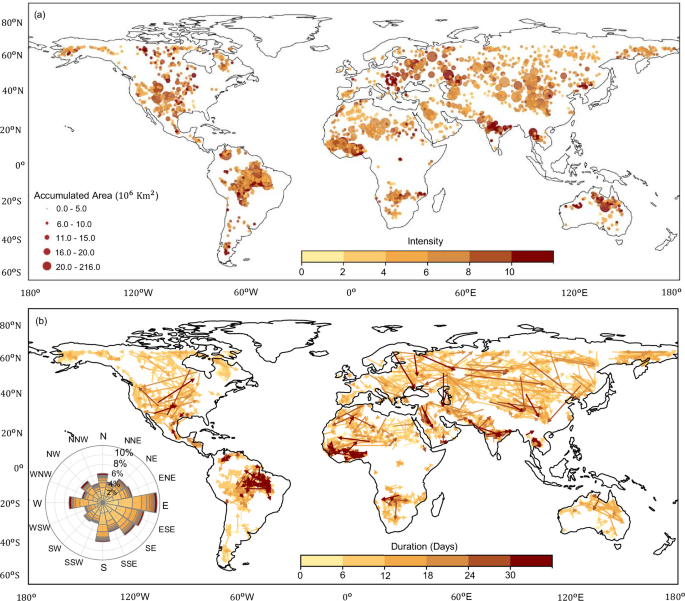
The increasing frequency of compound drought and heatwave (CDHW) events poses a growing threat to water security, agriculture, and ecosystems. However, the evolution, expansion, and spatial reorganization of CDHW hotspots across global land regions remain largely unexplored. Here we track more than 2500 CDHW events using a three-dimensional connected-component (CC3D) labeling approach and show that CDHWs, often treated as spatially stationary extremes, exhibit systematic displacement over time. Larger and longer-lasting events tend to travel farther and faster, expanding the spatial footprint of compound heat and moisture stress. Most contiguous events persist for 6–12 days, displace by up to ~500 km, and reach peak daily spatial extents of 2–5 × 10⁵ km². Migration is strongest in the Northern Hemisphere mid-latitudes and is predominantly eastward. We identify emerging hotspots of increasing CDHW migration potential across the European Plains, western North America, the Amazon, the West African Sahel, Central Asia, and northern Australia. These shifts are linked to evolving large-scale atmospheric circulation and are reinforced by downstream drying through reduced moisture transport and strengthened land–atmosphere coupling.
A South Atlantic atmospheric river dipole as a key precursor of Amazon wildfires
Authors: Shiyue Zhang, Wenhao Dong, Deliang Chen
Journal: Nature Communications · DOI: 10.1038/s41467-026-78572-z
Matched topics: river
Wildfires in the Amazon have far-reaching climatic and ecological impacts, yet their predictability remains limited. Here we identify a large-scale atmospheric precursor of August–September Amazon wildfires: a June–July dipole mode of South Atlantic atmospheric rivers (ARs), characterized by suppressed AR activity in the north and enhanced activity in the south. This dipole is strongly linked to interannual variability in Amazon wildfire activity through land–atmosphere feedbacks associated with reduced precipitation and humidity, enhanced surface warming and solar radiation, and increased vegetation stress. We estimate that wildfire-related forest loss associated with this AR dipole mode accounts for approximately 26% of the observed interannual variability in total forest loss. Adding the South Atlantic AR dipole to predictors based on May–June sea surface temperature anomalies and June–July wildfire activity yields substantial predictive skill for August–September burned area (R² = 0.67). Climate model projections further indicate a future intensification of the South Atlantic AR dipole mode, implying increased wildfire-driven ecological degradation in the Amazon under continued warming.
AI for Science
How AI is changing research
-
An AI tool improves weather forecasts up to a month ahead (Nature, 2026-10-21) — A new AI-based model pushes skillful sub-seasonal weather forecasting beyond two weeks, a threshold that has long resisted conventional numerical weather prediction. For hydrologists and water managers, accurate monthly outlooks are transformative: they enable earlier decisions on reservoir pre-release, drought preparedness, and flood-risk operations that currently rely on ensemble forecasts with large uncertainty at 3–4 week lead times.
-
Using thousands of AI agents to uncover new leads in biological data (OpenAI Blog, 2026-10-21) — OpenAI deployed a fleet of thousands of AI agents to screen large biological datasets and surface non-obvious hypotheses. The methodology is field-agnostic: the same multi-agent parallelism could be applied to large Earth-system model ensemble archives or satellite remote-sensing time series—rapidly generating and ranking hypotheses about, for example, which combinations of land-surface parameters drive model spread in streamflow projections.
Cross-discipline sparks
- Cave stalagmites document global patterns in monsoon rainfall over the past 450,000 years (Nature, 2026-10-21) — A new global synthesis of speleothem δ¹⁸O records reveals coherent monsoon variability across four orbital cycles. The AI angle: modern sequence models and graph neural networks can now integrate thousands of spatially distributed speleothem records with orbital forcing to produce high-resolution paleohydrologic reconstructions—work that previously required years of manual correlation. For earth-system modelers, this offers a new benchmark dataset for validating paleo-ESM simulations of the Holocene and LGM hydrological cycle.
Statistics
| Metric | Count |
|---|---|
| Journals searched | 11 |
| Total papers fetched | 111 |
| Passed deterministic filter | 10 |
| After LLM relevance filtering | 5 |
| Rejected (not relevant) | 5 |
| AI for Science items picked | 3 |
Papers by journal
| Journal | Papers |
|---|---|
| Nature | 2 |
| Geophysical Research Letters | 1 |
| Nature Communications | 2 |
Filtering Criteria
Topics: hydrology, hydrologic model, river, runoff, streamflow, reservoir, water management, flood, drought, seasonal, land surface model, climate change, hydropower, surface water, irrigation, earth system model, estuary, coastal, freshwater discharge, river plume, ocean biogeochemistry, marine heatwave, paleohydrology, paleoclimate, Quaternary, Holocene, Pleistocene, fluvial geomorphology, river terrace, loess, drainage network, river capture, landscape evolution, luminescence dating
Fields: engineering, environmental science, computer science, geology, geography