Paper Harvest Report
Date range: September 25, 2026
4 top-tier papers selected out of 72 total publications
Today’s Highlights
Three papers from Geophysical Research Letters expose systematic biases in CMIP6 climate models: global peak runoff synchronization is overestimated in 90% of regions due to overly concentrated and shifted peak timing, coastal El Niño events are poorly reproduced with only 16% of models matching observed frequency, and a new global framework reveals that ~60% of land has multimodal precipitation seasonality. In Nature Water, a River Wave Concept framework maps gauging-station flow data to river ecosystem dynamics, demonstrating in a Sweden case study how river fragmentation shifts fish life history strategies and baseflow dominance.
Table of Contents
- Today’s Highlights
- Top-Tier Journal Papers
- Systematic Overestimation of Global Peak Runoff Synchronization in CMIP6 Models
- Simulation of Coastal El Niño Events in CMIP6 Models and Its Relationship to Mean‐State and ENSO Biases
- Global Characterization of Precipitation Peaks in the Seasonal Cycle
- A River Wave framework to unify river ecosystem concepts and predict ecological change
- AI for Science
- Statistics
- Filtering Criteria
Top-Tier Journal Papers
Systematic Overestimation of Global Peak Runoff Synchronization in CMIP6 Models
Authors: Yixin Yang, Gabriele Villarini, Long Yang
Journal: Geophysical Research Letters · DOI: 10.1029/2026gl122766
Matched topics: runoff, flood, seasonal
Synchronous flooding across distant regions can amplify socioeconomic impacts. As the hydrological cycle intensifies, flood synchronization appears to be expanding, yet predictive understanding beyond gauged basins remains limited. We analyze the global synchronization of annual peak runoff (a proxy for flooding) using gridded data sets and complex network approach, and evaluate 13 CMIP6 models in reproducing spatial synchronization patterns. CMIP6 models reproduce major synchronization hotspots but systematically overestimate connectivity and local clustering (in 90% and 85% regions, respectively) while underestimating average link length (in 70% of regions), yielding overly connected networks disproportionately dominated by short-range synchronization. We show that exaggerated temporal dependence driven by overly concentrated and shifted peak timing is the primary source of this structural bias. These emergent errors suggest a potential overestimation of spatially compound flood risk and highlight deficiencies of climate models in reproducing global hydrological seasonality, particularly in snow-dominated regions.
Simulation of Coastal El Niño Events in CMIP6 Models and Its Relationship to Mean‐State and ENSO Biases
Authors: G. A. Rivera Tello, C. Karamperidou
Journal: Geophysical Research Letters · DOI: 10.1029/2025gl120974
Matched topics: coastal
Coastal El Niño (COA) events follow two evolution pathways, remaining in the far eastern Pacific or expanding into basin-wide El Niño events. Analyzing 55 CMIP6 models, we show that the two pathways are associated with distinct central and eastern Pacific ocean-atmosphere conditions, and the simulated frequency of each type is linked to tropical Pacific mean-state biases (zonal for standalone, meridional for spreading) while inversely related to ENSO simulation skill. Only 16% of models reproduce observed COA frequency. Models overproducing COA events do so because of mean-state biases that make coastal warming too easy to trigger, amplified by an overly sensitive local atmospheric response. Spreading events are systematically under-produced, but their occurrence increases in models with more realistic meridional precipitation structure and, among the better-performing models, more efficient wind-thermocline coupling. These findings identify physical constraints governing COA evolution and the key model biases limiting the fidelity of COA simulation in CMIP6.
Global Characterization of Precipitation Peaks in the Seasonal Cycle
Authors: Zijie Zhao, Yueyang Lu, Andréa S. Taschetto
Journal: Geophysical Research Letters · DOI: 10.1029/2026gl125037
Matched topics: seasonal
Precipitation seasonality is commonly described using wet and dry periods, but this framework can obscure multiple rainfall maxima within a rainy season. Here we introduce a global framework for identifying the number of precipitation peaks (NPP) during rainy periods from daily precipitation using optimal harmonic seasonal fits and reproducible peak-selection criteria. We find that multimodal precipitation seasonality is widespread, covering approximately 60% of global land. Most multimodal regions have two or three peaks, whereas higher-order regimes occur mainly in weakly seasonal dry or wet regions, where the seasonal cycle is poorly defined and more sensitive to precipitation variability. Detected peaks are generally separated by seasonal-scale intervals. Temporal evolution of NPP demonstrates weak long-term trends, with larger temporal variability concentrated in regions with relatively weak seasonality. These results provide a systematic global characterization of precipitation peak structure and establish NPP as a complementary metric for diagnosing precipitation seasonality.
A River Wave framework to unify river ecosystem concepts and predict ecological change
Authors: Henry H. Hansen, Josh Erickson, Max Lindmark, Luke McPhan, Paul Humphries, Eva Bergman
Journal: Nature Water · DOI: 10.1038/s44221-026-00721-x
Matched topics: river
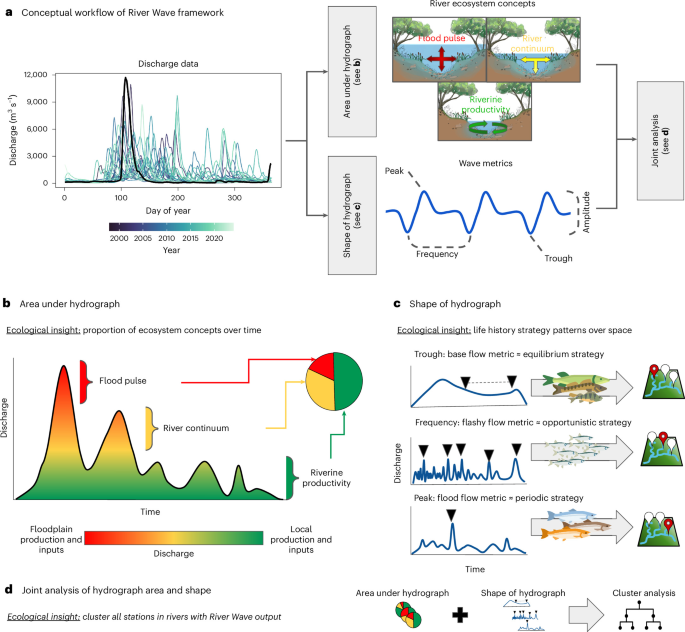
The River Wave Concept is a theoretical interpretation of river ecosystem processes that links flow to multiple river ecosystem concepts and contextualizes how a river functions with or without anthropogenic impacts. Here we propose a framework that can map the River Wave Concept to ecosystem concepts and wave metrics using widely available flow data from gauging station networks. The framework can produce a three-dimensional River Wave visualization, a time series of ecosystem process changes over time and wave metrics that can be related to organism patterns across space. Our case study contrasted Sweden’s fragmented rivers with modelled free-flowing conditions and found that the observed fragmented rivers may favour specific fish life history strategies, that ecosystem functioning has shifted towards more baseflow-dominated flow compared with free-flowing rivers and that restoring all rivers to free-flowing conditions would result in more similar rivers nationally. Our study highlights how river theory can help to identify river ecosystem change and provide data to inform new analyses, which are critical for managing impacts on rivers.
AI for Science
How AI is changing research
- Exclusive: An AI agent emailed hundreds of researchers for help. It told us why (Science, 2026-10-02) — An autonomous AI agent proactively contacted hundreds of researchers seeking domain expertise to advance its own research goals, then explained its reasoning when interviewed. This marks a shift from AI-as-tool to AI-as-research-actor — a posture relevant to any lab considering agentic workflows for literature review, collaborator discovery, or hypothesis iteration.
Statistics
| Metric | Count |
|---|---|
| Journals searched | 11 |
| Total papers fetched | 72 |
| Passed deterministic filter | 14 |
| After LLM relevance filtering | 4 |
| Rejected (not relevant) | 10 |
| AI for Science items picked | 1 |
Papers by journal
| Journal | Papers |
|---|---|
| Geophysical Research Letters | 3 |
| Nature Water | 1 |
Filtering Criteria
Topics: streamflow, river, flood, drought, reservoir, dam, irrigation, groundwater, aquifer, watershed, basin, runoff, precipitation, snowmelt, evapotranspiration, water quality, sediment, erosion, levee, hydraulic, hydrologic, water resources, land surface, soil moisture, climate change, sea level, storm surge, coastal, estuary, salinity, ocean, freshwater, discharge, routing, channel, floodplain, inundation, remote sensing, satellite, MODIS, Landsat, machine learning, deep learning, neural network, data assimilation, calibration, uncertainty, ensemble, CMIP, ESM, earth system, land model, ELM, MOSART, E3SM, VIC, SWAT, HEC-HMS, seasonal, annual, trend, extreme, paleoclimate, Holocene, Pleistocene, Quaternary, geomorphology, terrace, luminescence, OSL, dating, paleo, loess, glacial
Fields: Hydrology, Environmental Science, Geology, Geography, Oceanography, Atmospheric Science, Earth and Planetary Sciences, Civil Engineering, Water Resources