Paper Harvest Report
Date range: October 15, 2026
7 top-tier papers selected out of 143 total publications
Today’s Highlights
A Nature Water study reveals that atmospheric drying translates unevenly into river drought across regions, suggesting that vapor pressure deficit trends alone cannot predict streamflow deficits without accounting for catchment storage and land-surface feedbacks. The SWOT satellite demonstrated its capacity for daily-scale flood observation along a narrow Canadian river, tracking a 5 m water surface rise and fall in under 24 hours despite channel widths below 100 m. Meanwhile, a new lifecycle framework for compound drought-heatwave events shows that a minority of events undergo within-event regime shifts that dramatically amplify heat stress and ecosystem damage — a finding with direct implications for climate-adaptive water management.
Table of Contents
- Today’s Highlights
- Top-Tier Journal Papers
- Atmospheric drying translates unevenly into river drought
- ‘Super’ El Niño spurs research on ecosystem impacts
- Observation of Daily Flood Hazard During the SWOT Cal/Val Orbit
- Regime Shifts During Compound Drought‐Heatwave Events Amplify Ecosystem and Heat Stress Risks
- Multidecadal Changes in Atmospheric Dryness Over East Asia Dominated by Internal Climate Variability
- No Evidence for Strongly Enhanced Northern Hemisphere Cooling From Extratropical Versus Tropical Eruptions
- MJO Predictability: Its Sources and Limits
- AI for Science
- Statistics
- Filtering Criteria
Top-Tier Journal Papers
Atmospheric drying translates unevenly into river drought
Authors: Xiaomang Liu, Kaiwen Wang
Journal: Nature Water · DOI: 10.1038/s44221-026-00731-9
Matched topics: river, drought
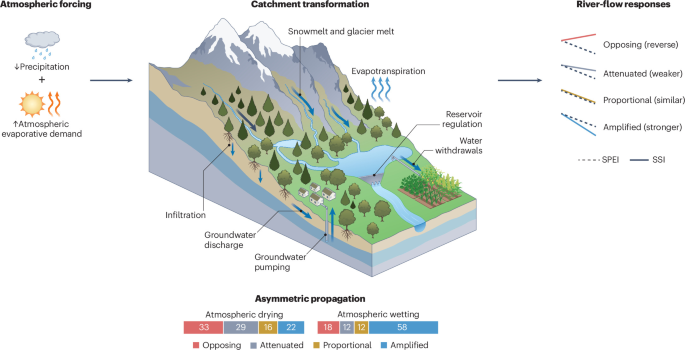
Abstract not available.
‘Super’ El Niño spurs research on ecosystem impacts
Authors: Warren Cornwall
Journal: Science · DOI: 10.1126/science.aen2357
Matched topics: climate change
This year’s event could shed light on how the natural world may respond to climate change in the decades ahead.
Observation of Daily Flood Hazard During the SWOT Cal/Val Orbit
Authors: Yukina Hara, Dai Yamazaki, Megumi Watanabe, Colin J. Gleason, Shinjiro Kanae
Journal: Geophysical Research Letters · DOI: 10.1029/2026gl124074
Matched topics: river, flood
Flood peaks can develop and recede within a day, making them difficult to capture with satellites with multi‐day revisit intervals. Here, we exploit daily observations during the Calibration and Validation phase of the SWOT mission to examine a short‐lived flood in May 2023 along the Du Gouffre River in Canada. Despite channel widths below 100 m, SWOT tracked day‐to‐day changes in water surface elevation, capturing a rapid rise of approximately 5 m consistent in timing and magnitude with in situ measurements. We derived flood extent based on classification and confidence information. The results show partial spatial overlap with an independent post‐event flood hazard map, with differences primarily associated with reduced classification confidence in vegetated floodplains and narrow reaches. Some areas not identified as water may reflect erosion, sediment deposition, or post‐peak conditions. These results highlight the value of high‐frequency wide‐swath radar altimetry for monitoring transient floods.
Regime Shifts During Compound Drought‐Heatwave Events Amplify Ecosystem and Heat Stress Risks
Authors: Yi Yang, Jianping Tang
Journal: Geophysical Research Letters · DOI: 10.1029/2026gl125653
Matched topics: drought, seasonal
Compound drought‐heatwave events (CDHEs) can cause severe ecological and socioeconomic impacts worldwide. However, their mechanisms are often inferred from seasonal statistics or event‐mean composites that obscure within‐event process evolution. Here we develop a daily regime‐based framework to characterize global summer CDHE lifecycles using reanalysis data from 1961 to 2022. Most events remain within a single thermodynamic regime, whereas a recurrent minority undergoes within‐event regime shifts. The two leading transition pathways remain far less frequent than steady pathways, but events following them last longer, are more severe, and have increased significantly over recent decades. Sunny‐Humid to Advective transitions are linked to strengthened warm air transport and amplified human heat stress, whereas Sunny‐Humid to Sunny‐Dry transitions reflect a shift toward moisture‐limited conditions and larger declines in ecosystem productivity. Accounting for daily process evolution can therefore improve assessments of compound drought‐heatwave risks in a warming climate.
Multidecadal Changes in Atmospheric Dryness Over East Asia Dominated by Internal Climate Variability
Authors: Xi Wang, Wenjian Hua, Aiguo Dai, Lu Zhou, Minhua Qin, Haishan Chen
Journal: Geophysical Research Letters · DOI: 10.1029/2026gl125508
Matched topics: river
Summer near‐surface vapor pressure deficit (VPD), a key measure of atmospheric dryness, has increased markedly across East Asia since 1980, yet the relative roles of external forcing and internal variability (IV) in its multidecadal changes remain unclear. Here we show that IV dominates East Asian VPD variability during 1901–2024, accounting for about 81% of the total variance and largely explaining the recent drying over northern China. We identify the Indian Ocean Basin Mode (IOBM) as a key oceanic driver of this variability. A positive IOBM phase triggers a Pacific–Japan pattern‐like teleconnection, enhances subsidence and warming over East Asia and suppresses moisture transport into northern China, thereby increasing VPD. Indian Ocean pacemaker experiments capture the main circulation and warming responses, supporting this mechanism. Together, these results provide robust evidence that tropical Indian Ocean–driven IV has played a decisive role in recent atmospheric drying over East Asia.
No Evidence for Strongly Enhanced Northern Hemisphere Cooling From Extratropical Versus Tropical Eruptions
Authors: Zachary McGraw, Benjamin O. Goldman, Lorenzo M. Polvani
Journal: Geophysical Research Letters · DOI: 10.1029/2026gl122071
Matched topics: paleoclimate
Volcanic eruptions in the Northern Hemisphere extratropics have been reported to produce several times greater cooling in that region than tropical eruptions of similar magnitude. Using a large ensemble of simulations spanning the eruption size range from 5 to 40 Tg of stratospheric sulfur, we find that the extratropical‐to‐tropical cooling ratio is consistently within a factor of two, indicating no enhancement beyond the effect of aerosols being confined to a single hemisphere. We further show that paleoclimate evidence suggests similarly unexceptional cooling, and also reconcile why earlier analyses yielded unreliable estimates. Moreover, owing to their rarity, we argue that extratropical eruptions exert a smaller overall influence on Northern Hemisphere extratropical temperatures than tropical eruptions. These findings question the notion that extratropical eruptions are of outsized importance for the climate of the Northern Hemisphere.
MJO Predictability: Its Sources and Limits
Authors: Meriem Krouma, Yakelyn R. Jauregui, Boualem Khouider, Brandon Kerns, Daehyun Kim, Hyemi Kim et al.
Journal: Bulletin of the American Meteorological Society · DOI: 10.1175/bams-d-25-0345.1
Matched topics: seasonal, climate change

The Madden–Julian Oscillation (MJO) is the dominant mode of intraseasonal variability in the tropical atmosphere and a central source of subseasonal-to-seasonal (S2S) predictability. Despite decades of progress, theoretical understanding of its forecast horizon remains elusive and contested. This workshop-inspired review synthesizes insights on MJO predictability, highlighting advances in theory, modeling, and machine learning applications, while critically assessing persistent challenges. We revisit the layered concepts of intrinsic, potential, and practical predictability, with intrinsic predictability set by the flow itself, potential predictability defined by idealized initial conditions, and practical predictability constrained by real observations, data availability, and forecasting methodologies. We examine the physical sources and statistical approaches underlying prediction skill, and evaluate current metrics and verification methodologies, emphasizing that evaluation metrics must be responsive to user needs and that observing systems should be designed in concert with model requirements. We then assess limits imposed by physical processes such as MJO initiation and the Maritime Continent propagation barrier, as well as their potentially unclear modification under climate change. Finally, we outline future research opportunities—spanning observations, hybrid modeling, and user-centered forecasting—and argue for a more integrative prediction framework in which dynamical, statistical, hybrid, and machine-learning approaches are treated not as competitors but as complementary components of a unified MJO forecasting system, while identifying open questions that will shape the next decade of MJO research.
AI for Science
How AI is changing research
- Beyond tree cover: mapping the world’s forest types (Google DeepMind, 2026-10-22) — Google DeepMind released a global forest-type map at 10-meter resolution, classifying every patch of Earth’s land surface into distinct structural forest types — going well beyond simple tree-cover fraction. For land-surface and earth-system modelers, this layer directly improves parameterization of canopy interception, stomatal conductance, and litter inputs — quantities that cascade into evapotranspiration and runoff partitioning in models such as ELM and CLM. The ability to distinguish forest structural type rather than just presence/absence is a resolution step-change for catchment-scale hydrology and global land-surface parameter databases.
Statistics
| Metric | Count |
|---|---|
| Journals searched | 11 |
| Total papers fetched | 143 |
| Passed deterministic filter | 14 |
| After LLM relevance filtering | 7 |
| Rejected (not relevant) | 7 |
| AI for Science items picked | 1 |
Papers by journal
| Journal | Papers |
|---|---|
| Geophysical Research Letters | 4 |
| Science | 1 |
| Bulletin of the American Meteorological Society | 1 |
| Nature Water | 1 |
Filtering Criteria
Topics: hydrology, hydrologic model, river, runoff, streamflow, reservoir, water management, flood, drought, seasonal, land surface model, climate change, hydropower, surface water, irrigation, earth system model, estuary, coastal, freshwater discharge, river plume, ocean biogeochemistry, marine heatwave, paleohydrology, paleoclimate, Quaternary, Holocene, Pleistocene, fluvial geomorphology, river terrace, loess, drainage network, river capture, landscape evolution, luminescence dating
Fields: engineering, environmental science, computer science, geology, geography