Paper Harvest Report
Date range: October 16, 2026
4 top-tier papers selected out of 11 total publications
Today’s Highlights
Mid-Holocene biomarker records from across the Arctic, combined with a Bayesian proxy system model, reduce uncertainty in future winter sea ice projections by 85% — suggesting ice extent nearly 1 million km² lower than prior multi-model estimates. Meanwhile, high-resolution hydrodynamic modeling of a Nebraska Tribal Nation reveals that climate warming produces localized flood adjustments rather than widespread intensification, highlighting a transferable framework for under-mapped communities. Interpretable machine learning further shows that Earth system models likely underestimate nonlinear soil carbon responses to temperature and precipitation extremes.
Table of Contents
- Today’s Highlights
- Top-Tier Journal Papers
- Palaeoclimate constraints narrow uncertainty in future Arctic winter sea ice projections
- Flood Responses to Climate Warming on Tribal Lands Using High‐Resolution Hydrodynamic Modeling
- Offshore Freshened Groundwater Distribution Is Controlled by Along‐ and Cross‐Shore Topographic Variability
- Interpretable Machine Learning Reveals Global Nonlinear Responses of Soil Respiration to Climate
- AI for Science
- Statistics
- Filtering Criteria
Top-Tier Journal Papers
Palaeoclimate constraints narrow uncertainty in future Arctic winter sea ice projections
Authors: C. Y. Fu, M. B. Osman, M. A. Aquino-López
Journal: Nature Geoscience · DOI: 10.1038/s41561-026-02123-w
Matched topics: seasonal, Holocene
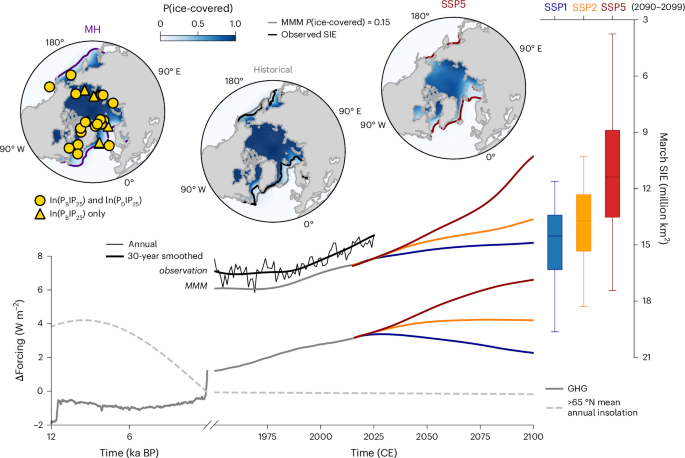
Arctic sea ice decline has been observed across all seasons and is projected to continue in the future. Relative to historical observations, climate models show their largest biases and uncertainties during winter, when ice cover strongly regulates air–sea heat exchange, ocean mixing and atmospheric circulation. Palaeoclimate records offer opportunities to evaluate model performance beyond the historical period, but applications have remained largely qualitative. Here we compile an Arctic-wide database of mid-Holocene (5–7 thousand years ago) biomarkers to assess sea ice simulations of this past warm period. Using a recently developed proxy system model, we present a Bayesian palaeoclimate model weighting scheme that refines the multi-model mean winter sea ice extent through fully quantitative proxy-model comparisons, accounting for model interdependence and non-stationary proxy seasonality. We demonstrate that, by adjusting the contribution of each model to the ensemble mean based on proxy evidence, model weights can eliminate biases and reduce uncertainties by 85%, to the level of interannual variability. Weighted projections using the same climate models indicate that future winter sea ice extent may be nearly 1 million km² lower than prior estimates across forthcoming decades and possible emissions scenarios, with broad implications for Arctic ecosystems, mid-latitude weather, and cryosphere stability.
Flood Responses to Climate Warming on Tribal Lands Using High‐Resolution Hydrodynamic Modeling
Authors: Tianjiao Pu, Gabriele Villarini, Renato S. Amorim, Donghui Li, Sudershan Gangrade, Martha Durr, Brandi Janssen
Journal: Geophysical Research Letters · DOI: 10.1029/2026gl124766
Matched topics: runoff, flood
Tribal nations across the United States face disproportionate flood impacts yet remain significantly underrepresented in national‐scale assessments, creating a critical equity gap in climate adaptation. We address this deficiency through a climate‐to‐local‐inundation framework for the Santee Sioux Nation, Nebraska, by forcing 10‐m hydrodynamic simulations with a 42‐year paired historical and pseudo‐global‐warming CONUS404 runoff event set. Results show that projected changes in inundation frequency and flood depth are limited, with no evidence of widespread intensification of flood extremes. Instead, changes manifest as localized adjustments in floodplain activation and tributary connectivity. Pixel‐wise return‐period analysis shows small changes in flood depth and only minor deviations in the statistical structure of extremes. These findings demonstrate a transferable pathway for translating climate‐driven hydrologic forcing into locally resolved inundation information for under‐mapped Tribal lands.
Offshore Freshened Groundwater Distribution Is Controlled by Along‐ and Cross‐Shore Topographic Variability
Authors: Yi‐Peng Zhang, Anner Paldor
Journal: Geophysical Research Letters · DOI: 10.1029/2026gl123775
Matched topics: reservoir
Offshore Freshened Groundwater (OFG) reservoirs are regarded as a potentially significant resource stored in continental shelves. While the role of subsurface geological conditions in controlling OFG has been widely recognized, the influence of the topography of the hosting continental shelf on OFG evolution remains poorly understood. Here, using generalized numerical modeling representative of a broad range of systems worldwide, we evaluate how the shelf slope affects the evolution of OFG in subsea aquifers, considering sea‐level rise over paleohydrogeological timescales. Our findings show that shallow dipping shelves are expected to have greater extents of OFG by up to 2.8 times and enhance the longevity of OFG preservation. Crucially, natural‐scale alongshore slope variability substantially influences the cross‐shore salt distribution. Considering alongshore flow shows that cross‐sectional analyses can overestimate OFG volumes by up to 3 times. These findings highlight the significance of shelf slope and lateral (alongshore) dynamics in estimating and predicting OFG resources.
Interpretable Machine Learning Reveals Global Nonlinear Responses of Soil Respiration to Climate
Authors: Benjamin Laffitte, Zhihan Yang, Tao Zhou, Xiangjun Pei, Xiaolu Tang
Journal: Geophysical Research Letters · DOI: 10.1029/2026gl124051
Matched topics: river, seasonal, climate change, earth system model
Soil respiration (Rs) is a major component of the global carbon cycle, yet its responses to environmental drivers remain poorly constrained. Using 8,111 observations and a SHAP‐interpreted Random Forest model, we identified global response patterns for key environmental drivers of Rs. Temperature contributions showed a peaked association with a descriptive maximum of 27.7°C, precipitation contributions plateaued at high values, and leaf area index contributions increased approximately linearly. These results provide a global, data‐driven characterization of peaked temperature and saturating precipitation associations, including how their shapes and supported ranges vary among climate zones. Our results indicate that monotonic assumptions in Earth system models may overlook important nonlinearities and potentially bias estimates of terrestrial carbon flux responses to seasonal climate extremes. Interpretable machine learning therefore provides a transparent framework for evaluating and improving the representation of soil carbon dynamics under climate change.
AI for Science
Cross-discipline sparks
- Predicting protein electrostatics with protein language models (Nature: Machine Learning, 2026-10-24) — A language model trained on protein sequences now accurately predicts electrostatic surface properties — a physical quantity never present in the training signal, yet emerging from sequence patterns alone. The earth-science analog: a foundation model pre-trained on raw remote-sensing time series (MODIS, Sentinel, streamflow records) might similarly learn to predict unobserved hydrologic states (soil moisture, groundwater recharge, snowpack) without those labels in training. The barrier was always architecture + compute; this paper suggests the representation itself does most of the work.
Statistics
| Metric | Count |
|---|---|
| Journals searched | 11 |
| Total papers fetched | 57 |
| Passed deterministic filter | 11 |
| After LLM relevance filtering | 4 |
| Rejected (not relevant) | 7 |
| AI for Science items picked | 1 |
Papers by journal
| Journal | Papers |
|---|---|
| Nature Geoscience | 1 |
| Geophysical Research Letters | 3 |
Filtering Criteria
Topics: hydrology, hydrologic model, river, runoff, streamflow, reservoir, water management, flood, drought, seasonal, land surface model, climate change, hydropower, surface water, irrigation, earth system model, estuary, coastal, freshwater discharge, river plume, ocean biogeochemistry, marine heatwave, paleohydrology, paleoclimate, Quaternary, Holocene, Pleistocene, fluvial geomorphology, river terrace, loess, drainage network, river capture, landscape evolution, luminescence dating
Fields: engineering, environmental science, computer science, geology, geography