Paper Harvest Report
Date range: August 24, 2026
7 top-tier papers selected out of 95 total publications
Today’s Highlights
A landmark SWOT-based evaluation of global river models reveals systematic gaps in economically developed areas, multi-channel rivers, and arid regions — pointing to where next-generation river modeling must improve. In parallel, a Nature Climate Change study finds climate warming is creating thermal fragmentation barriers that will affect 63% of riverine fish species under high-emission scenarios, with tropical regions facing the greatest species-level risk. A 47,000-year speleothem record from Central Asia illuminates how westerly circulation shifts have driven large-scale hydroclimate reorganizations, with direct implications for future water availability as subtropical circulation zones migrate northward.
Table of Contents
- Today’s Highlights
- Top-Tier Journal Papers
- SWOT, Empiricism, and River Modeling
- Climate warming drives thermal shocks and accelerated freshwater habitat fragmentation
- Declining hydraulic safety in a drier world
- Extended Fire Season Over Eastern Siberia Driven by Accumulated August–September Drought
- Methane Emissions From U.S. Lakes Dominated by Ebullition, Shallow Zones, and Anthropogenic Drivers
- The moisture dynamics in arid Central Asia over the last 47,000 years: Insights from the speleothem record
- Coastal Resilience in a Changing World: Lessons, Gaps, and Pathways Forward
- Statistics
- Filtering Criteria
Top-Tier Journal Papers
SWOT, Empiricism, and River Modeling
Authors: Colin J. Gleason, Paul D. Bates, Michael T. Durand, Dongmei Feng, Augusto Getirana, Peirong Lin et al.
Journal: Geophysical Research Letters · DOI: 10.1029/2026gl124323
Matched topics: river, surface water
Given the insurmountable challenge of measuring all rivers in situ, global river models serve as the foundation of freshwater knowledge past, present, and future. We adopt an inductive empirical framework based on Surface Water and Ocean Topography (SWOT) satellite measurements to assess these models. After controlling for SWOT data quality, we examine 68,347 individual river reaches representing ~38% of global discharge. We find river models currently struggle in areas of heavy economic development, multi‐channel rivers, arid areas, and many Arctic rivers. After controlling for these expected errors, we find better skill as rivers get wider and that parts of Siberia and China are particularly difficult to model. We also find large variability and spatial heterogeneity to model performance, resisting oversimplification. Our results suggest that leveraging SWOT observations within river models will improve them, but river models must adapt their structure to represent realistic hydraulics to do so.
Climate warming drives thermal shocks and accelerated freshwater habitat fragmentation
Authors: Hong Wang, Junguo Liu, Joseph Holden, Penghan Chen, Valerio Barbarossa, Megan Klaar
Journal: Nature Climate Change · DOI: 10.1038/s41558-026-02731-9
Matched topics: river, climate change
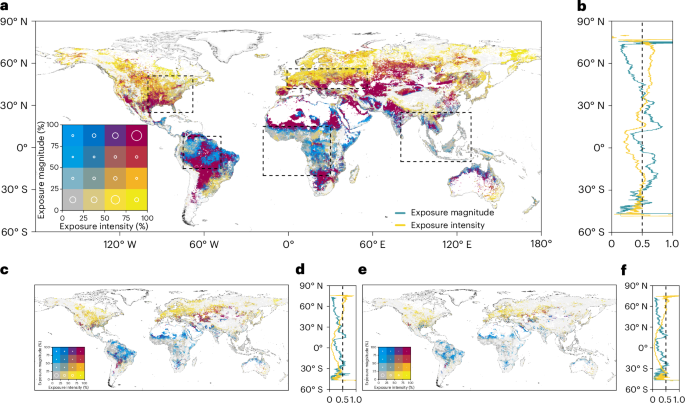
Climate change is exposing freshwater fish to warmer temperatures, causing widespread range contraction and population declines. However, how climate-driven disruptions will affect freshwater fish persistence under future thermal extremes remains poorly understood. Here, using weekly water temperature data (1976–2099), we assess the vulnerability of 9,809 freshwater species to short- and long-term thermal extremes and show that gradual warming can trigger abrupt thermal exposure. Tropical regions experience a high proportion of species at risk, whereas non-tropical regions face severe thermal extremes. We introduce the concept of thermal fragmentation exposure to understand how heterogeneous warming fragments freshwater habitat, thereby amplifying local extinction risks. Around 63% of riverine fish will experience more persistent thermal barriers under a high-emissions scenario, with thermal fragmentation accelerating over time. These findings underscore the urgent need for targeted conservation strategies to safeguard freshwater fish biodiversity.
Declining hydraulic safety in a drier world
Authors: Xingyun Liang, Nate G. McDowell, Defu Wang, Bo Cui, Jiemin Chen, Keyi Qiu et al.
Journal: Proceedings of the National Academy of Sciences · DOI: 10.1073/pnas.2622754123
Matched topics: drought, climate change
Forests worldwide are increasingly exposed to soil drought under climate change, with their fates depending on the ability to maintain essential functions like water transport (hydraulics) and photosynthesis. Acclimation is expected to mitigate drought impacts, but the extent to which trees acclimate remains largely untested, which limits our predictive confidence. Here, we examined 24 physiological attributes from 40 globally distributed forest throughfall reduction (TFE) experiments and found no evidence that trees adjusted their hydraulic or photosynthetic systems in response to drought. Key attributes related to embolism resistance, hydraulic efficiency, leaf nutrients, and Rubisco carboxylation capacity remained unchanged, regardless of coniferous or broadleaf trees, local precipitation levels, or the duration and severity of drought treatments. However, drought-induced declines in tissue water potentials, combined with unchanged embolism resistance, led to narrower hydraulic safety margins and thus an increased risk of hydraulic failure. Although net photosynthetic rate declined significantly due to stomatal closure, nonstructural carbohydrates (starch and sugars) remained stable, suggesting a shift in carbohydrate allocation toward storage. These findings indicate that trees maintain their hydraulic and photosynthetic capacities under drier conditions, enabling them to maximize carbon assimilation on favorable periods following rainfall, while facing an increased risk of hydraulic failure during drought. Physiological acclimation is unlikely to mitigate future drought impacts, while tree mortality from hydraulic failure is likely to increase.
Extended Fire Season Over Eastern Siberia Driven by Accumulated August–September Drought
Authors: Yawen Liu, Lian Xue, Xin Huang, Yun Qian, Minghuai Wang
Journal: Geophysical Research Letters · DOI: 10.1029/2026gl123797
Matched topics: river, drought, seasonal
Siberian wildfires, a major disturbance to ecosystems and carbon cycles, have intensified in recent decades, yet long‐term changes in fire seasonality remain unclear. Here, using a refined fire‐season framework, we identify a pronounced shift in fire season characteristics over eastern Siberia during 2002–2023, marked by substantial lengthening of the fire season and increasingly clustered occurrence of large fires. The fire season extends primarily through delayed termination of 1.48 days/yr into late autumn, associated with the growing persistence of extremely large September fires and more wildfire ignitions in October. We further find that enhanced fire‐weather conditions are the main driver, arising from accumulated drought associated with precipitation deficits in the preceding August–September period. These deficits coincide with persistent high‐pressure anomalies linked to declining Arctic sea ice and subpolar North Atlantic cooling, underscoring the importance of understanding mechanisms and improving early warning of antecedent hydroclimate in shaping high‐latitude fire‐season dynamics.
Methane Emissions From U.S. Lakes Dominated by Ebullition, Shallow Zones, and Anthropogenic Drivers
Authors: Chunqi Shen, Peter A. Raymond
Journal: Geophysical Research Letters · DOI: 10.1029/2026gl124792
Matched topics: river
Lakes are globally important sources of atmospheric methane (CH4), yet a process‐based understanding of their emissions and drivers at regional scales remains limited. Here we developed and applied a one‐dimensional lake model to 42,948 natural lakes across the contiguous United States (CONUS). Simulations indicate that ebullition is the dominant emission pathway, contributing ~70% of total fluxes, particularly in shallow, eutrophic systems. Shallow benthic zones act as emission hotspots, accounting for ~85% of lake CH4 emissions. CONUS lakes oxidize ~65% of produced CH4 on average, with oxidation efficiencies ranging from 46% in shallow lakes to 92% in deeper systems. Scenario analyses demonstrate that warming and nutrient enrichment jointly drive strong, nonlinear increases in lake CH4 emissions by preferentially enhancing ebullition. Our results indicate that nutrient management offers a practical and effective pathway to mitigate future lake CH4 release and weaken anthropogenic climate feedbacks.
The moisture dynamics in arid Central Asia over the last 47,000 years: Insights from the speleothem record
Authors: Yanjun Cai, Hai Cheng, Sebastian F. M. Breitenbach, Nosir Shukurov, Maxim Petrov, Shukhrat Shukurov et al.
Journal: Proceedings of the National Academy of Sciences · DOI: 10.1073/pnas.2537342123
Matched topics: Holocene
Water resources are crucial for the survival and development of human societies in arid Central Asia. However, our understanding of regional hydroclimate variability and moisture dynamics remains limited. Here, we present a precisely dated, high-resolution speleothem δ18O record from caves in northern Uzbekistan that reconstructs changes in precipitation δ18O over the last 47,000 years. During the glacial interval, relatively low speleothem δ18O values align with precipitation isotope records from high northern latitudes. The close correspondence between the Uzbekistan record and Greenland ice-core δ18O during Heinrich Stadial 1 indicates a strong temperature control on regional precipitation δ18O, although Dansgaard-Oeschger-scale variability is weakly expressed. During the Holocene, speleothem δ18O reached minimum values near 8 ka BP and then increased toward the present, broadly consistent with records from southern Uzbekistan and the Asian monsoon region, but with less coherent centennial- to millennial-scale variability. Supported by model simulations, we propose that during the glacial and mid-Holocene, when winter temperatures were low, the regional precipitation was dominated by northerly and northwesterly moisture transport linked to enhanced high-latitude temperature gradients and southward-shifted westerlies. In contrast, late Holocene hydroclimate increasingly reflected southerly to southwesterly cyclonic moisture transport from the eastern Mediterranean and the Near East, driven by northward-shifted westerlies. These results show that arid Central Asian hydroclimate and precipitation δ18O have been shaped by the position and strength of the westerlies through major reorganizations in moisture-source trajectories, with direct implications for understanding future water availability as subtropical and temperate circulation zones shift northward.
Coastal Resilience in a Changing World: Lessons, Gaps, and Pathways Forward
Authors: Gema Hernán, Maria Calleja, Baptiste Mourre, Simón Ruiz, Giacomo Tavecchia, Miguel Agulles et al.
Journal: Bulletin of the American Meteorological Society · DOI: 10.1175/bams-d-26-0238.1
Matched topics: coastal

Abstract not available.
Statistics
| Metric | Count |
|---|---|
| Journals searched | 11 |
| Total papers fetched | 95 |
| Passed deterministic filter | 15 |
| After LLM relevance filtering | 7 |
| Rejected (not relevant) | 8 |
| AI for Science items picked | 0 |
Papers by journal
| Journal | Papers |
|---|---|
| Geophysical Research Letters | 3 |
| Proceedings of the National Academy of Sciences | 2 |
| Nature Climate Change | 1 |
| Bulletin of the American Meteorological Society | 1 |
Filtering Criteria
Topics: hydrology, hydrologic model, river, runoff, streamflow, reservoir, water management, flood, drought, seasonal, land surface model, climate change, hydropower, surface water, irrigation, earth system model, estuary, coastal, freshwater discharge, river plume, ocean biogeochemistry, marine heatwave, paleohydrology, paleoclimate, Quaternary, Holocene, Pleistocene, fluvial geomorphology, river terrace, loess, drainage network, river capture, landscape evolution, luminescence dating
Fields: engineering, environmental science, computer science, geology, geography