Paper Harvest Report
Date range: October 23, 2026
1 top-tier paper selected out of 65 total publications
Today’s Highlights
A new study in Nature Communications provides a comprehensive assessment of climate-driven water stress across the US food-energy-water nexus, drawing on two decades of high-frequency withdrawal data. Future projections (2040–2070) reveal stark sectoral divergence: crop irrigation demand may rise 32–44% while thermoelectric cooling demand actually declines nearly 20–28% due to adaptation, and public water use swings widely depending on warming level and population scenario. The findings underscore that water scarcity is not a uniform national trend but a seasonally and regionally concentrated challenge shaped as much by adaptation choices as by climate itself.
Table of Contents
Top-Tier Journal Papers
Climate-driven water stress in the United States is seasonal, regional, and shaped by adaptation
Authors: Joey Blumberg, Travis Warziniack
Journal: Nature Communications · DOI: 10.1038/s41467-026-78688-2
Matched topics: seasonal
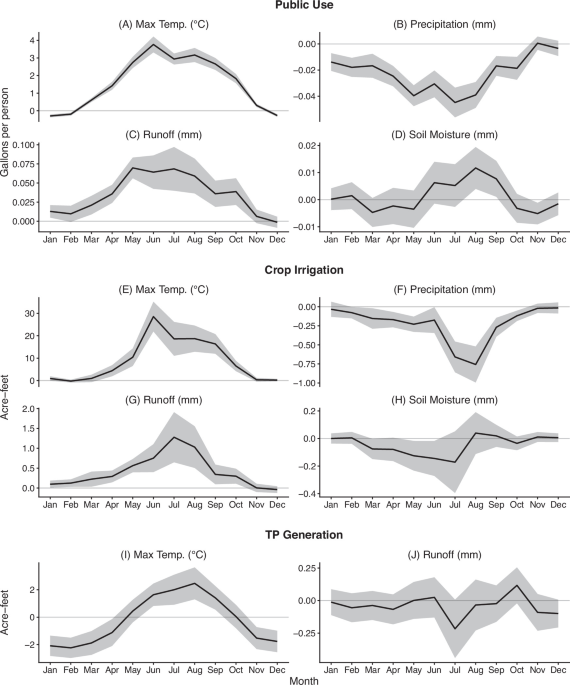
This study quantifies drivers of water use across the food-energy-water nexus and assesses how climate change, population growth, and adaptation may reshape future water scarcity in the United States. Using high frequency water withdrawal data from 2000–2020, we disentangle the effects of climate, hydrology, and socioeconomic factors on public water use, crop irrigation, and cooling for thermoelectric power generation. Future water demands (2040–2070) are estimated using recent climate and socioeconomic projections, representing 1.0 ∘C to 2.9 ∘C warming and population growth ranging from 1% to 44%. Across 28 scenarios, we estimate annual water use changes ranging from -10.7% to +28.9% for public use, +32.1% to +43.6% for crop irrigation, and -27.9% to -19.9% for thermoelectric power cooling, contingent on continued adaptive efforts. Results reveal strong sectoral variation in climate sensitivity, seasonal mismatches between water supply and demand, and shifts in regional water stress under future warming. Climate change and economic activity are reshaping when and where water stress occurs in the United States. This study identifies the drivers and locations of water stress and shows how targeted water management policies can reduce future scarcity.
Statistics
| Metric | Count |
|---|---|
| Journals searched | 11 |
| Total papers fetched | 65 |
| Passed deterministic filter | 5 |
| After LLM relevance filtering | 1 |
| Rejected (not relevant) | 4 |
| AI for Science items picked | 0 |
Papers by journal
| Journal | Papers |
|---|---|
| Nature Communications | 1 |
Filtering Criteria
Topics: hydrology, hydrologic model, river, runoff, streamflow, reservoir, water management, flood, drought, seasonal, land surface model, climate change, hydropower, surface water, irrigation, earth system model, estuary, coastal, freshwater discharge, river plume, ocean biogeochemistry, marine heatwave, paleohydrology, paleoclimate, Quaternary, Holocene, Pleistocene, fluvial geomorphology, river terrace, loess, drainage network, river capture, landscape evolution, luminescence dating
Fields: engineering, environmental science, computer science, geology, geography