Paper Harvest Report
Date range: October 26, 2026
3 top-tier papers selected out of 15 total publications
Today’s Highlights
A new GRL study deconstructs how extreme rainfall triggers a cascade from landslides to flash floods to debris flows, showing that landslide-channel coupling increases Shields stress by more than an order of magnitude and asymmetric transition mechanisms govern each stage. A complementary Nature Communications study quantifies the staggering material and emissions cost of flood-driven infrastructure rebuilding across Europe, projecting that coastal flooding alone could push annual demand more than tenfold higher by 2080 under moderate warming. Rounding out the day, a Nature Reviews Earth & Environment paper takes stock of small hydropower’s role in the Sustainable Development Goals, highlighting the trade-offs between energy access and ecological integrity.
Table of Contents
- Today’s Highlights
- Top-Tier Journal Papers
- Landslide‐Channel Coupling Controls Asymmetric Flash Flood—Debris Flow Transitions: Insights From an Extreme Rainfall‐Induced Hazard Chain in Yuzhong of China in 2025
- Building materials and emissions from rebuilding under increasing climate-driven flood hazards
- The role of small hydropower in achieving Sustainable Development Goals
- Statistics
- Filtering Criteria
Top-Tier Journal Papers
Landslide‐Channel Coupling Controls Asymmetric Flash Flood—Debris Flow Transitions: Insights From an Extreme Rainfall‐Induced Hazard Chain in Yuzhong of China in 2025
Authors: Guan Chen, Yan Chong, Xinghua Zhu, Zhelin Liu, Yi Yan, Yajun Li et al.
Journal: Geophysical Research Letters · DOI: 10.1029/2026gl124036
Matched topics: flood
Extreme rainfall‐triggered landslide–flash flood–debris flow hazard chains (LFFDF) are increasingly responsible for hydroclimatic losses worldwide. Although dynamics of individual hazards are established, transition mechanisms within LFFDF governed by coupled landslide–channel responses remain unresolved. Taking a catastrophic LFFDF event in northwestern China in 2025, we reconstructed the transition dynamics of the hazard chain using satellite data, seismic records, and numerical modeling. The results show that the LFFDF cascade operates as asymmetric transition processes, in which the dominant controls are state‐dependent. Rainfall‐induced landslides supplied one‐third of the mobilized sediment; their interaction with flash floods increased channel‐flow Shields stress by more than an order of magnitude, prematurely initiating debris flows in headwater channels. The downstream reversion from debris flow to flash flood is mainly controlled by the thickness and saturation state of channel sediments. Finally, we suggest a cascade‐based paradigm for risk assessment to enhance community resilience to LFFDF risks.
Building materials and emissions from rebuilding under increasing climate-driven flood hazards
Authors: Xiaoyang Zhong, Tomer Fishman, Timothy Tiggeloven, Yoav Peled, Yi Jin, Philip J. Ward et al.
Journal: Nature Communications · DOI: 10.1038/s41467-026-79185-2
Matched topics: river, flood, climate change, coastal
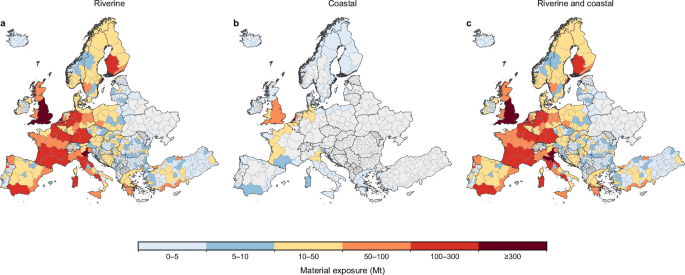
Floods threaten lives and infrastructure, while recovery and reconstruction require materials whose production generates greenhouse gas emissions. These material needs and emissions remain insufficiently quantified. Here we assess the impacts of riverine and coastal flooding on building materials across Europe under climate change and land subsidence. Baseline annual replacement demand is about 30 million tonnes of materials, generating about 9 million tonnes of carbon dioxide equivalent emissions. With flood protection maintained but not upgraded, both could increase more than tenfold by 2080 under a moderate emissions scenario, driven by coastal flooding. Impacts could be about 22% higher under a high emissions scenario. Cumulative replacement emissions over 2024–2080 under the moderate scenario could reach 4.0 billion tonnes of carbon dioxide equivalent, exceeding ten times Europe’s annual building material production emissions in 2020. Increasing both mitigation and adaptation efforts is essential to reduce material losses, further emissions and human suffering.
The role of small hydropower in achieving Sustainable Development Goals
Authors: Sijiu Zhang, Qiuwen Chen, Wei Zhi, Jianyun Zhang, Xia Zhang, Xingcheng Yan et al.
Journal: Nature Reviews Earth & Environment · DOI: 10.1038/s43017-026-00843-6
Matched topics: hydropower
Abstract not available.
Statistics
| Metric | Count |
|---|---|
| Journals searched | 11 |
| Total papers fetched | 79 |
| Passed deterministic filter | 15 |
| After LLM relevance filtering | 3 |
| Rejected (not relevant) | 12 |
| AI for Science items picked | 0 |
Papers by journal
| Journal | Papers |
|---|---|
| Geophysical Research Letters | 1 |
| Nature Communications | 1 |
| Nature Reviews Earth & Environment | 1 |
Filtering Criteria
Topics: hydrology, hydrologic, streamflow, river, flood, drought, reservoir, dam, irrigation, groundwater, watershed, basin, runoff, precipitation, evapotranspiration, soil moisture, water resources, water quality, climate change, land surface, remote sensing, satellite, machine learning, deep learning, neural network, sea level, coastal, estuary, ocean, salinity, sediment, erosion, geomorphology, paleoclimate, Holocene, Pleistocene, Quaternary, loess, glacier, ice sheet, permafrost, hydropower, water management, seasonal, monsoon
Fields: Environmental Science, Earth and Planetary Sciences, Geology, Geography, Oceanography, Hydrology, Water Resources