Paper Harvest Report
Date range: August 27, 2026
3 top-tier papers selected out of 123 total publications
Today’s Highlights
A glacier collapse above Nepal’s Thame valley unleashed one of the country’s deadliest flash floods in recent memory, underscoring the growing risk of glacial lake outburst floods as Himalayan ice retreats. Separately, a 1,000-year coral archive from the eastern Pacific shows El Niño events have grown markedly stronger since the late 20th century, with climate change emerging as the most plausible driver—an important signal for seasonal hydrology and water-resource planning across ENSO-sensitive basins. A Science Perspective argues that desert and dryland regions have been systematically overlooked in global flood adaptation frameworks, calling for targeted policy and monitoring investment in areas where flash floods are becoming more frequent under warming.
Table of Contents
Top-Tier Journal Papers
Glacier collapse caused Nepal’s deadly flash flood — a sign of things to come?
Authors: Mohana Basu
Journal: Nature · DOI: 10.1038/d41586-026-02716-w
Matched topics: flood
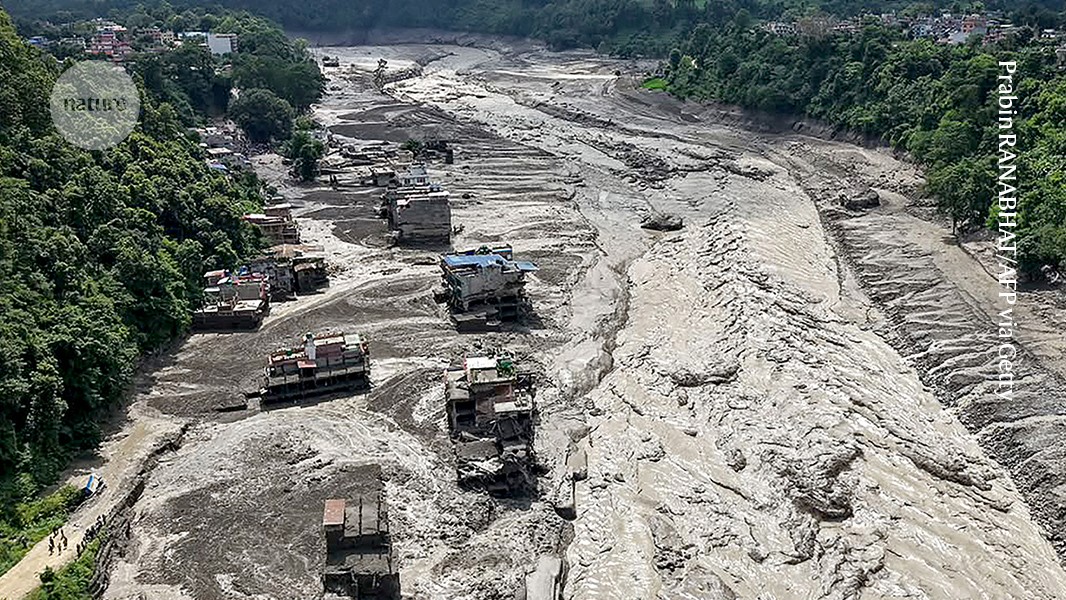
Abstract not available.
Why are El Niños getting stronger? 1,000-year-coral record points to climate change
Authors: James Dinneen
Journal: Nature · DOI: 10.1038/d41586-026-02717-9
Matched topics: climate change

Abstract not available.
Desert flooding highlights a critical gap in climate change adaptation
Authors: Ji-Xi Gao, Hai-Dong Li, Li-Jun Zhao, Dilinuer Tuoliewubieke, Ying-Kui Li, Ya-Mei Shao
Journal: Science · DOI: 10.1126/science.aek8173
Matched topics: flood, climate change
Abstract not available.
AI for Science
How AI is changing research
-
Introducing WeatherNext 3, our most advanced and accurate global weather AI model (Google DeepMind, 2026-09-03) — DeepMind’s third-generation global weather AI achieves new accuracy benchmarks at higher spatial resolution. For hydrologists and land-surface modelers this matters directly: WeatherNext-class forecasts are increasingly adopted as atmospheric forcing for catchment-scale runoff models and flood prediction systems, and accuracy gains translate immediately to improved streamflow forecast skill.
-
Can AI help solve the peer-review crisis? Here are its promises and pitfalls (Science, 2026-09-03) — Amid a shortage of human reviewers, AI-assisted tools are entering the scientific workflow at scale. Early evidence suggests AI can screen for statistical errors and flag missing methods, but struggles with novelty assessment. For hydrology, where large modeling-ensemble studies often stall in review limbo, faster triage of routine technical checks could meaningfully accelerate publication cycles.
Statistics
| Metric | Count |
|---|---|
| Journals searched | 11 |
| Total papers fetched | 123 |
| Passed deterministic filter | 6 |
| After LLM relevance filtering | 3 |
| Rejected (not relevant) | 3 |
| AI for Science items picked | 2 |
Papers by journal
| Journal | Papers |
|---|---|
| Nature | 2 |
| Science | 1 |
Filtering Criteria
Topics: hydrology, hydrologic model, river, runoff, streamflow, reservoir, water management, flood, drought, seasonal, land surface model, climate change, hydropower, surface water, irrigation, earth system model, estuary, coastal, freshwater discharge, river plume, ocean biogeochemistry, marine heatwave, paleohydrology, paleoclimate, Quaternary, Holocene, Pleistocene, fluvial geomorphology, river terrace, loess, drainage network, river capture, landscape evolution, luminescence dating
Fields: engineering, environmental science, computer science, geology, geography