Paper Harvest Report
Date range: July 13, 2026
4 top-tier papers selected out of 14 total publications
Today’s Highlights
A neural network emulator (Neural-BGC) coupled to the Regional Ocean Modeling System reproduces observed biogeochemical patterns—including oxygen minimum zones and coastal nutrient fronts—and outperforms a tuned NPZD model across contrasting upwelling regimes, opening an efficient path for data-driven ocean BGC modeling. On the terrestrial side, a US-wide forest inventory analysis shows that compound heat–drought extremes exert synergistic negative impacts stronger than the sum of individual extremes, but higher tree diversity consistently improves both resistance and recovery. A BAMS essay rounds out the day by exploring how co-producing ethno-climatological knowledge with National Meteorological and Hydrological Services can strengthen climate adaptation in agriculture.
Table of Contents
- Today’s Highlights
- Top-Tier Journal Papers
- Tall and small trees are equally vulnerable to drought
- Neural‐BGC: An Observation‐Driven Emulator for Hybrid Physical‐Biogeochemical Modeling
- Prospects for co-producing ethno-climatological knowledge (ECK) with National Meteorological and Hydrological Services (NMHS) information for agriculture
- Biodiversity buffers forest ecosystems from compound climate extremes
- Statistics
- Filtering Criteria
Top-Tier Journal Papers
Tall and small trees are equally vulnerable to drought
Authors: Holly Smith
Journal: Nature · DOI: 10.1038/d41586-026-02121-3
Matched topics: drought

Abstract not available.
Neural‐BGC: An Observation‐Driven Emulator for Hybrid Physical‐Biogeochemical Modeling
Authors: Said Ouala, Zouhair Lachkar
Journal: Geophysical Research Letters · DOI: 10.1029/2026gl123123
Matched topics: seasonal, coastal
Coupled ocean‐biogeochemical models are essential for understanding marine ecosystems, yet they often suffer from persistent biases due to poorly constrained empirical parameters. To address this limitation, we introduce Neural‐BGC, an observation‐driven neural network emulator for hybrid physical‐biogeochemical modeling. Neural‐BGC is trained on quality‐controlled ocean profiles from the World Ocean Database. The model employs a cascaded architecture to predict dissolved oxygen and nitrate concentrations from physical state variables and spatiotemporal coordinates. We couple this emulator to the Regional Ocean Modeling System and evaluate the hybrid framework in two contrasting regions: the Arabian Sea and the Canary Current Upwelling. The hybrid model reproduces observed spatial patterns and seasonal variability, while capturing features such as oxygen minimum zones and coastal nutrient fronts. Notably, Neural‐BGC often outperforms a tuned NPZD model in simulating the mean biogeochemical state. This framework offers a computationally efficient, data‐driven alternative for high‐fidelity regional and global ocean BGC modeling.
Prospects for co-producing ethno-climatological knowledge (ECK) with National Meteorological and Hydrological Services (NMHS) information for agriculture
Authors: Jorge Alvar-Beltrán, Lina Rodríguez, Nuria Sanz, Roger Stone, Lindis Norlund, Tek Maraseni et al.
Journal: Bulletin of the American Meteorological Society · DOI: 10.1175/bams-d-25-0103.1
Matched topics: climate change

This essay provides an overview of the importance, challenges, and opportunities in co-producing ethno-climatological knowledge (ECK) with climate information generated by the National Meteorological and Hydrological Services (NMHSs). We bridge the gap between ECK holders and NMHSs by recognizing both forms of knowledge and highlighting the importance of transmitting and integrating ECK into agricultural adaptation and policy efforts. We propose a way forward to increase access to and use of readily available climate information. The essay is complemented with examples on climate folklore and presents approaches for the co-production of climate services in the agriculture sector. Throughout the essay, we emphasize the need to create dialogue spaces that build trust, ensure meaningful engagement, and foster mutual understanding where ECK holders are central in the co-production of climate services. The essay also calls for climate services and climate change adaptation actors to acknowledge and respect the unique value of ECK and to inform the ongoing dialogue on the urgency of integrating ECK into climate action.
Biodiversity buffers forest ecosystems from compound climate extremes
Authors: Xuetao Qiao, Jakob Zscheischler, Michel Loreau, Peter B. Reich, Qingqing Chen, Michael Bahn et al.
Journal: Nature Communications · DOI: 10.1038/s41467-026-75370-5
Matched topics: drought
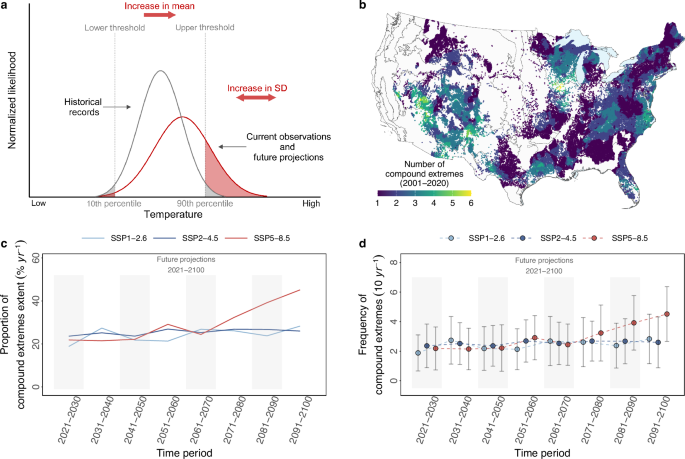
Forest ecosystems provide key ecological, social, and climate benefits, yet their functions are potentially threatened by rising compound extremes characterised by simultaneous heat and drought or moisture excess. Here, we explore how forests resist and recover from compound heat and moisture extremes and how tree diversity mediates these responses, using U.S. forest inventory data along with satellite-based stability estimates. We find that compound extremes result in lower forest resistance and recovery than individual extremes. Compound extremes tend to exhibit synergistic effects, causing greater negative impacts than the sum of individual extremes. Compound heat and drought have slightly stronger destabilising effects than compound heat and moisture excess. Higher tree diversity consistently improves resistance and recovery under both individual and compound extremes. Our findings suggest that focusing solely on individual climate extremes is likely to underestimate the impacts of compound extremes and to increase uncertainty in projections of terrestrial carbon-cycle feedbacks, while also highlighting the critical role of tree diversity in mitigating these threats under future climate conditions.
Statistics
| Metric | Count |
|---|---|
| Journals searched | 11 |
| Total papers fetched | 105 |
| Passed deterministic filter | 14 |
| After LLM relevance filtering | 4 |
| Rejected (not relevant) | 10 |
| AI for Science items picked | 0 |
Papers by journal
| Journal | Papers |
|---|---|
| Nature | 1 |
| Geophysical Research Letters | 1 |
| Bulletin of the American Meteorological Society | 1 |
| Nature Communications | 1 |
Filtering Criteria
Topics: hydrology, hydrologic model, river, runoff, streamflow, reservoir, water management, flood, drought, seasonal, land surface model, climate change, hydropower, surface water, irrigation, earth system model, estuary, coastal, freshwater discharge, river plume, ocean biogeochemistry, marine heatwave, paleohydrology, paleoclimate, Quaternary, Holocene, Pleistocene, fluvial geomorphology, river terrace, loess, drainage network, river capture, landscape evolution, luminescence dating
Fields: engineering, environmental science, computer science, geology, geography