Paper Harvest Report
Date range: July 16, 2026
5 top-tier papers selected out of 122 total publications
Today’s Highlights
The July 2025 Texas Hill Country flash flood — which killed 137 people near the Camp Mystic summer camp — is reconstructed in unprecedented hydrometeorological detail, showing how tropical moisture from two cyclones and supercell placement over the Guadalupe River basin drove catastrophic flood-wave superposition (BAMS). A global analysis reveals that phosphorus-rich anoxic coastal groundwater is a previously overlooked driver of accelerating algal blooms, explaining why bloom intensity persists even where nitrogen inputs have been curtailed (Nature Communications). Two Earth-system studies round out the day: permafrost carbon release scales linearly at 11–21 PgC per 100 degree-years of warming overshoot even under partial AMOC cooling, and desiccation of the Aral Sea has released 204 ± 53 Tg C since 1960, flipping the Central Asian basin from a carbon sink to a net source.
Table of Contents
- Today’s Highlights
- Top-Tier Journal Papers
- Hydrometeorological Analysis of the July 2025 Texas Hill Country Flash Flood Disaster
- Coastal groundwater phosphorus drives global acceleration of algal blooms
- Permafrost carbon release scales linearly with overshoot warming mediated by AMOC tipping
- Capturing Runoff‐Driven Seasonal Velocity Variations of Fast‐Flowing Outlet Glaciers in Coupled Ice‐Hydrology Simulations
- Drying of the Aral Sea reshapes the anthropogenic carbon inventory of Central Asia
- Statistics
- Filtering Criteria
Top-Tier Journal Papers
Hydrometeorological Analysis of the July 2025 Texas Hill Country Flash Flood Disaster
Authors: Thomas J. Galarneau, Jacob T. Carlin, Robert A. Clark, Jonathan J. Gourley, Jian Zhang
Journal: Bulletin of the American Meteorological Society · DOI: 10.1175/bams-d-25-0227.1
Matched topics: river, flood

On 4 July 2025, multiple factors combined to produce a catastrophic flash flood in the Texas Hill Country. The event caused 137 fatalities across South Texas, with the greatest impacts in Kerr County (119 fatalities with two additional missing persons) near the Camp Mystic for Girls summer camp. Widespread convection occurred across the Texas Hill Country, including a focused ten-county area that received >150 mm of rainfall between 0300 and 1800 UTC, while a quasi-stationary supercell generated localized totals >250 mm largely within a 3-h period from 0600 to 0900 UTC over the Guadalupe River basin headwaters. This study synthesizes observations, reanalyses, convection-allowing model analyses, and hydrologic simulations to diagnose the event. Results show that the supercell formed as a northwestward-moving surface boundary intersected strengthening midlevel westerly flow on the southern flank of a mesoscale convective vortex that tracked from northern Mexico into south-central Texas. Increasing southwesterly flow aloft and a strengthening southeasterly low-level jet enhanced vertical shear, supporting supercell organization and limited storm motion. Deep tropical moisture from the southeast, modulated by Tropical Cyclone Barry, together with mid- and upper-level moisture from the tropical eastern North Pacific associated with Tropical Cyclone Flossie, promoted high precipitation efficiency and extreme rain rates. Hydrologic simulations indicate that storm placement over the basin promoted near-synchronous flood-wave superposition from the South Fork of the Guadalupe River and Cypress Creek at Camp Mystic, exacerbating inundation. A companion study examines short-term predictability using convection-allowing ensemble forecasts coupled with hydrologic prediction tools.
Coastal groundwater phosphorus drives global acceleration of algal blooms
Authors: K. H. Cheng, Joseph H. W. Lee, Jiu Jimmy Jiao, Adina Paytan, Donald M. Anderson, Weijun Cai et al.
Journal: Nature Communications · DOI: 10.1038/s41467-026-75420-y
Matched topics: river, coastal
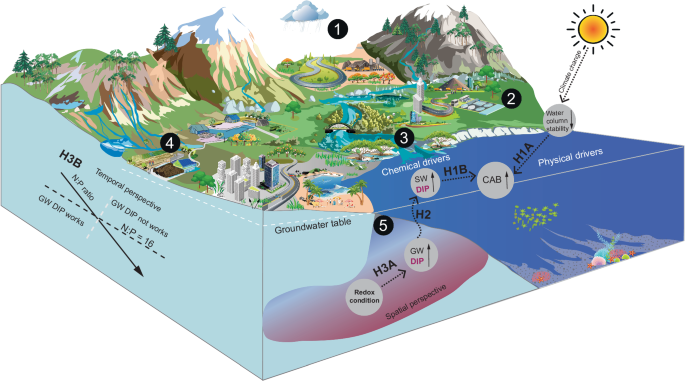
Coastal algal blooms (CABs) are accelerating worldwide. This intensification is particularly puzzling in regions where nitrogen inputs have been curbed, yet blooms persist or worsen. Here we reveal excess dissolved inorganic phosphorus (DIP) from coastal groundwater as a critical, previously overlooked driver. Combining a process-based physical-chemical framework with global datasets, we find decadal CAB trends are more strongly linked to coastal DIP than to nitrogen availability or water-column stability. A global meta-analysis with site-specific time series demonstrates anoxic groundwater releases substantial DIP. This mechanism explains continued CABs under nitrogen control and aligns with a shift toward phosphorus limitation in many coastal regions. Spatial and temporal variation in CAB trends reflects aquifer geochemistry, with reducing groundwater fueling blooms and oxidized systems suppressing them. Our findings establish groundwater as a missing link in the modern coastal nutrient cycle and underscore the urgency for integrated nitrogen–phosphorus management to mitigate the escalating impacts of CABs. Phosphorus-rich inputs from anoxic groundwater emerge as a key driver of accelerating global coastal algal blooms, offering an explanation for why these blooms persist despite strict nitrogen controls.
Permafrost carbon release scales linearly with overshoot warming mediated by AMOC tipping
Authors: Norman Julius Steinert, Jörg Schwinger, Eleanor Burke, Biqing Zhu, Thomas Gasser, Gregory Munday et al.
Journal: Nature Communications · DOI: 10.1038/s41467-026-73612-0
Matched topics: climate change
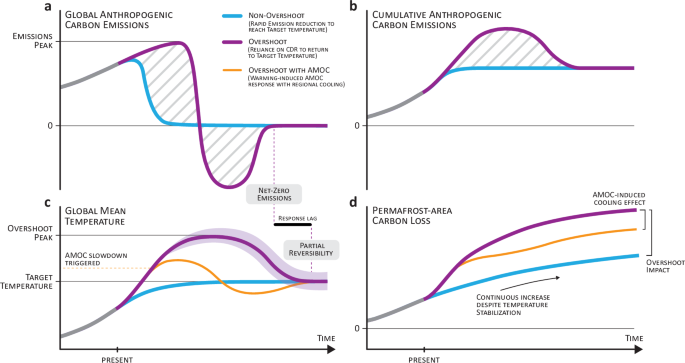
Overshooting global warming targets risks irreversible Earth system changes. However, uncertainties remain in how critical Earth system components such as permafrost and the Atlantic Meridional Overturning Circulation (AMOC) respond to and interact under warming. By using three climate models of varying complexity to assess the permafrost carbon response under idealized climate mitigation and overshoot scenarios, we here show that permafrost loses 11–21 PgC of carbon per 100 degree-years of warming exposure (cumulative warming over 100 years) during temperature overshoot in a robust linear relationship. This relationship also holds true under relative Northern Hemisphere cooling from a temporary AMOC slowdown during temperature overshoot. This relative cooling partially offsets climate change impacts on permafrost, while in itself causing adverse impacts on climate and society. These results underscore the importance of including both destabilizing and stabilizing Earth system feedbacks when assessing overshoot impacts, critical for informing carbon budgets, net-zero planning, and climate change reversibility. Climate models show permafrost carbon emissions scale linearly with warming exposure during temperature overshoot, also when AMOC-driven cooling partly offsets them. These climate feedbacks are crucial for carbon budgets and net-zero planning.
Capturing Runoff‐Driven Seasonal Velocity Variations of Fast‐Flowing Outlet Glaciers in Coupled Ice‐Hydrology Simulations
Authors: A. Jenson, J. M. Amundson, M. Truffer, A. Pohle, L. Ultee
Journal: Geophysical Research Letters · DOI: 10.1029/2026gl124023
Matched topics: hydrology, runoff, seasonal
The seasonal evolution of the subglacial drainage system is a critical control on velocity variations of Greenland marine‐terminating glaciers. Yet numerical models struggle to reproduce observed seasonal behavior, because fast flow suppresses channelization in subglacial hydrology models. We simulate the full spectrum of runoff‐driven velocity variations, including the seasonal velocity pattern observed on many marine‐terminating outlet glaciers: speed‐up in the early melt season followed by a slowdown below winter values in late‐summer. This behavior arises by fully coupling hydrology and ice flow, using basal melt rates as predicted by and consistent with the coupled model, enhancing closure rates of subglacial cavities, and assuming laminar flow with low sheet conductivity. Together, these modifications promote channelization beneath fast‐flowing glaciers, which has previously been elusive.
Drying of the Aral Sea reshapes the anthropogenic carbon inventory of Central Asia
Authors: Rafael Marcé, Daniel Diaz de-Quijano, Sofía Rodríguez-Gómez, Enrique Moreno-Ostos, Makhambet Mukhtar, Björn Wissel et al.
Journal: Science · DOI: 10.1126/science.aeb2344
Matched topics: flood
Lakes store large quantities of carbon in their sediments, contributing to climate regulation. Yet the fate of this carbon after lake desiccation remains unclear. Using a space-for-time substitution approach, combining sediment cores, carbon dioxide flux measurements, and remote sensing, we quantified organic carbon losses from the world’s largest desiccated lake, the Aral Sea. Since 1960, exposed lake bed sediments have released 204 ± 53 teragrams of carbon (Tg C), with vegetation growth offsetting less than 1%. Incorporating these emissions alters the regional carbon budget, transforming the Aral Sea basin from a presumed land-use-change carbon sink into a net source. Reflooding the sea could prevent an additional 165 ± 13 Tg C release, reframing restoration not only as an ecological and humanitarian imperative but also as a climate mitigation opportunity.
Statistics
| Metric | Count |
|---|---|
| Journals searched | 11 |
| Total papers fetched | 122 |
| Passed deterministic filter | 12 |
| After LLM relevance filtering | 5 |
| Rejected (not relevant) | 7 |
| AI for Science items picked | 0 |
Papers by journal
| Journal | Papers |
|---|---|
| Nature Communications | 2 |
| Science | 1 |
| Geophysical Research Letters | 1 |
| Bulletin of the American Meteorological Society | 1 |
Filtering Criteria
Topics: hydrology, hydrologic model, river, runoff, streamflow, reservoir, water management, flood, drought, seasonal, land surface model, climate change, hydropower, surface water, irrigation, earth system model, estuary, coastal, freshwater discharge, river plume, ocean biogeochemistry, marine heatwave, paleohydrology, paleoclimate, Quaternary, Holocene, Pleistocene, fluvial geomorphology, river terrace, loess, drainage network, river capture, landscape evolution, luminescence dating
Fields: engineering, environmental science, computer science, geology, geography