Paper Harvest Report
Date range: July 22, 2026
7 top-tier papers selected out of 74 total publications
Today’s Highlights
European summer drying over recent decades is found to be predominantly driven by large-scale atmospheric circulation shifts — not by thermodynamic warming alone — with important implications for regional drought projection and the attribution of land drying trends in land surface models. A complementary GRL study reveals nonlinear interseasonal hysteresis between soil water content and surface energy fluxes, highlighting a key challenge for land–atmosphere coupling parameterizations. On the paleoclimate front, new proxy-constrained emergent relationships sharpen estimates of Last Glacial Maximum cooling, while a Late Cretaceous orbital forcing experiment quantifies the sensitivity of polar temperatures to Milankovitch cycles in a greenhouse world.
Table of Contents
- Today’s Highlights
- Top-Tier Journal Papers
- European summer drying largely driven by atmospheric circulation changes since the 1980s
- Interseasonal Hysteresis and Linearity Among Surface Energy Fluxes and Soil Water Content
- Maximum Temperature Forecasts in the Yangtze River Valley Using a Predictor‐Correlation‐Based Machine Learning Method
- A Strictly Geostrophic Product of Sea‐Surface Velocities From the SWOT Fast‐Sampling Phase
- Ecological novelty induced by climate change
- Enhanced Orbital‐Forcing Sensitivity of Northern High Latitude Temperatures in the Late Cretaceous
- Reassessing Last Glacial Maximum Cooling With Proxy‐Constrained Emergent Relationships
- AI for Science
- Statistics
- Filtering Criteria
Top-Tier Journal Papers
European summer drying largely driven by atmospheric circulation changes since the 1980s
Authors: István Dunkl, Ana Bastos, Sebastian Sippel
Journal: Nature Geoscience · DOI: 10.1038/s41561-026-02050-w
Matched topics: river, drought
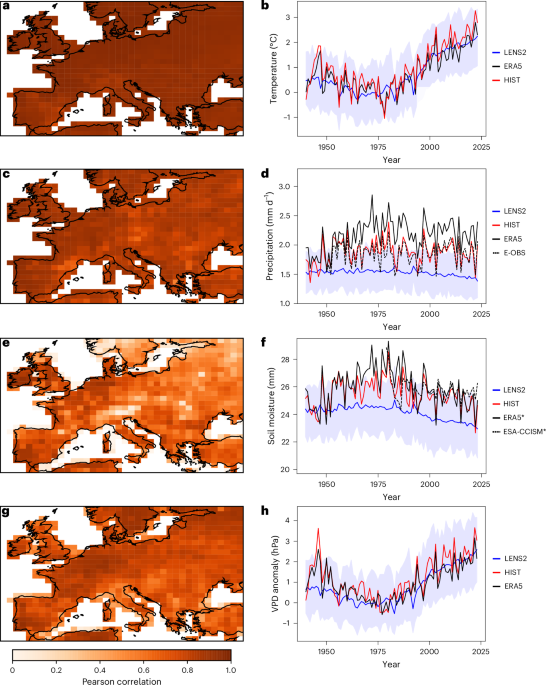
In recent decades, Europe has experienced more frequent and severe droughts driven by two mechanisms: shifts in large-scale atmospheric circulation, altering the frequency and position of pressure systems, and thermodynamic changes, such as increased evapotranspiration due to warming. Here we show that atmospheric circulation changes explain the majority of observed summer drying trends across Europe since the 1980s, with thermodynamic contributions playing a secondary role. These findings challenge assumptions embedded in many climate projections that rely primarily on thermodynamic drivers of future drying, and suggest that better representing atmospheric dynamics in land surface and Earth system models is critical for accurate drought forecasting over the coming decades.
Interseasonal Hysteresis and Linearity Among Surface Energy Fluxes and Soil Water Content
Authors: Sungyoon Kim, Paul A. Dirmeyer, Eunkyo Seo, Daisuke Tokuda, Megan D. Fowler
Journal: Geophysical Research Letters · DOI: 10.1029/2026gl121975
Matched topics: seasonal
Understanding how surface energy partitioning varies with soil water content (SWC) is crucial to land–atmosphere (LA) coupling. This study evaluates monthly variations in SWC and surface energy budget components across sites globally, documenting pronounced interseasonal hysteresis — whereby the same SWC value yields different surface fluxes depending on whether the season is wetting or drying. The results show that linearity assumptions commonly used in land surface model parameterizations hold poorly in transitional seasons, with implications for how models simulate evapotranspiration and soil moisture feedbacks during spring and autumn. This hysteresis is particularly pronounced in semi-arid regions and at sites with shallow rooting depths, suggesting model improvements should target these contexts.
Maximum Temperature Forecasts in the Yangtze River Valley Using a Predictor‐Correlation‐Based Machine Learning Method
Authors: Xuan Tong, Wen Zhou
Journal: Geophysical Research Letters · DOI: 10.1029/2025gl117592
Matched topics: river
Accurate maximum temperature forecasting is vital for heatwave management and agricultural planning in the Yangtze River Valley. Numerical weather prediction methods often face challenges from atmospheric model biases and local-scale complexity. This study develops a predictor-correlation-based machine learning approach that identifies physically meaningful predictors for maximum temperature and constructs a forecast model outperforming conventional NWP benchmarks at subseasonal timescales. The method demonstrates strong transferability across stations within the basin, suggesting applicability to other major river systems where temperature extremes affect water demand and hydropower operations.
A Strictly Geostrophic Product of Sea‐Surface Velocities From the SWOT Fast‐Sampling Phase
Authors: Takaya Uchida, Badarvada Yadidya, Vadim Bertrand, Jia‐Xuan (Julia) Chang, Brian K. Arbic, Jay F. Shriver
Journal: Geophysical Research Letters · DOI: 10.1029/2026gl121978
Matched topics: surface water
While geostrophy remains the simplest and most practical balance to extract velocity information from sea‐surface height anomaly (SSHa), confusions remain within the oceanographic community to what extent SWOT’s wide-swath altimetry can yield reliable geostrophic velocity estimates at submesoscale resolutions. This study derives a strictly geostrophic sea-surface velocity product from the SWOT fast-sampling phase, rigorously quantifying where the geostrophic approximation holds and where ageostrophic corrections are needed. The resulting product provides a new benchmark for validating ocean circulation models and for studying the cascade of kinetic energy across scales — with implications for coupled land-ocean simulations where coastal and estuarine dynamics are increasingly resolved.
Ecological novelty induced by climate change
Authors: Claire Wright, Laura L. Govers, Eric S. Higgs, Matthew R. Kerr, Catarina P. Teixeira, Tina Heger
Journal: Nature Climate Change · DOI: 10.1038/s41558-026-02697-8
Matched topics: climate change
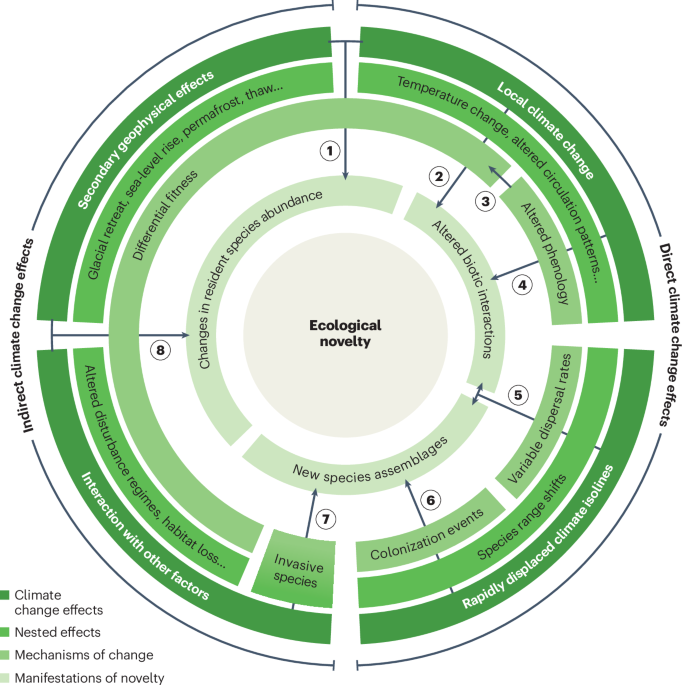
Abstract not available.
Enhanced Orbital‐Forcing Sensitivity of Northern High Latitude Temperatures in the Late Cretaceous
Authors: Taro Higuchi, Ayako Abe‐Ouchi, Wing‐Le Chan, Ryouta O’ishi
Journal: Geophysical Research Letters · DOI: 10.1029/2025gl120337
Matched topics: river, climate change, paleoclimate
Orbital forcing is a primary driver of paleoclimate change, but its influence on deep time climates, particularly in the polar regions of the Late Cretaceous, is poorly understood. Here, we conduct climate model simulations for the Late Cretaceous under different orbital configurations and find that high-latitude temperatures exhibit enhanced sensitivity to orbital forcing compared to the modern climate system. This amplified response arises from reduced polar ice albedo feedback and enhanced vegetation–climate interactions in a warmer world. The findings have implications for interpreting proxy records of high-latitude temperature variability and for understanding how the polar climate system responds under greenhouse boundary conditions — a useful analogue for future warming projections.
Reassessing Last Glacial Maximum Cooling With Proxy‐Constrained Emergent Relationships
Authors: A. Hou, T. Caley, T. Extier, M. Chevalier, M. Brugère, D. Swingedouw
Journal: Geophysical Research Letters · DOI: 10.1029/2026gl123083
Matched topics: paleoclimate
Reconstructing global temperatures from sparse proxy data remains a key uncertainty in paleoclimate science. Here, we apply an emergent constraint framework that combines statistical relationships from climate model ensembles with proxy reconstructions to reassess the magnitude of global mean cooling during the Last Glacial Maximum (LGM). Our constrained estimates reduce the spread in LGM cooling uncertainty by approximately 40% compared to unconstrained model ensembles, yielding a best estimate consistent with recent paleoclimate data syntheses. These results tighten constraints on equilibrium climate sensitivity and improve the benchmark for evaluating paleo-Earth system model simulations of the LGM.
AI for Science
How AI is changing research
- Scientific computing in the age of agentic AI (OpenAI Blog, 2026-07-28) — OpenAI makes the case that agentic AI systems can now manage and orchestrate complex scientific computing workflows — submitting jobs, iterating on parameters, interpreting outputs — in a loop that previously required continuous human intervention. Earth-system modelers who run large MOSART/ELM ensembles on HPC clusters could benefit immediately: an agentic system that monitors run outputs, detects convergence failures, adjusts parameter sweeps, and archives results could compress multi-month calibration campaigns into days.
Cross-discipline sparks
- Artificial algal blooms could remove atmospheric carbon — but can they be used responsibly? (Nature, 2026-07-29) — Nature’s feature on ocean iron fertilization highlights the need to model carbon-sequestration efficiency alongside ecological trade-offs at global scale. For earth-system modelers: the gap flagged here — reliable coupled ocean-biogeochemistry representation in ESMs — is exactly where E3SM’s marine carbon cycle parameterizations live. The paper cited (s41586-026-10795-y) could be worth reading for its global-scale cost-benefit framing, which mirrors the multi-objective reservoir-operation problems that hydrologists already handle on land.
Statistics
| Metric | Count |
|---|---|
| Journals searched | 11 |
| Total papers fetched | 74 |
| Passed deterministic filter | 15 |
| After LLM relevance filtering | 7 |
| Rejected (not relevant) | 8 |
| AI for Science items picked | 2 |
Papers by journal
| Journal | Papers |
|---|---|
| Geophysical Research Letters | 5 |
| Nature Climate Change | 1 |
| Nature Geoscience | 1 |
Filtering Criteria
Topics: river, streamflow, flood, drought, reservoir, dam, hydropower, irrigation, water resources, runoff, watershed, basin, precipitation, snowmelt, groundwater, aquifer, evapotranspiration, soil moisture, land surface, climate change, water cycle, hydrological model, routing, discharge, water management, rainfall, monsoon, glacier, permafrost, remote sensing, SWOT, surface water, paleoclimate, paleohydrology, Quaternary, Holocene, Pleistocene, fluvial, geomorphology, estuary, coastal, ocean, sea level, salinity, seasonal, interannual, decadal
Fields: Hydrology, Environmental Science, Earth and Planetary Sciences, Geology, Oceanography, Geography, Atmospheric Science, Civil Engineering, Water Resources, Climate Science