Paper Harvest Report
Date range: October 19, 2026
5 top-tier papers selected out of 84 total publications
Today’s Highlights
A standout result from Geophysical Research Letters shows that the Baroclinic Annular Mode drives up to a 50% increase in atmospheric river frequency and a 40% increase in associated precipitation extremes, offering a meaningful route to improved subseasonal flood prediction. On the groundwater front, a PNAS study of all 426 known transboundary aquifers finds that groundwater use and depletion concentrate near international borders, calling for geography-based governance rather than uniform aquifer-level agreements. Rounding out the week, a Nature Communications study reveals that ignoring daily meteorological variability in glacier models can systematically underestimate sea-level rise contributions by 5–10%.
Table of Contents
- Today’s Highlights
- Top-Tier Journal Papers
- Geography of groundwater use and depletion in internationally shared aquifers
- More Frequent Atmospheric Rivers and Associated Precipitation Extremes Induced by the Baroclinic Annular Mode
- Projected intensification of soil salinization in global drylands under future aridity increase
- The 2023 North Atlantic marine heatwave could have evolved into a far more extreme event
- Resolving short-term meteorological variability amplifies projected glacier loss and sea-level rise
- Statistics
- Filtering Criteria
Top-Tier Journal Papers
Geography of groundwater use and depletion in internationally shared aquifers
Authors: Marc F. Müller, Kyle F. Davis, Julie Faure, Davide Danilo Chiarelli, Fengwei Hung
Journal: Proceedings of the National Academy of Sciences · DOI: 10.1073/pnas.2619357123
Matched topics: river, irrigation
Transboundary aquifers (TBAs) underlie 35% of global groundwater-irrigated cropland, yet few are covered by formal cooperative arrangements. Whether this limited cooperation is consequential depends in part on where groundwater is used within shared aquifers, because pumping far from international borders may generate little cross-border impact. Combining ~116,000 well observations with global irrigation data across all 426 known TBAs, we assess how groundwater use and depletion differ from comparable domestic systems and how they are distributed relative to international borders. While we find no evidence of greater average depletion in TBAs, depletion is more strongly concentrated toward international borders in shared aquifers and varies substantially across systems. Irrigation is also more intensive and concentrated toward borders in shared aquifers, although much of this pattern is attenuated after accounting for border rivers. Groundwater-supplied irrigation remains more border-proximate after accounting for these rivers. A dyad-level typology distinguishes shared systems according to where groundwater demand is concentrated, linking their potential for cross-border interaction to different management options. These findings suggest that transboundary groundwater governance should be organized around the geography of groundwater use and potential cross-border interactions rather than treating shared aquifers as uniform governance units.
More Frequent Atmospheric Rivers and Associated Precipitation Extremes Induced by the Baroclinic Annular Mode
Authors: Sandro W. Lubis, L. Ruby Leung, J. Michael Battalio
Journal: Geophysical Research Letters · DOI: 10.1029/2026gl124953
Matched topics: river, seasonal
Atmospheric rivers (ARs) play a crucial role in the global hydrological cycle, yet how the intrinsic midlatitude atmospheric variability modulates their activity on subseasonal timescales remains poorly understood. Here, we show that AR frequency and landfall in both hemispheres vary strongly with the strength and phase of the Baroclinic Annular Mode (BAM). During its positive phase, BAM increases AR occurrence by up to ~50% and AR-driven precipitation extremes by up to ~40% relative to climatology. Stronger and more frequent ARs during the positive phase of the BAM are primarily driven by enhanced potential-to-kinetic energy conversion, which favors AR growth and intensification, particularly in the storm-track regions. This response is consistent with dynamically enhanced poleward moisture transport due to a more baroclinically unstable and stormier environment. The results underscore the importance of BAM-related intrinsic midlatitude storm-track variability in modulating global AR activity and its potential to improve extended-range AR prediction on subseasonal timescales.
Projected intensification of soil salinization in global drylands under future aridity increase
Authors: Dietian Yu, Nan Wang, Amirhossein Hassani, Saverio Perri, Yi Peng, Songchao Chen, Jie Peng et al.
Journal: Nature Communications · DOI: 10.1038/s41467-026-78622-6
Matched topics: water management
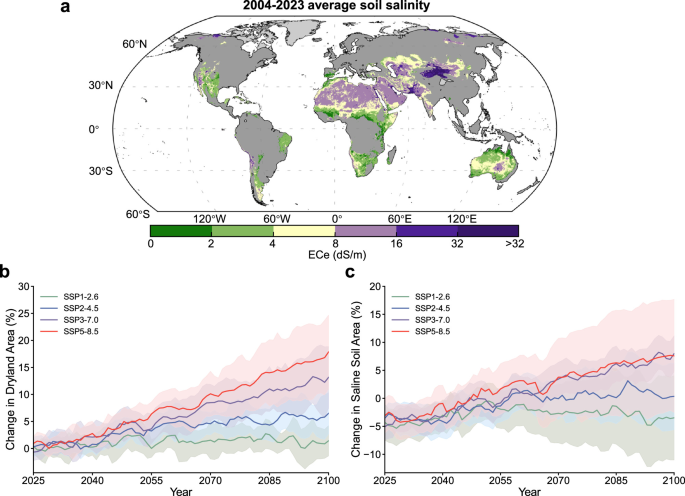
Soil salinization threatens agricultural production, water management, and ecosystem health. Yet, how increasing aridity will reshape 21st-century soil salinity patterns across drylands, particularly in croplands, remains unclear. Here, we compile a relatively comprehensive global soil salinity dataset from the past two decades, projecting future dryland soil salinity dynamics using climate-driven machine learning models with multiple covariates, including dynamic dryland extent and human influences. Our results show an 8% expansion of global drylands saline soils under increasing aridity by 2100 (SSP5-8.5) relative to 2004–2023. Southwestern US, Mexico, southern Europe, central South America, eastern and southern Africa are highest-risk hotspots. We further show dryland croplands face serious salinization, especially irrigated systems, where half of these newly salinized areas project more than 4.9% (maize), 17.2% (dryland rice), 3.3% (sorghum), and 21.2% (wheat) potential production losses. Our findings inform long-term adaptation strategies to mitigate emerging salinization risks and sustain water and food security.
The 2023 North Atlantic marine heatwave could have evolved into a far more extreme event
Authors: Catherine H. Gregory, Urs Hofmann Elizondo, Thibault Guinaldo, Thomas L. Frölicher
Journal: Nature Communications · DOI: 10.1038/s41467-026-78863-5
Matched topics: earth system model, marine heatwave

In 2023, the North Atlantic Ocean experienced a marine heatwave of unprecedented intensity and duration, raising the question of whether substantially more severe outcomes were physically plausible under comparable present-day preconditioning, and which processes could produce them. Here, we apply ensemble boosting to a coupled Earth system model to generate physically consistent alternative evolutions of a 2023-like event. The boosted ensemble produced marine heatwaves lasting up to 579 days, reaching maximum intensities of 4.5 °C above climatology and cumulative intensities of 717 °C·days, compared with 240 days, 2.9 °C and 224 °C·days in observations. Detailed analyses of the longest and most intense events highlight contrasting roles for persistent Euro-Atlantic high pressure, reduced turbulent heat loss, enhanced shortwave radiation and upper-ocean heat redistribution. Finally, we place these present-day storylines in the context of future warming, showing that events comparable to the observed 2023 event become increasingly common as global warming progresses.
Resolving short-term meteorological variability amplifies projected glacier loss and sea-level rise
Authors: Lander Van Tricht, Matthias Huss, Harry Zekollari, Rodrigo Aguayo, Janosch Beer, Marit van Tiel et al.
Journal: Nature Communications · DOI: 10.1038/s41467-026-78260-y
Matched topics: runoff
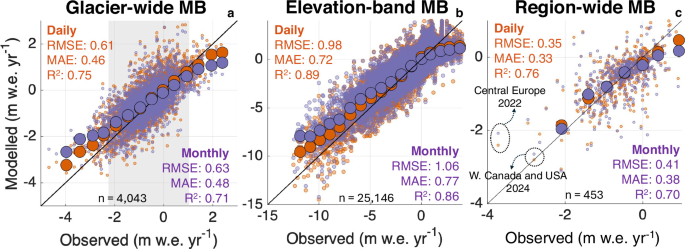
Global glacier models typically rely on temperature-index mass balance calculations forced with aggregated meteorological data, limiting their ability to resolve short-term variability. Here, we develop a daily-resolution version of the Global Glacier Evolution Model (GloGEM), which we apply globally and compare against the monthly configuration. Our results show that the daily model more closely reproduces mass balance observations and provides a more detailed representation of glacier runoff. Accounting for short-term meteorological variability leads to systematically greater projected mass loss, with up to 25% greater loss in Svalbard. These differences arise from extreme melt days, precipitation-phase transitions, and surface-type feedbacks not fully represented at monthly resolution. Globally, the daily model yields ice volume losses of 26 ± 10% under low-emission and 47 ± 17% under high-emission scenarios over 2025–2100 (ensemble mean ± 1 StD), resulting in an additional 5–10% mass loss (20–33 mm of global mean sea-level rise) relative to the monthly implementation. Resolving high-frequency forcing, or accounting for its effects through parameterisations, is therefore essential for robust glacier projections, while its omission may systematically underestimate future glacier loss.
Statistics
| Metric | Count |
|---|---|
| Journals searched | 11 |
| Total papers fetched | 84 |
| Passed deterministic filter | 11 |
| After LLM relevance filtering | 5 |
| Rejected (not relevant) | 6 |
| AI for Science items picked | 0 |
Papers by journal
| Journal | Papers |
|---|---|
| Proceedings of the National Academy of Sciences | 1 |
| Geophysical Research Letters | 1 |
| Nature Communications | 3 |
Filtering Criteria
Topics: hydrology, hydrologic model, river, runoff, streamflow, reservoir, water management, flood, drought, seasonal, land surface model, climate change, hydropower, surface water, irrigation, earth system model, estuary, coastal, freshwater discharge, river plume, ocean biogeochemistry, marine heatwave, paleohydrology, paleoclimate, Quaternary, Holocene, Pleistocene, fluvial geomorphology, river terrace, loess, drainage network, river capture, landscape evolution, luminescence dating
Fields: engineering, environmental science, computer science, geology, geography