Paper Harvest Report
Date range: September 01, 2026
3 top-tier papers selected out of 119 total publications
Today’s Highlights
Today’s harvest probes how climate change strains Earth’s water and carbon systems across contrasting scales. Gu et al. (Nature Geoscience) reveal that vertically compound soil moisture droughts — where every soil layer is simultaneously depleted — amplify ecosystem damage far beyond what conventional single-layer analyses capture, exposing 20% more global ecosystems to high-level drought risk. On the coastal frontier, Hu et al. (Nature Communications) show that polar and subpolar shelf seas are the dominant zones where marine heatwaves paradoxically intensify CO₂ uptake, while Matsuoka et al. (Reviews of Geophysics) deliver a sweeping synthesis of Antarctic coastal dynamics and its critical, still-uncertain contribution to future sea-level rise.
Table of Contents
Top-Tier Journal Papers
Multilayer soil moisture depletion intensifies drought impacts on global ecosystems
Authors: Xihui Gu, Ruijie Wang, Deliang Chen, Chiyuan Miao, Sijia Luo, Yansong Guan et al.
Journal: Nature Geoscience · DOI: 10.1038/s41561-026-02083-1
Matched topics: drought
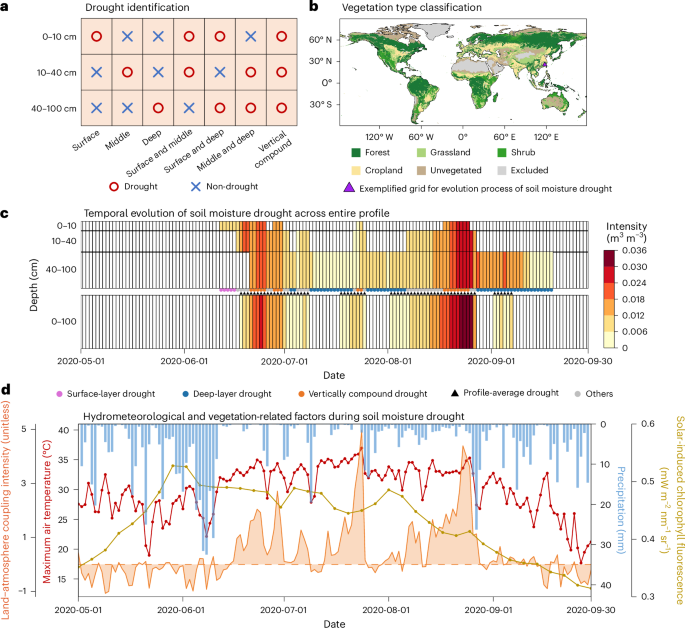
When soil moisture across all layers of the entire profile is depleted, ecosystems face the highest risk because they lose all vertical buffering capacity against drought. However, these vertically compound soil moisture droughts, in which every soil layer suffers simultaneous water deficits, have been neglected in existing drought analyses. Here we develop a framework to characterize soil-profile-integrated compound droughts (SPICDs) by comparing soil moisture deficits in surface and deep soils, and identify global trends from 1980 to 2023 using four global soil moisture datasets. We find that SPICDs expose 20% more global ecosystems to high-level drought risk than would conventional single-layer analyses suggest. Over the past 40 years, SPICDs have expanded in extent (at a rate of 0.73% per decade) and intensified in severity (at a rate of −0.0057 m³/m³ per decade), with the greatest changes in tropical forests and shrublands. SPICDs are projected to dramatically intensify under warming scenarios. Given the disproportionate impact of SPICDs on ecosystem functioning, including reductions in gross primary production and rises in tree mortality, our findings highlight the critical need to update current drought monitoring and assessment frameworks to encompass the entire soil profile.
Toward an Improved Understanding of the Antarctic Coastal Zone and Its Contribution to Future Global Sea Level
Authors: Kenichi Matsuoka, Geir Moholdt, Jennifer F. Arthur, Julien A. Bodart, Xiangbin Cui, Fausto Ferraccioli et al.
Journal: Reviews of Geophysics · DOI: 10.1029/2022rg000803
Matched topics: climate change, coastal
Understanding the coastal zone of the Antarctic Ice Sheet (AIS), where it interacts with the Southern Ocean and warmer air masses, is crucial for predicting Antarctica’s influence on the global climate and sea level. This region has multiple tipping mechanisms that could trigger large, rapid, and potentially irreversible mass loss. Geophysical, glaciological, and oceanographic data have improved our understanding of the AIS coastal zone, but key gaps remain, particularly in the interactions between ice, ocean, atmosphere, and bedrock in remote regions. This paper provides a comprehensive synthesis of data and methods needed to improve our understanding of the Antarctic coastal zone, with a focus on key dynamic components: the sub-shelf cavity, basal melting, grounding line dynamics, and the contribution of ice discharge to sea level rise. We discuss priorities for future observations, modeling, and data integration and highlight processes that remain poorly understood. By integrating these insights, we hope to guide future research efforts to reduce uncertainties in projections of AIS contributions to future global sea level.
Polar and subpolar shelf seas dominate enhanced coastal CO2 uptake during marine heatwaves
Authors: Zhentao Hu, Moritz Mathis, Hongmei Li, Tatiana Ilyina, Yoana G. Voynova, Vlad A. Macovei et al.
Journal: Nature Communications · DOI: 10.1038/s41467-026-77165-0
Matched topics: climate change, coastal, marine heatwave
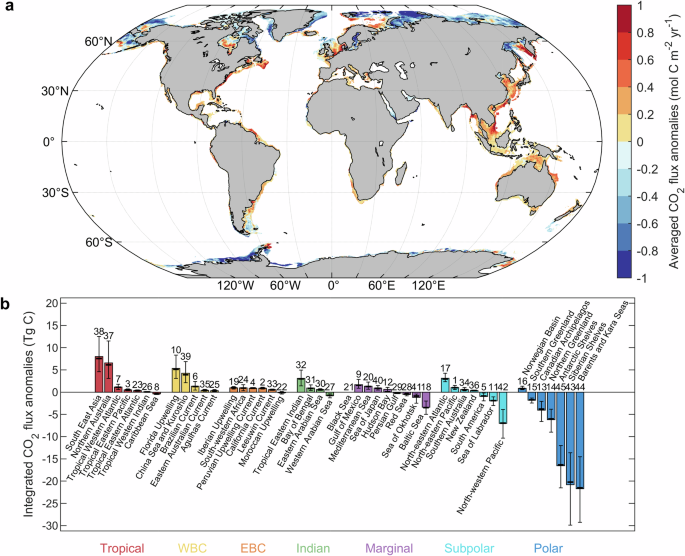
Marine heatwaves (MHWs) perturb air–sea CO2 fluxes, but their cumulative impact on the global coastal carbon sink remains poorly understood. Using four observation-based CO2 flux datasets, with priority given to a global coastal product, we find that MHWs enhance net CO2 uptake in global shelf seas by an average of 3.7 ± 0.9% per year. Polar and subpolar shelf seas—particularly the Arctic Ocean and Southern Ocean shelves—dominate this enhanced uptake by controlling the thermal solubility pump. In contrast, tropical and subtropical shelf seas exhibit reduced CO2 uptake or even outgassing during MHWs. Our findings suggest that projected warming and expanding MHWs could alter the role of shelf seas in the global carbon cycle, with implications for climate–ocean feedbacks and marine biogeochemistry.
AI for Science
How AI is changing research
-
AI Has Solved One of Math’s $1 Million Millennium Prize Problems (Quanta Magazine, 2026-09-08) — OpenAI claims to have solved the Navier–Stokes Millennium Prize Problem, one of the seven Clay Mathematics Institute problems. The Navier–Stokes equations govern the motion of viscous fluids and are foundational to river hydraulics, ocean circulation, and atmospheric dynamics. If the proof holds peer review, it could eventually inform analytical approaches to turbulence in hydrological and coastal models — though this one will take time to fully digest.
-
Update to Google’s AI weather model improves forecast accuracy (Ars Technica, 2026-09-08) — Google’s AI-driven weather forecasting model now ingests raw satellite radiance data directly, bypassing the preprocessing steps traditional NWP models require. For hydrology, improved short-to-medium-range precipitation forecasts translate immediately into better streamflow and flood-hazard guidance — this is AI squeezing more out of existing observing systems.
Statistics
| Metric | Count |
|---|---|
| Journals searched | 11 |
| Total papers fetched | 119 |
| Passed deterministic filter | 5 |
| After LLM relevance filtering | 3 |
| Rejected (not relevant) | 2 |
| AI for Science items picked | 2 |
Papers by journal
| Journal | Papers |
|---|---|
| Nature Geoscience | 1 |
| Reviews of Geophysics | 1 |
| Nature Communications | 1 |
Filtering Criteria
Topics: streamflow, river, flood, drought, reservoir, dam, irrigation, groundwater, precipitation, runoff, watershed, basin, hydrological, hydraulic, water resources, land surface model, earth system model, climate change, sea level, coastal, estuary, ocean, marine heatwave, paleoclimate, paleohydrology, Quaternary, fluvial, geomorphology
Fields: Environmental Science, Earth and Planetary Sciences, Geography, Geology, Oceanography, Hydrology, Climate Science, Water Resources, Atmospheric Science