Paper Harvest Report
Date range: September 07, 2026
1 top-tier paper selected out of 37 total publications
Today’s Highlights
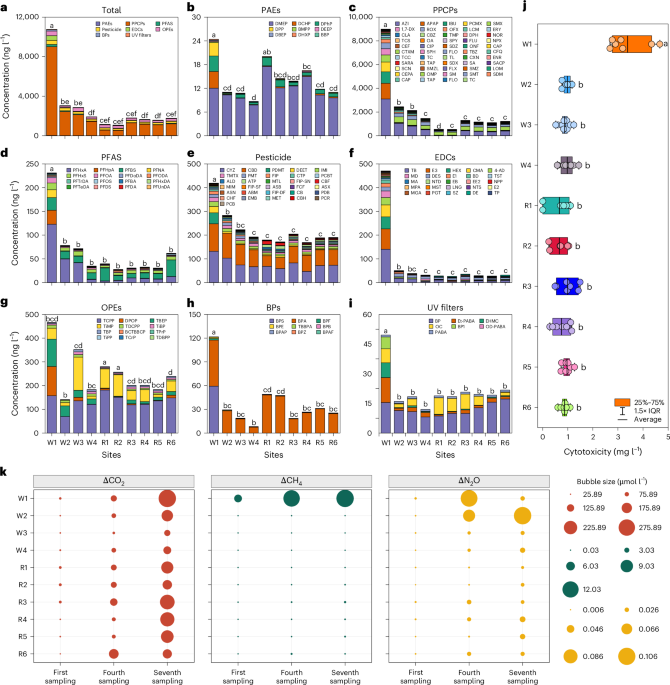
A new study in Nature Water finds that emerging contaminants entering river systems induce a defence–energy trade-off in microbial communities, diverting metabolic resources away from organic carbon decomposition toward detoxification pathways — with the unintended consequence of increased greenhouse gas production. The research links pollution inputs to downstream changes in aquatic greenhouse gas emissions, raising implications for water quality management and the role of river systems in regional carbon budgets.
Table of Contents
Top-Tier Journal Papers
Emerging contaminant stress promotes greenhouse gas production through microbial defence–energy trade-off in receiving rivers
Authors: Rui-Feng Yan, Jing-Long Han, Ying-Nan Han, Bin Liang, Shu-Hong Gao, Yi-Lu Sun et al.
Journal: Nature Water · DOI: 10.1038/s44221-026-00704-y
Matched topics: river
Abstract not available.
AI for Science
How AI is changing research
- Make AI traceable before it shapes global climate assessments (Nature, 2026-09-15) — A Nature editorial calls for mandatory traceability standards before AI-generated content enters IPCC-style reports, arguing that opaque AI contributions undermine scientific accountability. As large language models increasingly assist in synthesizing literature and drafting assessment sections, the field urgently needs audit trails — which AI model, which training data, which version — so future assessments can be reproduced and contested.
Cross-discipline sparks
- Why Nepal floods resulted in a disaster even after satellites spotted danger (Nature, 2026-09-15) — Satellites detected the Koshi River flood risk in advance, yet warnings failed to translate into effective evacuation. The bottleneck was not sensing but interpretation and communication: translating a satellite-derived risk index into localized, actionable guidance across fragmented governance. A small earth-science team with access to a reasoning-capable LLM could now prototype the missing layer — an AI agent that ingests satellite streamflow anomalies, retrieves downstream population exposure from OpenStreetMap, and drafts structured alerts in local languages — a workflow that would have required a multi-institution collaboration a few years ago.
Statistics
| Metric | Count |
|---|---|
| Journals searched | 11 |
| Total papers fetched | 37 |
| Passed deterministic filter | 2 |
| After LLM relevance filtering | 1 |
| Rejected (not relevant) | 1 |
| AI for Science items picked | 2 |
Papers by journal
| Journal | Papers |
|---|---|
| Nature Water | 1 |
Filtering Criteria
Topics: hydrology, hydrologic model, river, runoff, streamflow, reservoir, water management, flood, drought, seasonal, land surface model, climate change, hydropower, surface water, irrigation, earth system model, estuary, coastal, freshwater discharge, river plume, ocean biogeochemistry, marine heatwave, paleohydrology, paleoclimate, Quaternary, Holocene, Pleistocene, fluvial geomorphology, river terrace, loess, drainage network, river capture, landscape evolution, luminescence dating
Fields: engineering, environmental science, computer science, geology, geography