Paper Harvest Report
Date range: November 04, 2026
2 top-tier papers selected out of 5 total publications
Today’s Highlights
A new spectral-scaling analysis of 671 U.S. watersheds reveals that streamflow persistence is shaped by both climate forcing and catchment memory, identifying three distinct regimes — rapid-response, forcing-persistent, and hydrologically buffered — with important implications for how land-surface and routing models should represent subsurface storage. On the coastal side, a global synthesis of 332 sediment cores revises downward the carbon burial capacity of seagrass meadows, showing they store 6–15 Tg C yr⁻¹ globally — still a meaningful fraction of total oceanic organic carbon burial despite covering less than 0.1% of the seafloor.
Table of Contents
Top-Tier Journal Papers
Temporal Scaling of Hydrological Signals Reveals Forcing Persistence and Watershed Filtering Across the Contiguous U.S.
Authors: Yunqiu Zhou, Yi Zheng, Yingjie Yang, Xiuyu Liang
Journal: Geophysical Research Letters · DOI: 10.1029/2026gl124564
Matched topics: streamflow
Streamflow temporal persistence reflects both hydrological inputs and watershed filtering, but their relative contributions remain difficult to distinguish. We analyzed spectral scaling in precipitation, evapotranspiration, effective precipitation, streamflow, and the effective precipitation‐to‐streamflow transfer function across 671 contiguous U.S. watersheds. Streamflow and transfer‐function scaling exponents vary more widely across watersheds than those of the hydrological inputs. Combining effective‐precipitation and transfer‐function exponents identifies three regimes: rapid‐response watersheds with weak input persistence and filtering, widespread across the central and eastern U.S.; forcing‐persistent watersheds with persistent inputs but limited filtering, mainly in the West; and hydrologically buffered watersheds with strong filtering, concentrated in the western mountains, northern regions and Southeast. Western mountain buffered watersheds have greater snow influence and baseflow contributions, whereas southeastern buffered watersheds have little snow but more permeable soils and subsurface materials. The two exponents distinguish input persistence from watershed filtering in shaping streamflow persistence.
Seagrass sediment organic carbon burial rates are globally significant
Authors: Ariane Arias-Ortiz, Anna Lafratta, Phil Colarusso, James W. Fourqurean, Chuancheng Fu, Hilary Kennedy et al.
Journal: Nature Communications · DOI: 10.1038/s41467-026-79168-3
Matched topics: coastal
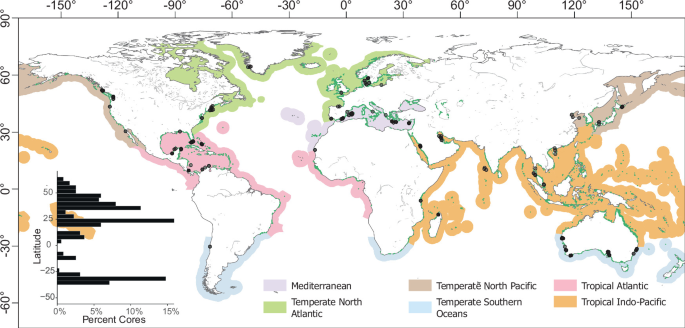
Crucial for coastal carbon sequestration, global seagrass organic carbon (OC) burial rates remain uncertain as early estimates were derived from mixed methodologies across geographically and taxonomically biased datasets. Here, we present a data-driven reassessment from a synthesis of 332 sediment cores spanning the last century. Results show that seagrasses bury OC at 25 ± 3 g OC m−2 yr−1 (geometric mean), with an area-weighted global average of 33 ± 9 g OC m−2 yr−1. Rates reflect a balance between sediment OC content and sediment accumulation, which share a negative exponential relationship driven by mineral dilution. Based on a revised mapped seagrass extent (247,700–366,400 km2), global burial scales to 6–15 Tg C yr−1. Although one-fourth of earlier benchmarks, seagrasses account for 3–4% to 3–6% of total oceanic OC burial despite covering <0.1% of the seafloor. Combined with mangroves and tidal marshes, vegetated coastal ecosystems contribute 8–13% of oceanic OC burial.
AI for Science
How AI is changing research
- Anthropic bought a one-person, AI-powered biotech: is this drug discovery’s future? (Nature, 2026-11-11) — A solo researcher running an AI-powered drug-discovery lab — acquired by Anthropic — illustrates how AI is collapsing the team-size barrier in experimental science, enabling one person to cover biology, chemistry, and informatics simultaneously.
Cross-discipline sparks
- DeepMind’s ultra-powerful AI for genome mapping wows scientists (Nature, 2026-11-11) — AlphaGenome 2 uses a foundation model pretrained on vast regulatory-DNA sequences to predict how cells interpret the genome — a dramatic accuracy leap over prior tools. The same masked-pretraining-on-sequence architecture is directly transferable to hydrology: pretraining on long records of precipitation, soil moisture, and streamflow across thousands of catchments could yield a foundation model that generalises across watersheds the way AlphaGenome generalises across cell types. A 1–2 person team could plausibly attempt this now using publicly available CAMELS data and off-the-shelf transformer recipes.
Statistics
| Metric | Count |
|---|---|
| Journals searched | 11 |
| Total papers fetched | 130 |
| Passed deterministic filter | 5 |
| After LLM relevance filtering | 2 |
| Rejected (not relevant) | 3 |
| AI for Science items picked | 2 |
Papers by journal
| Journal | Papers |
|---|---|
| Geophysical Research Letters | 1 |
| Nature Communications | 1 |
Filtering Criteria
Topics: hydrology, hydrologic model, river, runoff, streamflow, reservoir, water management, flood, drought, seasonal, land surface model, climate change, hydropower, surface water, irrigation, earth system model, estuary, coastal, freshwater discharge, river plume, ocean biogeochemistry, marine heatwave, paleohydrology, paleoclimate, Quaternary, Holocene, Pleistocene, fluvial geomorphology, river terrace, loess, drainage network, river capture, landscape evolution, luminescence dating
Fields: engineering, environmental science, computer science, geology, geography