Paper Harvest Report
Date range: November 09, 2026
3 top-tier papers selected out of 57 total publications
Today’s Highlights
Regional climate change is now approaching Paris Agreement warming thresholds in many parts of the world, underscoring the urgency of adaptation in water-dependent sectors. A landmark 430-year reconstruction of Chinese flood and drought records reveals systematic “generational amnesia” — societies consistently underestimate the severity of climate extremes relative to long-term climatology because risk perception is anchored to lived experience. Meanwhile, new sediment core evidence from the Amundsen Sea confirms that the West Antarctic Ice Sheet has repeatedly lost its most vulnerable outlet glaciers during every warm period of the last 800,000 years, documenting an ocean-forced mechanism with direct relevance to future sea-level projections.
Table of Contents
Top-Tier Journal Papers
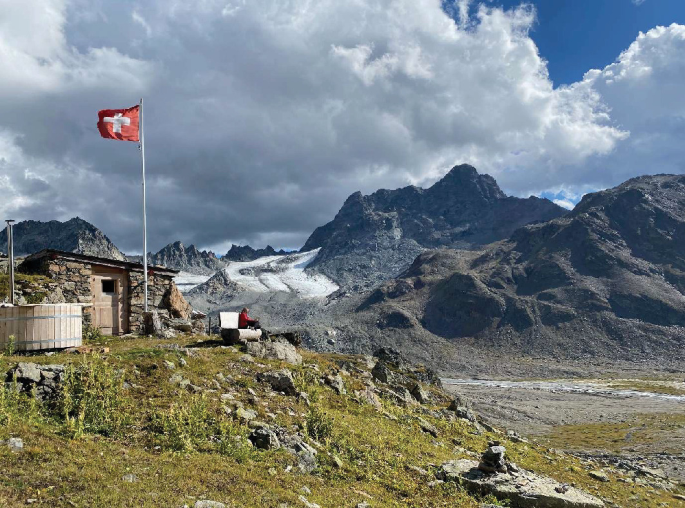
Regional climate change approaches Paris limits
Authors: Peter Stott
Journal: Nature Climate Change · DOI: 10.1038/s41558-026-02797-5
Matched topics: climate change
Abstract not available.
Archival and palaeoenvironmental documentation of extreme climate events reveals generational amnesia in collective memory
Authors: Shuang Song, Bo Hu, David Max Findley, Xutong Wu, Wei Liu, Robert W. Middeke-Conlin et al.
Journal: Nature Communications · DOI: 10.1038/s41467-026-78922-x
Matched topics: flood, drought, paleoclimate
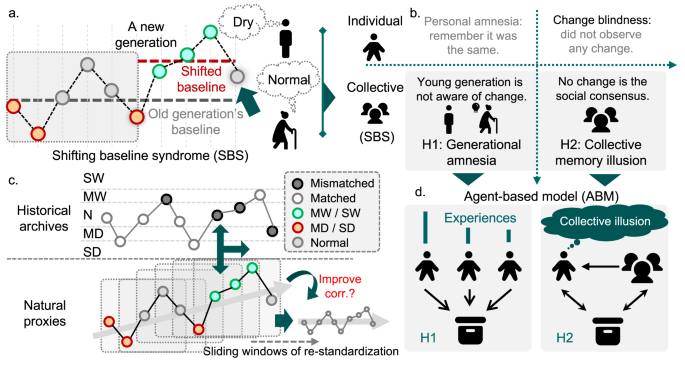
Collective memory shapes how societies respond to extreme climate events, yet long-term evidence on how the collective memory of such events becomes perceptually biased over time is lacking. Here, we utilise four centuries (1470–1900) of climatic archives from northern China, along with tree–ring–based hydroclimate reconstructions, which are validated against instrumental observations of Wet/Dry Index (1901–2000) to fill the gap. We find that historical records reveal systematic, non-random mismatches, where severity assessments are often biased toward recent experience rather than absolute climatic anomalies. Correlations between historical and natural records increase when the natural series is re-standardised using 20–40-year sliding windows, reflecting a generational offset. A heuristic agent-based model reproduces this pattern, suggesting that generational amnesia is sufficient to explain the offsets in perception of environmental change. We argue that historical archives carry a generational imprint of perceptual bias, in which the severity of climate extremes is judged against recent lived experience rather than long-term climate variability. This has implications for bias-aware corrections for risk assessment, adaptation, and paleoclimate reconstruction.
Repeated loss of the West Antarctic Ice Sheet’s Amundsen Sea sector during late Pleistocene interglacials
Authors: Claus-Dieter Hillenbrand, Werner Ehrmann, Young Kyu Park, Jinwook Kim, Steve M. Bohaty, Reed P. Scherer et al.
Journal: Nature Communications · DOI: 10.1038/s41467-026-77004-2
Matched topics: Pleistocene
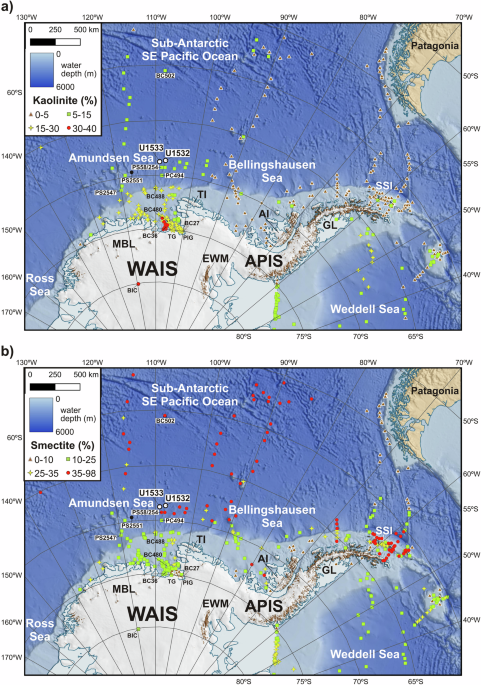
Sea-level reconstructions and numerical models suggest that the vulnerable West Antarctic Ice Sheet underwent major mass losses during the late Pleistocene, raising global sea level by several metres. However, direct evidence from ice-sheet proximal records for such retreat has remained inconclusive. Here we investigate variations in clay mineral assemblages and past ocean temperatures archived in West Antarctic continental margin sediments during the last 800,000 years. Our results demonstrate that the supply of glacigenic detritus sourced from the main outlet glaciers in the Amundsen Sea sector of the West Antarctic Ice Sheet ceased almost entirely during all previous warm periods, documenting the loss of their drainage basins. Concomitant seawater warming, revealed by a microfossil proxy, is attributed to intensified deep-water advection towards Antarctica’s Pacific margin, which is corroborated by the clay mineralogical evidence. Our findings show that ocean forcing can drive major deglaciation of West Antarctica and related global sea-level rise.
AI for Science
How AI is changing research
- Can AI actually help the climate? Nations want to harness the technology to cut emissions (Nature, 2026-11-17) — Nations are actively mobilizing AI to accelerate climate mitigation, from optimizing energy grids to improving climate models. For hydrology and water-resources teams, this signals growing institutional support and funding for AI-driven earth-system work — a good moment to demonstrate how AI-assisted streamflow forecasting, reservoir operations, and drought prediction translate into measurable emissions and adaptation dividends.
Statistics
| Metric | Count |
|---|---|
| Journals searched | 11 |
| Total papers fetched | 57 |
| Passed deterministic filter | 12 |
| After LLM relevance filtering | 3 |
| Rejected (not relevant) | 9 |
| AI for Science items picked | 1 |
Papers by journal
| Journal | Papers |
|---|---|
| Nature Climate Change | 1 |
| Nature Communications | 2 |
Filtering Criteria
Topics: hydrology, hydrologic model, river, runoff, streamflow, reservoir, water management, flood, drought, seasonal, land surface model, climate change, hydropower, surface water, irrigation, earth system model, estuary, coastal, freshwater discharge, river plume, ocean biogeochemistry, marine heatwave, paleohydrology, paleoclimate, Quaternary, Holocene, Pleistocene, fluvial geomorphology, river terrace, loess, drainage network, river capture, landscape evolution, luminescence dating
Fields: engineering, environmental science, computer science, geology, geography