Paper Harvest Report
Date range: November 16, 2026
3 top-tier papers selected out of 51 total publications
Today’s Highlights
Today’s harvest surfaces three papers spanning water security at opposing ends of the temporal spectrum. Gleick et al. (PNAS) provide a landmark analysis of global water use trends, finding decoupling between economic growth and water withdrawal in several major economies and raising the possibility that some regions have reached “peak water.” At the glacial frontier, Van Wyk de Vries (Nature Climate Change) argues that the thousands of hazardous glacial lakes now forming worldwide require the same governance frameworks applied to engineered reservoirs — a critical but under-recognized intersection of water infrastructure and climate adaptation. Rounding out the day, a Nature commentary calls for systematic monitoring of extreme marine heatwaves as El Niño builds, underscoring the need for coupled land-ocean modeling to protect coastal communities.
Table of Contents
Top-Tier Journal Papers
As El Niño builds, studies of extreme marine heatwaves must start now
Authors: Alistair J. Hobday, Kathryn E. Smith, Claire M. Spillman, Karen Filbee-Dexter, Neil J. Holbrook, Caroline Rowland, Dan A. Smale, Grant Smith et al.
Journal: Nature · DOI: 10.1038/d41586-026-03715-7
Matched topics: marine heatwave

Researchers must track warming oceans and use the knowledge gained to inform strategies for sustaining fisheries and communities that depend on them. Researchers must track warming oceans and use the knowledge gained to inform strategies for sustaining fisheries and communities that depend on them.
Peak water: Trends in decoupling regional and global water use
Authors: Peter H. Gleick, Junguo Liu, Amr Al-Zu’bi, Bruk Berhanu, Guozhong Tang, Yoshihide Wada
Journal: Proceedings of the National Academy of Sciences · DOI: 10.1073/pnas.2626255123
Matched topics: river
Water use for human activities, including food and fiber production, energy generation, and residential, commercial, and industrial supply, has grown significantly over the past century, driven by rising populations, expanding economic activity, and changes in technologies and consumer demands. Traditional narratives about water describe an ever-increasing demand for a finite resource and suggest that water scarcity will worsen over time. This paper examines long-term trends in water use globally and by region to determine if and where decoupling is occurring between water use and economic or population growth.
Hazardous glacial lakes need reservoir governance
Authors: Maximillian Van Wyk de Vries
Journal: Nature Climate Change · DOI: 10.1038/s41558-026-02796-6
Matched topics: reservoir
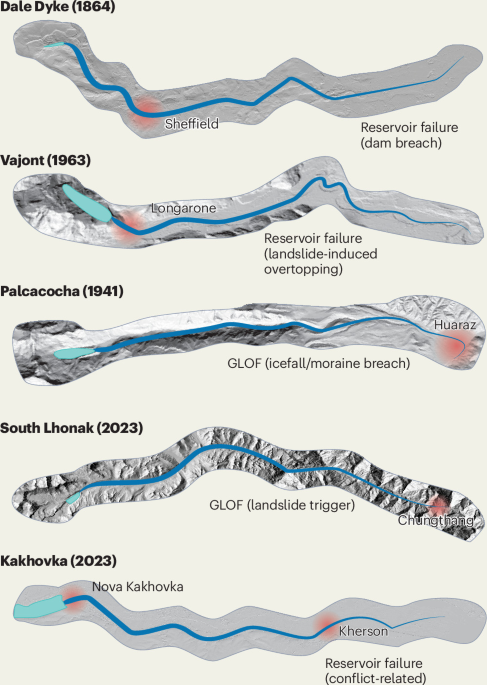
Abstract not available.
AI for Science
How AI is changing research
- Finding faster quantum algorithms with agents and formal verification (Google DeepMind, 2026-11-23) — DeepMind used teams of AI agents combined with formal verification to discover faster quantum algorithms for fusion and chemistry simulations. The methodology — agents exploring large combinatorial algorithm spaces while proofs confirm correctness — is a generalizable paradigm for scientific algorithm discovery. Earth-science modelers could apply the same approach to discover faster numerical solvers for river-routing PDEs or more efficient land-surface parameterizations, areas where manual algorithm design has been the bottleneck for decades.
Statistics
| Metric | Count |
|---|---|
| Journals searched | 11 |
| Total papers fetched | 51 |
| Passed deterministic filter | 8 |
| After LLM relevance filtering | 3 |
| Rejected (not relevant) | 5 |
| AI for Science items picked | 1 |
Papers by journal
| Journal | Papers |
|---|---|
| Proceedings of the National Academy of Sciences | 1 |
| Nature | 1 |
| Nature Climate Change | 1 |
Filtering Criteria
Topics: flood, drought, streamflow, river, reservoir, dam, water, irrigation, hydropower, runoff, basin, watershed, aquifer, groundwater, rainfall, precipitation, snowmelt, evapotranspiration, climate change, land surface, earth system, remote sensing, satellite, machine learning, deep learning, neural network, coastal, estuary, sea level, marine heatwave, Holocene, Quaternary, paleohydrology, paleoclimate, fluvial, geomorphology, loess, luminescence, OSL, drainage network, river capture, paleo, seasonal, monsoon
Fields: Earth and Planetary Sciences, Environmental Science, Geography, Agricultural and Biological Sciences, Engineering